
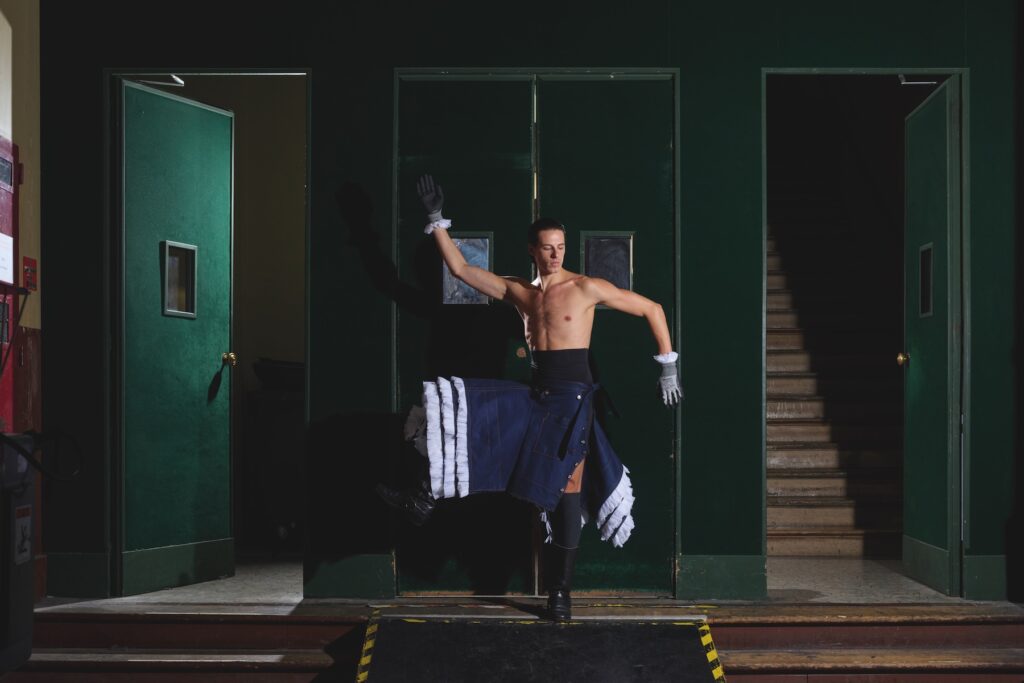
[Interview to be found in the Spring issue, on newsstands or by subscription.] The Paris Opera’s étoile dancer has put his pointe shoes aside for a fashion project that highlights a piece still too overlooked in men’s wardrobes: the skirt.
Gendered stereotypes in fashion are stubborn. For daring to wear a skirt on the red carpet at the Cannes Film Festival 2026, comedian and performer Artus found himself under fire on social media, enduring reactions steeped in backwardness, homophobia, and fatphobia. If a man wearing a skirt still shocks in 2026, the students of the Institut Français de la Mode (IFM), in Paris, have this year taken on a challenge: design a bespoke collection of skirts for Germain Louvet. We met the étoile dancer to discuss the possibilities of a garment that remains almost exclusively associated, in Western wardrobes, with the feminine.
Putting on a skirt, is that new for you?
It’s a garment we sometimes wear in dance, so it wasn’t a total cultural shock. I even own a small tennis skirt that I’ve worn several times! But the first time was destabilizing. You have air that passes between the legs, which is rather new, and you pay more attention to manspreading when you sit. [Laughter]
What interested you in this IFM student project?
The artisanal side spoke to me, but it was also interesting to see how the students perceived me, depending on which garment was made for me. For example, they drew on my social and family background to design a skirt with workwear blues and a tutu underneath, probably because they read in an interview that my grandparents were workers. Their skirts say things about my public image, but also about what it means to be a man in contemporary ballet.
The stereotyped image of the star dancer isn’t linked to supposedly “masculine” criteria. Was it difficult for you to grasp your own masculinity?
I consider gender to be something entirely constructed and highly fluid, evolving with social norms and sociopolitical dynamics. Proof is in ballet: a hundred years ago, jumping en pointe in tights was considered very manly, and it’s not the case in 2026. Today, there persists more of a stereotype around the presumed homosexuality of dancers. Growing up in this society while evolving in ballet forced me to question gender while also allowing me to free myself from it more easily.
View this post on Instagram
Sophie Brennan