
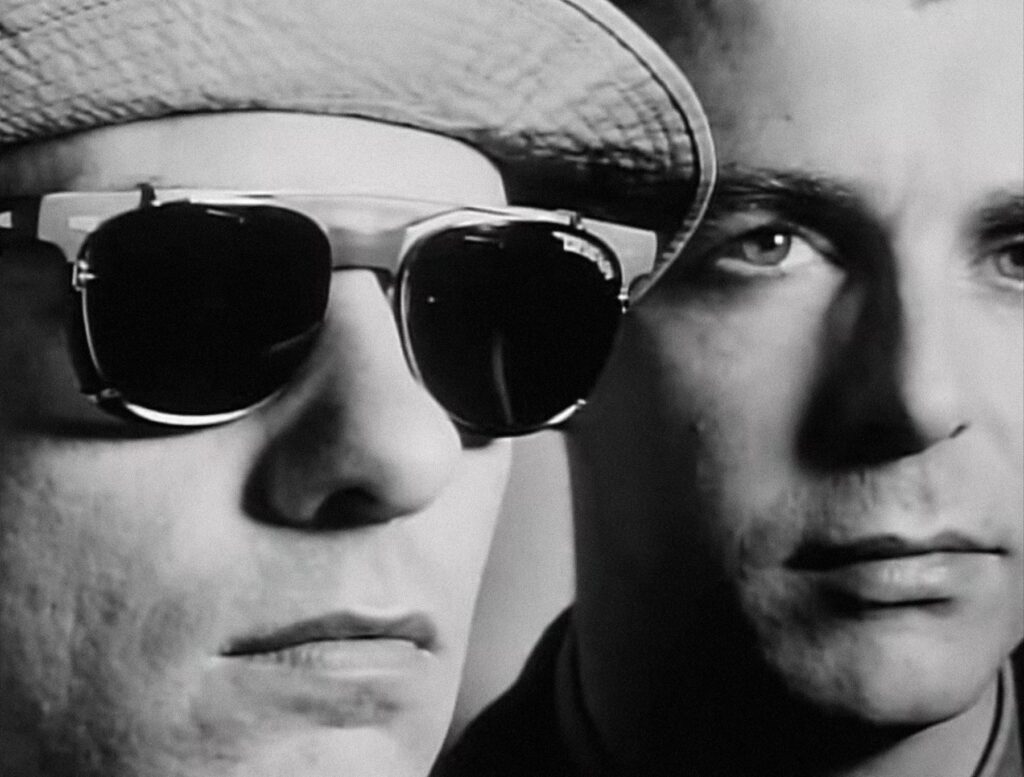
[Article to be found in the summer issue, in kiosks or by subscription.] The first album by the British synth-pop duo Pet Shop Boys, Please, is celebrating its 40th anniversary. As they are about to celebrate it with a concert at the Zenith on July 1, a look back at five landmark songs from a group that became a symbol of a gay youth dancing to conjure HIV/AIDS and Thatcherism.
“West End Girls” (1984)
Released for the first time as a single in 1984, the song found its real success in 1986, upon its re-release, becoming the one through which Neil Tennant and Chris Lowe rose to fame: it quickly reached number one in the United Kingdom, Canada and the United States. A track blending synthpop with hip-hop influence – a genre in its early emergence – “West End Girls” draws for its lyrics on the poem The Waste Land and addresses social differences, in a pure English tradition that would later be echoed by Blur or Pulp. Forty years after its release, “West End Girls” remains a hit: while it is rarely reprised in fiction or advertising, this song was streamed 70 million times on British streaming platforms in 2024, making it the Pet Shop Boys’ most listened-to track.
“Always on My Mind” (1987)
In 1987, Neil Tennant and Chris Lowe were invited to the British ITV channel for a special program dedicated to the tenth anniversary of Elvis Presley’s death. On this occasion, they covered “Always on My Mind,” a song recorded by the King in 1971, and transformed it into a Hi-NRG hit with dance-pop and disco accents. At Christmas that year, the track was the United Kingdom’s number one selling single. A particularly strong cultural marker across the Channel. Ranked among the best cover versions of all time in a BBC poll in 2014, the song features in several films cherished by the queer community, such as Matthias & Maxime by Xavier Dolan, in 2019, or All of Us Strangers by Andrew Haigh, released in France in 2023 under the title Sans jamais nous connaître. It is also heard in 2017 in a Burberry advertisement featuring Cara Delevingne and Matt Smith.
“It’s a Sin” (1987)
First single from the album Actually, “It’s a Sin” continues to explore the synthpop thread while revealing a camp, theatrical and dramatic dimension that would become a signature of the duo. The title is directly inspired by the very strict Catholic education Neil Tennant received at St. Cuthbert’s High School in Newcastle, a northern English city. “When I went to school, we were taught that everything was a sin,” the singer recalls. With a video directed by Derek Jarman, a gay artist and filmmaker who died of AIDS in 1994, it’s hard not to read this “sin” as a reference to homosexuality, at a time when the HIV/AIDS epidemic was beginning to ravage communities. In 2021, the song also gave its name to the mini-series It’s a Sin, by Russell T. Davies, which follows young gay men whose lives are upheaved by the HIV epidemic in the 1980s. A reference that would lead Olly Alexander, the series’ main actor, and Elton John to perform the track on the Brit Awards stage that same year.
“Being Boring” (1990)
From the Pet Shop Boys’ fourth album, Behaviour, released in 1990, “Being Boring” sits squarely in the pure tradition of British synthpop and new wave. Both danceable and melancholic, the song is accompanied by a black-and-white video as glamorous as it is timeless, directed by American photographer Bruce Weber, who at the time also shot several campaigns for Calvin Klein. If the title originated from a Japanese critique accusing the duo of having become “boring,” the song mainly addresses coming of age, memory, and loss. It holds a very personal resonance for Neil Tennant. “It talks about one of my friends who died of AIDS. It recalls our adolescence, our move to London, the fact that I managed to lead a life, while he fell ill”, explains the singer. He would dedicate two other tracks to this lost friend: “It Couldn’t Happen Here,” in 1987, and “Your Funny Uncle,” in 1989. Regarded by The Guardian as one of the most beautiful songs ever written about the AIDS epidemic, “Being Boring” is also often seen as one of the peaks of the duo’s discography.
“Go West” (1993)
“Go West” was first performed in 1979 by the Village People. Even though its composer has defended himself from having intended it as such, the piece quickly became a gay anthem celebrating San Francisco as a homosexual utopia. The Pet Shop Boys, who fully embrace this ode to a queer utopia, first performed it at a charity concert held in Manchester to benefit a AIDS-HIV awareness association in 1992, before releasing it as a single the following year. The duo then abandons the disco patina of the original version in favor of a colder synthpop production, whose accents recall the Soviet anthem. The video even reinterprets a whole imagery associated with communism, so much so that the song is often interpreted as a reference to the fall of the USSR, which happened two years earlier. This double reading probably explains why the track appears as much in Stephan Elliott’s Priscilla, Queen of the Desert (1994), as in Jia Zhangke’s Mountains May Depart (Beyond the Mountains) (2015). Ironically, given the known homophobia in stadiums, “Go West” has become, in adapted versions, a chant sung by football club supporters in several countries, including France.
