
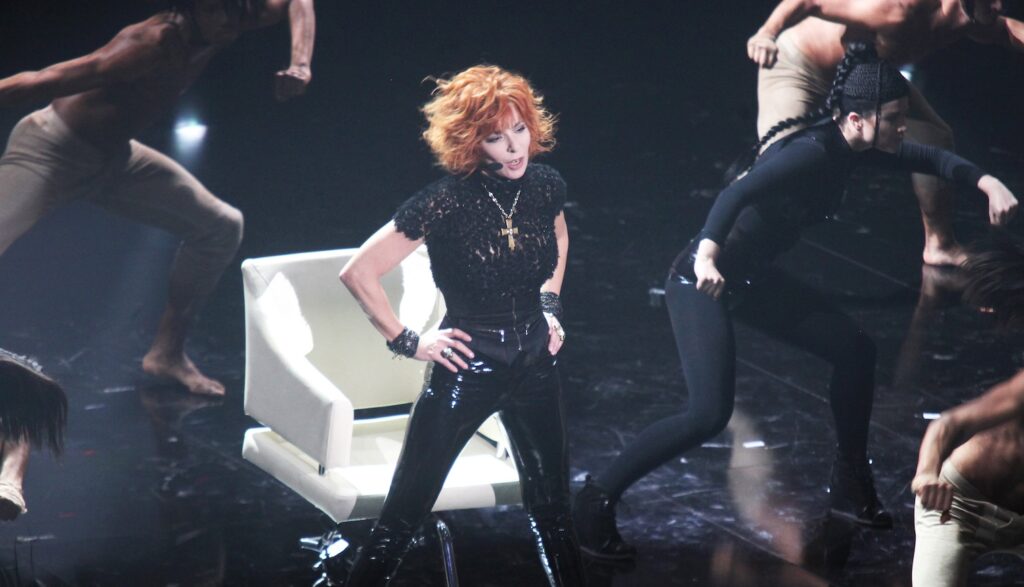
[Article to be found in the summer issue, on newsstands or by subscription.] Forty years after Moon Ashes, her first album released in 1986, Mylène Farmer continues to inhabit our fissures and soothe our nights. On the eve of a new album due October 30, behind the single “C’est à qui le tour”, her faithful speak of their flame.
Mylène has never really been a singer for us. She is a presence. A red-haired silhouette that rose on the wall of our adolescence, a tomb for our secrets and for nights that were too long. The headphones plugged in with the volume too high, and that confusing sensation of feeling different without quite knowing why. Mylène Farmer doesn’t have fans, she has devoted followers. Souls seized very early by something almost physical, before even understanding her lyrics. Sylvain, 47, co-creator of the podcast Histoires de… devoted to the artist, still remembers the shock. “My first memory is that fucking voice piercing me. I was 6 or 7 when ‘Plus grandir’ was released as a single. It is its vocal frequencies that comfort me. All of this is very chemical.”
Alexandre, 37, also fell into it as a child. “I was 8 when my sister bought Anamorphosée. Since then, there isn’t a day when I don’t listen to this album. Her music is an enchantingly looping melody to which I keep returning non-stop. She is like a confidant, someone who speaks softly in my ear.” With Farmer, there are wolves and churches, children who don’t want to grow up, boys lost at the end of the night, and girls told that “mom is wrong.” A world where many of us have learned to inhabit our own shadow.
To Life, to Love
Because Mylène often speaks from that troubled zone where desire and shame, loneliness and fantasy meet. Without ever saying everything outright. “I have the sense that she writes while being inside our heads,” says Sylvain. She manages to express her melancholy with a lot of poetry, in a way that is both rich and tortured. But my favorite songs are the ones where she says ‘Go fuck yourself’, like ‘Fuck Them All’; these are the ones that saved me from others’ scrutiny, allowed me to own my differences, in love and also physically.”
The journalist Adrien Naselli, who spent time at têtu· and who dedicated a thesis to her lyrics, reminds us how Farmer built a pop saturated with literary, religious and philosophical references. With her, Baudelaire crosses synthesizers, psalms are refrains, dark romanticism is danced in white boots. “She is above all the author of her songs, from the beginning of her career, argues Alexandre. I place her with the romantics, like George Sand or Alfred de Musset or Baudelaire, where the ideal overtakes the rational to rise.”
In the farmerian tongue, the “I” becomes porous. Everyone comes to deposit a piece of themselves there. “The ‘I’ recurs very often in her lyrics – ‘Ainsi soit je…’, ‘Je te rends ton amour’, ‘J’ai rêvé qu’on pouvait s’aimer’… notes Alexandre. This ‘I’, we adopt it very quickly.” For Arnaud Alessandrin, author of Sociologie de Mylène Farmer, it is an “biographical companionship”, a relationship that traverses the years and touches the intimate: the body, sexuality, love life, loneliness.
Pop fervor
And then, there is the voice. That way she has of whispering, of breathing the words, of pushing the high notes to the edge of dizziness. With Farmer, the songs have a liturgical quality, an erotic confession in the form of a communion. “When she hits the high notes, she transports you elsewhere,” says Alexandre. There is in her a search for the absolute. The farmerian ideal is a right to exist, to feel contradictory emotions, to be both shadow and light, emotional and sexual, religious and anti-christ.” On beds of icy synthesizers, her existential obsessions return like strange whispered prayers.
In Mylène Farmer, the Diva of Pop, the historian Isabelle Marc speaks of a “process of deification” of the singer. “Some will go to mass; me, I can very well listen to one of her albums to center myself,” confides Erwan, 40. When I saw her perform ‘Les Mots’ with Seal at the NRJ Music Awards in 2002, it felt like an apparition. She is now a fundamental pillar for me.”
@mylenien It was 24 years ago today: Mylène Farmer & Seal – Les Mots ( NRJ Music Awards 2002 )! Third year for the ” NRJ Music Awards ” which take place during the Midem in Cannes, live from the Palais des Festivals! Three appearances by Mylène Farmer that evening… First, at the start of the show, with footage of the red carpet arrivals that happened a few minutes earlier! Mylène Farmer appears very smiling, in Seal’s arms… She is wearing a long black coat designed by Isabel Marant with a skull on the back! Performance by Mylène and Seal performing the single “Les mots”! This is, to this day, the only TV performance for this title… It is the first single from Mylène Farmer’s Best-Of released on November 27, 2001 and which has seen real triumph: number one on the compilations chart in France for six weeks and already sold over 500,000 copies! The single of the same name has been available since November 13, 2001 and also enjoys success with nearly 200,000 copies sold at the date of this show… The performance of Mylène Farmer will give a second life to this single which was just starting to falter in the rankings! In the week following the NRJ Music Awards, radio airplay soars and the single climbs from 9th to 2nd place in the French singles chart… The TV excerpt is an ampex but Mylène Farmer and Seal perform on stage at the Palais des Festivals in Cannes in front of the audience! Mylène Farmer is nominated with Seal in the category “Best Duo or Francophone Group”… The trophy will go to Céline Dion and Garou for Sous le vent! Mylène Farmer will redeem herself a few minutes later, at the end of the show, by winning for the third consecutive year the trophy for “Best Francophone Female Artist” (the other nominees were: Alizée, Lââm, Hélène Ségara and Zazie) which is presented to her by Estelle Lefébure and Gad Elmaleh! The crowd chants her name… In the various shots we recognize: Alizée, Max Guazzini (then NRJ director) and Thierry Suc! #MyleneFarmer #Seal #LesMots #NRJMusicAwards #TF1 ♬ original sound – Mylenien
Cette ferveur repose aussi sur l’absence. Rare en interview, absente des réseaux sociaux, la discrète continue d’organiser sa disparition médiatique. Plus Farmer se retire, plus elle devient disponible à nos fantasmes et à nos projections. “C’est une relation unilatérale. Les fans ont le sentiment de connaître l’artiste, sans que l’inverse soit vrai, analyse Arnaud Alessandrin. Ce qui est spécifique à Mylène Farmer, c’est qu’elle ne noue pas de relation directe. Elle entretient une logique de retrait qui alimente le désir et le manque.” Ses concerts deviennent alors des lieux de communion. “Tu ne penses à rien d’autre, ça a un vrai effet antidépresseur”, décrit Erwan. Alexandre, lui, a vu la tournée Timeless dix fois. “C’est un rituel pour moi d’y retourner. C’est la même émotion à chaque fois, même si je connais le spectacle par cœur : une joie intense.”
Pauvres pécheurs
Dans les années 2000, les forums consacrés à Mylène Farmer deviennent des lieux de sociabilité queer. On y échange des enregistrements pirates, des photos et vidéos de concerts, des analyses des paroles de la chanteuse, disséquées ligne par ligne. Beaucoup y ont rencontré leurs premiers amis gays, voire leur amoureux. Dans les files d’attente des concerts, on échange des places et des souvenirs. Il y a les fans qui étaient à Bercy 1996 et qui ont pu assister à son arrivée suspendue à une immense araignée, et il y a les autres. Ceux qui connaissent par cœur les gestes du Mylenium Tour, les silences de Timeless ou les larmes d’Avant que l’ombre… Et ce cri, qui surgit de la fosse : “Mylène, on t’aime !” Même lorsqu’on n’y était pas, ces images circulent, talismans hérités qui forgent une mémoire commune.
Mais cette dévotion peut aussi révéler des solitudes immenses. “Des personnes blessées ou coupées de leur famille font de Mylène l’élément essentiel de leur vie, c’est un peu triste”, observe Erwan. Pour beaucoup d’entre nous, pourtant, Mylène Farmer a aussi été un langage commun. Jean-Baptiste, 41 ans, se souvient des forums des années 2000 : “Mylène a aussi été un canal d’émancipation sur Internet, où ses fans étaient principalement gays, ce qui m’a permis de me faire des amis.”
Parfois, la frontière entre admiration et intimité finit par se brouiller. “J’ai cherché à la rencontrer, confie Alexandre. J’ai su où elle habitait, je me suis posé, comme d’autres, sur les bancs en face de chez elle. J’espérais l’apercevoir. Ça fait vingt-cinq ans que je suis fan, je comprends désormais la femme qui est derrière l’artiste. Et c’est elle que j’aime. C’est quelque chose de très intime.” Chez Farmer, la confusion entre présence artistique et présence affective semble presque inévitable. Comme si elle avait fini par occuper une place trop profonde dans nos vies pour rester complètement inaccessible. “Partout, c’est fou, je te sens près de moi…” Une présence insaisissable, à laquelle confier ses fantômes.
