
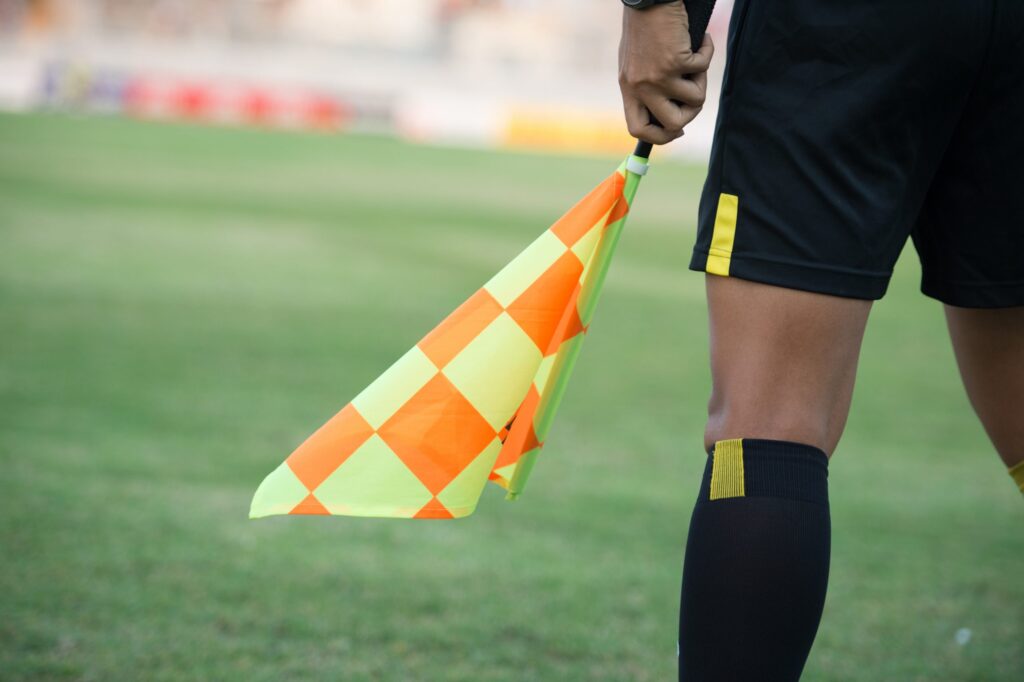
Homophobic chants, tensions around the LGBT flag, absence of openly gay players… On the occasion of the 2026 World Cup, Julien Pontes, spokesperson for Rouge Direct, notes that football still struggles to apply its own anti-discrimination rules.
The men’s FIFA World Cup is in full swing in North America (the United States, Canada and Mexico). But several queer supporter groups have decided not to attend for safety reasons, homophobic chants were heard in stadiums during some matches, and Iran opposed LGBT flags during the “Pride Match” against Egypt. In short, homophobia still runs rampant on the pitches… The point on this Sisyphean struggle with Julien Pontes, co-founder of the anti-homophobia collective Rouge Direct and author of a book on the subject to be published in August, The League of Homophobes.
Rouge Direct reports weekly on homophobic chants and remarks heard in stadiums, and this applies in Ligue 1 as well as at the World Cup…
Julien Pontes : At the World Cup, we are witnessing on a grand scale what is happening in French football. We must apply FIFA’s zero-tolerance protocol against discrimination, which provides for stopping the match in the event of homophobia. There is then a first announcer’s announcement to warn that if those chants do not stop, the match risks being permanently interrupted. It is a reasonable protocol, it exists, but it is not being applied.
You propose, with deputy Danièle Simonnet, to enshrine in law a “result obligation” for clubs: what would that change?
This is the solution that seems to us the most effective and accessible to put football clubs face to face with the disorder provoked by their supporters. This proposed law by Danièle Simonnet aims to insert in the sports code a ruling from the Conseil d’État that already imposes this obligation of result. Concretely, this would make the automatic application of the regulation. Because a decision of the Conseil d’État can be overturned by an administrative decision. When it’s in the law, it’s more solid: failure to comply = sanctions. We are not asking for anything extravagant, this bill should have been signed by hundreds of deputies and supported by the Minister of Sports! But ultimately nothing happened.
We do not hear from the Minister of Sports, Marina Ferrari, on LGBT+ issues: what is your relationship with her?
We sent her a letter on January 2, with Inter-LGBT, Stop Homophobia, SOS Homophobia, the LGBT+ Federation, Football Paris-Arkansas and Paname Pride. We wanted to request a meeting, notably about our demand to inscribe in the sports code this obligation of result. We had an initial meeting with her office in February; we were supposed to meet the minister in April, but we did not receive a meeting proposal. So we followed up; we were to meet her on May 14, and she canceled that appointment… It is an insult to the LGBT+ community. We speak of an important LGBT+ coalition, with major players in the fight against homophobia, and we still have not been received! We have never seen this. The minister refuses to fight homophobia in football.
This year, the Ligue de Football Professionnel (LFP) abandoned rainbow colors for the Pride day. Did that discourage you?
That operation was interesting, but it required accompanying the players so they understand at least the meaning of the action. There was groundwork to do with the LFP, but they chose to abandon it and to congratulate themselves on the new campaign, which invisibilizes the fight against homophobia by gathering all discriminations. We did everything we could to denounce this abandonment, but no one responded. The LFP threw away 15 years of anti-homophobia work.
When the French Football Federation (FFF) organizes a Pride tournament, is it an important moment in your view?
The impact is minimal. If a professional player had shared the Pride tournament on his social networks or had been present that day, it could have produced interesting visibility. But the urgency mainly arises when supporters cause disorder in the stadiums, from the Vélodrome to the Parc des Princes. It is there that fighting homophobia makes sense.
You were expecting statements from the FFF or players on the occasion of the first match of the Blues against Senegal, where anti-LGBT persecution is taking place. Nothing happened—what do you say about that?
Anti-LGBT criminalization in Senegal has dramatically worsened since March. That would have been a strong signal, and a statement that would have flowed naturally since we share a history with that country. But obviously it did not happen. It is at once not surprising and very discouraging.
The World Cup Pride Match fell on the Iran-Egypt match. An ironic paradox…
These countries are among the worst regarding LGBT rights, but we would be wrong to focus on this match, even if they deserve it. This big spotlight on them should not be a way to excuse the responsibility of the 64 other countries in the world that criminalize homosexuality. The stakes are much higher.
Professional football still seriously lacks openly gay representation. If you were an active player, would you come out?
Given current conditions, it would be too risky. How could a gay player, in this context of the banalization of homophobia, take such a risk? It would risk the sudden collapse of an entire career, all the sacrifices made often since childhood. If I were to do it, it would certainly be at the end of my career.
Whom do you support during this World Cup?
I quite like Germany’s team led by Manuel Neuer, which has taken very clear and firm positions against homophobia, and for a long time.
