
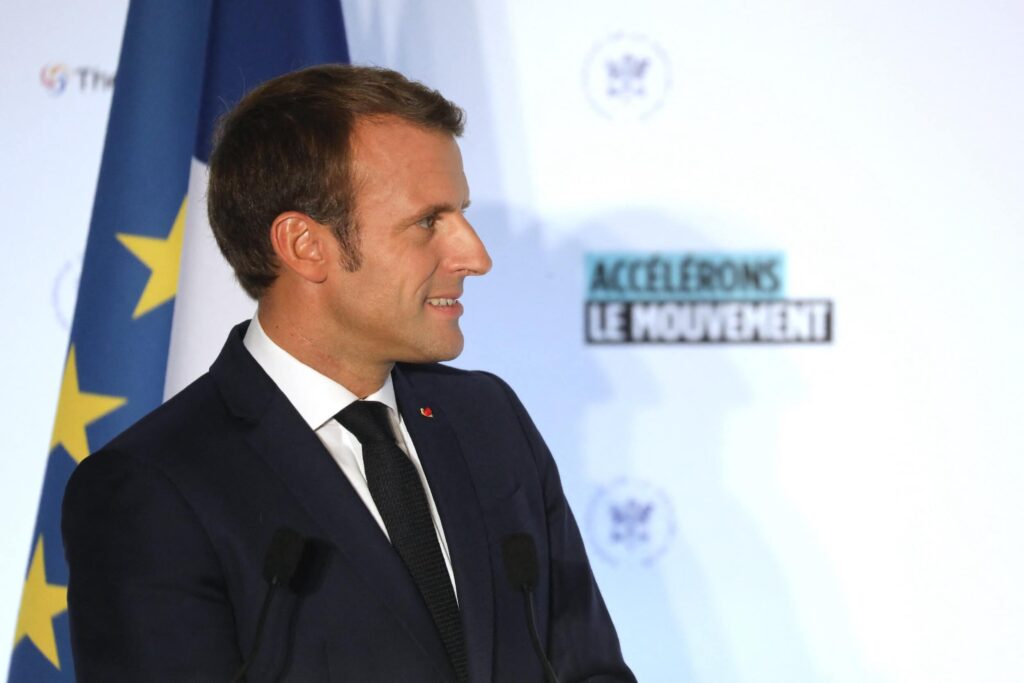
The government confirmed to têtu· the sharp decline of France’s contribution to the global fight against HIV/AIDS, which drops it from second to fifth place. In 2019, Emmanuel Macron nonetheless delivered an urgent speech: “We do not have the right not to be at the rendezvous.”
We hoped for a rebound, in vain. Mid-February, franceinfo announced a 58% reduction of France’s multiannual contribution to the Global Fund, the main financier of HIV/AIDS advocacy groups. In the absence of official confirmation, one might expect a correction by April 7, the date on which Emmanuel Macron is due to open in Lyon the One Health Summit, an international health summit. But the Ministry of Foreign Affairs confirms to têtu· this clear cut: “Overall, for 2026-2028, France aims to contribute 860 million euros to the Global Fund and to Unitaid combined”, the Quai d’Orsay tells us.
Thus, a reduction of more than half (54%) of France’s contribution is announced: during the last multiannual cycle (2023-2025), France had committed 1.6 billion euros solely for the Global Fund, in addition to 255 million euros allocated to Unitaid. Government explanations: “Heavy constraints currently weigh on our public finances. The government has set the objective of containing the public deficit at 5% in 2026, which requires significant budgetary efforts.” And the Quai d’Orsay nevertheless assures: “Health remains one of the first priority sectors of our social and solidarity investment policy.”
“The Sad Path of Donald Trump”
“France’s resignation”, denounce in a joint press release nine associations fighting HIV. “France abandons and kills millions of people”, accuses Camille Spire, president of AIDES. “France is taking the worst cut of all the G7 countries and is deserting the global fight against pandemics and global health”, adds Florence Thune, head of Sidaction.
On the political side, the National Assembly voted on February 3, unanimously of the 135 votes cast, a resolution calling for the “maintenance of financial mobilization (…) in the global fight against HIV/AIDS”. “I hope the government will realize this and reverse its decision”, pleads the author of this non-binding text, Socialist deputy Arthur Delaporte, co-chair of the HIV study group, who laments: “The government chooses to follow the sad path of Donald Trump.” Since the return of the reactionary president to the White House, the United States, the world’s leading funder of the fight against HIV/AIDS, has indeed fallen from 6 billion to 4.6 billion dollars, weighing heavily on field actors.
RIP the End of AIDS by 2030
“This decline is contradictory to France’s standing in global health. While we have always been drivers, we are now lagging”, notes to têtu· Vincent Leclercq, general director of Coalition Plus, a network of about a hundred HIV organizations spread across 50 countries. While France was the second global contributor, it slips to fifth place, behind the United States, but also Germany and the United Kingdom which have not fallen below the 1-billion-euro mark, and even behind the Gates Foundation which pledged 788 million euros.
In 2019, when France hosted in Lyon the sixth conference on the Global Fund to Fight AIDS, Tuberculosis and Malaria (its full name), President Emmanuel Macron had nonetheless delivered a strongly proactive speech, considering that it was not about “helping (but) deciding, investing against injustices” and promising: “The eradication goal by 2030 is achievable, it is achievable if today we meet our responsibilities. (…) And we do not have the right not to be at the rendezvous.”
“Who can still believe in an end to the HIV/AIDS epidemic by 2030?” now asks the organization Actions Traitements. What was an achievable objective a few years ago has become impossible in a short time. The decision by the United States to halt funding for vital programs in 2025 and the French decision (…) already signal a resurgence of the epidemic in certain regions.” In total, the Global Fund to Fight AIDS, Tuberculosis and Malaria, which hoped to raise 18 billion dollars of funding for the next three years, will have to settle for less than 13 billion.
