
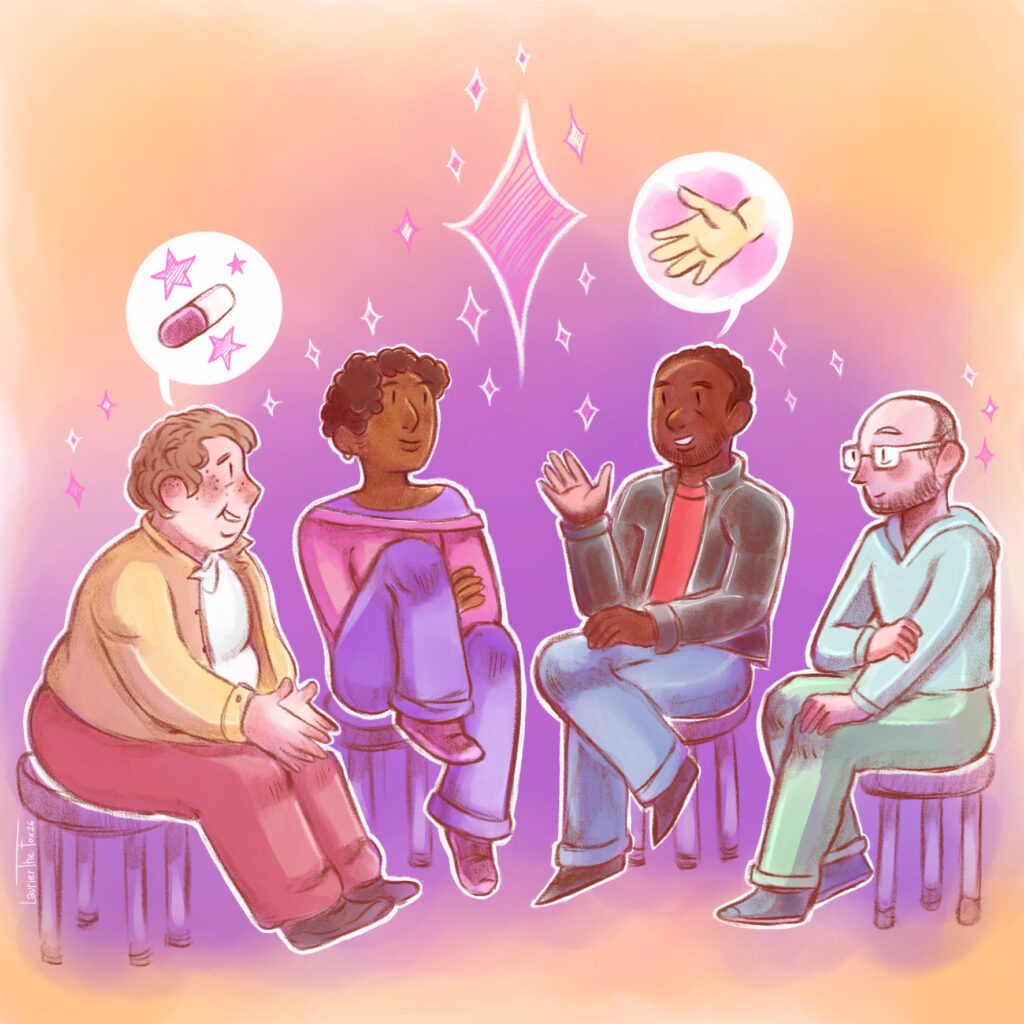
When chemsex practice becomes problematic, peer support allows non-judgmental examination of drug use in a sexual context or to sustain one’s sobriety journey. But joining a talk group can feel intimidating when you’ve never set foot in one. On the occasion of Useful April, we did it for you.
Illustration: Laurier The Fox for têtu·
“So, is it like in the movies?” The question often comes up when discussing talk groups on addiction and dependence. It must be said that American culture is not shy about depicting this stereotype: a group of people at the bottom of the barrel, seated in a circle on chairs in a drab room with questionable lighting, confiding in turn to garner encouragement from the collective.
To get a feel for reality, therefore go to La Bulle, in the Marais district of Paris, home of LGBTQI+ Solidarity where the Chems Pause association offers chemsex users every Friday evening a talk group “providing a space for a caring exchange where everyone can share their experiences, express themselves freely and find support” from other concerned individuals.
7:30 p.m., voices begin to open up
The room that welcomes us isn’t particularly large, but large enough to accommodate about thirty people. As is proper, participants are seated in a circle, and while the decor isn’t very warm, the welcome is. Some of the men present seem to already know each other, and await the session’s start by exchanging smiles and some small talk.
At 7:30 p.m., the door closes. The group facilitator invites us to silence and introduces himself as a sex therapist, before moving on to the rules to ensure a safe discussion space:
- – avoid any form of judgment, particularly about consumption habits or sexual practices
- – prioritize the confidentiality of those present (you can, in fact, introduce yourself under a pseudonym)
- – practice active listening when another participant speaks
- – do not force anyone to speak
- – do not explicitly name substances or specify the modes of consumption in order not to trigger craving, i.e., an irresistible urge to use
One by one, everyone introduces themselves more or less briefly, giving the reason for their presence. A moment that Hollywood films and series do not show us: collective brainstorming. The facilitator then invites group members to suggest themes related to chemsex and addiction that they would like to address that evening. How to manage craving? How to reclaim a sexuality without products? How to recover after a relapse? All the suggested ideas are noted on a board and then, by a show of hands, two themes for the session are chosen. The floor can start to turn.
Here, as in school, you raise your hand to signal your wish to speak. The most talkative quickly signal themselves, the shy observe with cautious reserve. The distribution of speaking time, however, remains balanced, thanks to the facilitator who ensures that every willing participant can take part in the exchanges. For those without a confidant to confide in, the group is a space to let loose. Some manage to speak about their traumas with ease, whether related to childhood, abusive relationships, or sexual assaults suffered in a chemsex context. When a member ventures to generalize their personal experience or strays a bit too far from the chosen theme, the facilitator steps in to provide clarifications or steer the conversation back.
9:30 p.m., the group grows closer
After an hour, there is a break. An opportunity to socialize or continue the discussion in a small group while nibbling on candies picked up from the table in the corner of the room. The participants present a wide variety of profiles: they are 20 to 60 years old, some have been abstinent for several years while others used last weekend. After about ten minutes, everyone returns to their seats, and we begin the second theme of the evening. As the end of the session approaches, at 9:30 p.m., the facilitator offers a ceremonial farewell: one by one, each participant reiterates their first name and highlights what they took from the session and may, if they wish, punctuate their final contribution with an “I love myself”. We find here the famous clichés of the talk group, but in reality, these are words not so easy to pronounce… Many participate, some abstain, and some dodge with an equally touching “I love you all”.
At the end of this session, it is clear that the initial apprehensions have evaporated over the course of the discussion, peer-to-peer conversation pushing shame out of the talking circle. And this is precisely the secret of these talk groups, whose effectiveness does not reside so much in the topics discussed, often repetitive, as in this feeling of mutual recognition and mutual aid. Here, thanks to experiences that echo one another, everyone speaks the same language. A valuable community of experience when the non-user circle around you, even well-intentioned, often struggles to understand the mechanisms of addiction, particularly chemsex.
