
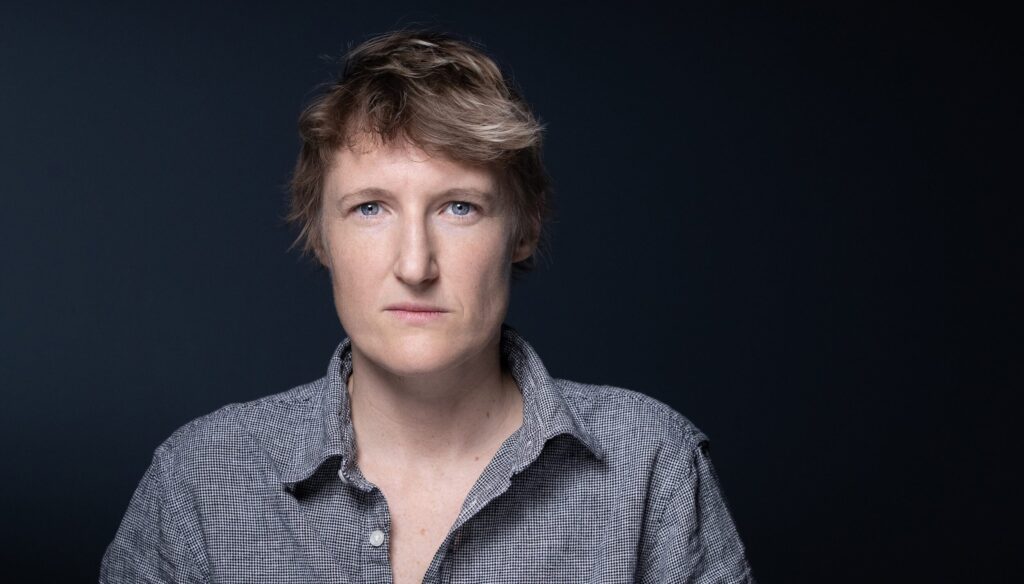
The activist Alice Coffin claims that far-right voting concerns mainly gays, while lesbians would take no responsibility for it. The poll she comments on, conducted by Ifop for têtu·, does not say this, on the contrary. Decoding.
“LGBT people who will vote for the far right, it’s mainly the gays.” Questioned by the Instagram account SimiliQueer at the festival of the Ideal Libraries in Strasbourg, where she came to present her book The Camp of the Good, the lesbian activist Alice Coffin, former journalist and ex-green elected official of the Paris City Council, contrasted the electoral behaviors of gay men with those of lesbians.
The publication relies on a figure from the Ifop poll for têtu· conducted in February 2026: 32% of LGBT people who expressed an intention to vote choose a far-right candidacy for the 2027 presidential election. “How did we get here, as a community?”, asks the author of Lesbian Genius, who offers this black-and-white explanation: “Sorry gays, but you’ll have to take responsibility because it’s not exactly like that in the lesbian community.” But the survey data do not support this claim. Its results even lean more toward the opposite, with methodological limitations that deserve to be clarified.
LGBT voting intentions: what the Ifop poll shows
In the scenario tested by the poll for the first round of the 2027 presidential election, Jordan Bardella thus collects 25% of voting intentions among gays, versus 37% among lesbians. In the scenario tested by the poll for the first round of the 2027 presidential election, Jordan Bardella thus collects 25% of voting intentions among gays, versus 37% among lesbians. Éric Zemmour obtains 4% of voting intentions among gays, against none measured among lesbians. The total therefore reaches 29% among gays and 37% among lesbians, i.e. a gap of 8 points. Nicolas Dupont-Aignan, also included in the Ifop’s “radical right” bloc, obtains no voting intention in either group.
Reading these results, however, requires understanding how a survey is built among LGBT people. Studying a minority population indeed requires a starting survey wide enough to identify a substantial number of concerned individuals. To be able to assemble a sample of 1,137 LGBT individuals surveyed, Ifop first had to establish a nationally representative sample of 10,196 adults. But the more responses are broken down inside this set, the smaller the counts become and the greater the uncertainty. The survey thus counts 434 gay, bisexual or pansexual men and 322 lesbian, bisexual or pansexual women. If one then isolates only gays and only lesbians, these counts fall to 214 and 78 respectively, even before considering those who expressed an intention to vote.
Comparing the different letters of the acronym is thus already an exercise that requires care. But in this case, Alice Coffin makes the data available say the opposite of what they show. A broader comparison between gay/bisexual men and lesbian/bisexual women, which allows for larger samples, does not go further in her favor: voting intentions for the far-right bloc reach about 27% among men and 26% among women. An almost equal split.
The RN’s growth is more marked among lesbians
The previous Ifop poll for têtu·, conducted for the 2022 presidential election, allows extending the comparison. Marine Le Pen already collected 21% of voting intentions among lesbians, compared with 16% among gays. But Éric Zemmour obtained 14% among the latter, against 3% among the former. With Nicolas Dupont-Aignan, credited with 1% and 3% respectively, the “radical right” bloc thus reached 31% among gays and 27% among lesbians. The latter thus considered voting more for the National Rally (RN).
These results require the same precautions as those of our 2027 poll. Yet their comparison reveals a more marked progression among lesbians. The RN thus rises from 21% to 37% among them, compared with 16% to 25% among gays: a 16-point rise, versus 9. For the entire “radical right” bloc, voting intentions rise from 27% to 37% among lesbians, while they remain relatively stable among gays, from 31% to 29%. Both surveys therefore suggest a dynamic different from the one described by Alice Coffin. Under no circumstances do they confirm her portrayal of things.
Beyond LGBT voting alone, research on the entire electorate also invites us to relativize the idea of a RN vote being essentially male. Political scientists Anja Durovic, Nonna Mayer and Noémie Piolat studied voting behaviors by gender, based on a survey carried out with 5,109 people after the 2024 legislative elections. Their work, published in 2025, shows no significant difference between women and men in RN voting in the first round, including among 18- to 29-year-olds. In the 2024 European elections, women even voted more for the RN list than men. These works concern the whole electorate and do not allow conclusions specifically about lesbian voting. They do, however, show that the idea of a lower propensity among women to vote RN can no longer be taken for granted in France.
