
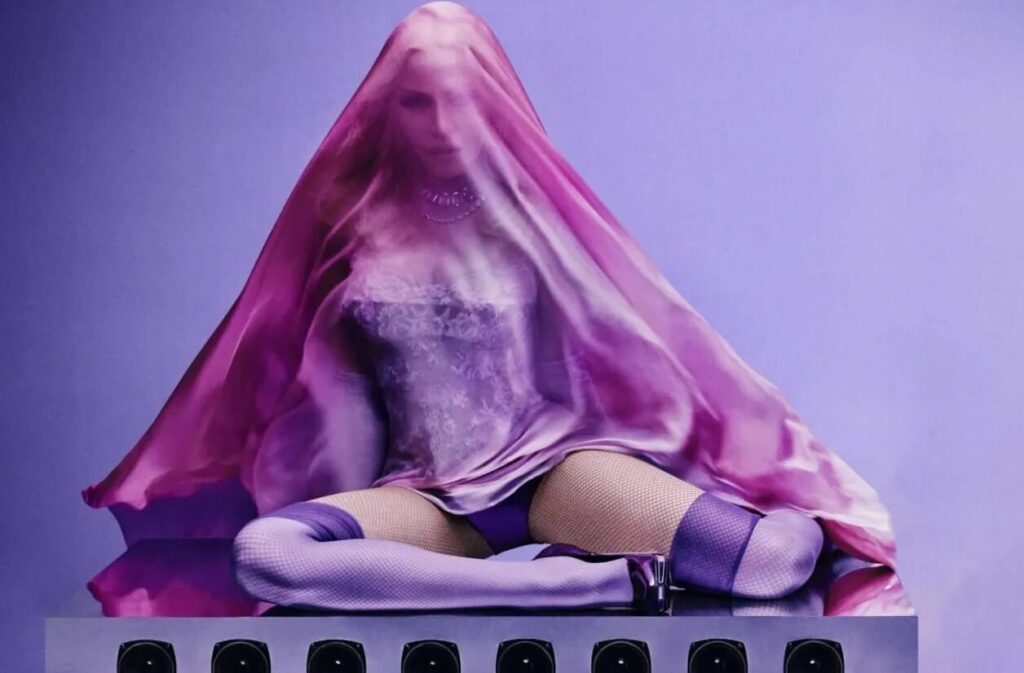
With her new album, a sequel to the mythical Confessions on a Dance Floor, Madonna continues to speak to her era, reinvigorates the dance floor with vigor, and delivers arguably her best album in twenty years.
We are in 2005. After already more than twenty years of a career, Madonna reaches a new summit with Confessions on a Dance Floor. The album, propelled by the unstoppable Hung Up, sells ten million copies and makes the whole world dance. Since then, the Queen of Pop has lived several lives, and so have we. A global pandemic, new wars and a suffocating political context have redefined our world. “I told myself that the world was going through a very dark period and that people needed to dance”, she simply confides in Interview Magazine.
The star of your favorite pop icon thus offers a sequel: Confessions II. A potentially risky move, since it places expectations at the level of the first opus, two decades later. To give herself every chance, Madonna reunites with Stuart Price, the producer of the first Confessions, which presents another risk, that of repeating herself. One would misjudge our pop diva. At 67, the singer does not look only backward: she uses her own past to converse with the present.
An Eye Back
To kick off this new era, last April 17, Madonna took the stage at Coachella alongside Sabrina Carpenter, Gen Z’s superstar. Together, they unveiled Bring Your Love, the album’s first official single. With this dance duet perfectly calibrated for radios, it’s already a matter of transmission, a symbolic passing of the baton between a pop queen, already in the history books, and the next generation. This will to stay rooted in her era runs through the entire record. Stuart Price never tries to redo Confessions on a Dancefloor. The productions flirt with house, the EDM or contemporary dance, while Madonna surrounds herself with artists from several generations. The Dutch DJ Martin Garrix electrifies Bizarre, the Colombian Feid lends his voice to Read My Lips and, more unexpectedly, Lourdes Leon shares with her mother The Test, a poignant dialogue about their relationship tested by fame.
But Confessions II looks as much forward as backward. With more than forty years of a career, Madonna turns her own legend into raw material. She mentions her first love, Sean Penn, in Bizarre, returns to her conflicted relationship with her mother-in-law Joan Ciccone in Betrayal and delivers the most heartbreaking track on the album with Fragile, a tribute to her brother Christopher Ciccone, who died of cancer in October 2024. In My Sins Are My Savior, a duet with Stromae built around a sample of Justify My Love, she also revisits her reputation as a provocateur. In French, she sums up four decades of scandals in a few lines: “I wasn’t lost, I was just broken / They tried to bring me down / I don’t care, my sins are my saviors…”
Madonna/Mylène, the Same Fight
This dive into her memory peaks with Danceteria, perhaps the most fascinating track on the record. Madonna revives the New York that saw her rise as an artist. The title indeed refers to the nightclub where she had entrusted the cassette of Everybody to DJ Mark Kamins in 1982. In a rap that echoes the verses of Vogue, she summons the ghosts of Keith Haring, Martin Burgoyne, Jean-Michel Basquiat, Maripol, or the B-52’s. More than a nostalgia exercise, Danceteria becomes a love letter to a world of yesterday devastated by the AIDS crisis, but whose pioneering energy continues to infuse her music. This journey through time nourishes all of Confessions II. To speak of the present, Madonna references herself without ever confining herself to nostalgia. The electronic colors of Ray of Light resurface in One Step Away, Fragile or L.E.S Girl. The atmosphere of Bedtime Stories and of Erotica surfaces in Love Without Words.
Deep down, Confessions II precisely succeeds at what its title promised. It extends Confessions on a Dance Floor without trying to reproduce it. Madonna does not use her past as a refuge but nostalgia as a momentum. In a world that she deems more anxious than ever, she pits synthesizers against fear-mongering discourse, clubs against cultural wars, and dance against despair. The echo of this message is strikingly similar to Mylène Farmer’s, three years her junior, in her latest single “C’est à qui le tour”… Twenty years after Hung Up, Madonna does not dance to forget the world. She dances to resist it. At 67, where many icons end up celebrating their own legend, she continues to write it.
