
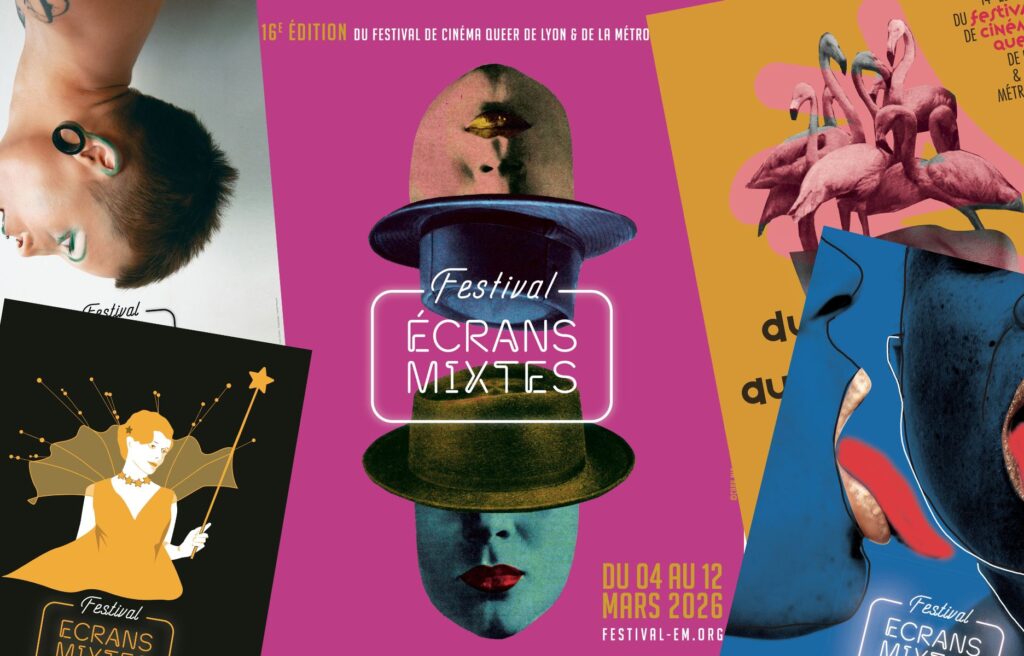
Created in 2011, the Écrans Mixtes festival in Lyon highlights queer cinema in its beautiful diversity. As its 2026 edition, the sixteenth, runs until March 12, we meet Olivier Leculier, its president, and Ivan Mitifiot, its artistic director and programmer.
This year, the Écrans Mixtes festival blows out its sixteenth candle: it has found its audience! Have you identified who it reaches?
Olivier Leculier: It is hard to identify a single audience for this festival, because we offer a wide palette of cinema, ranging from classic fiction film to underground documentary. One thing is certain: the audience trusts us. We have reached a level where we can now afford to present more specialized screenings. This year, for example, we chose for the festival’s opening an Iranian film made clandestinely and a fifty-six-minute documentary for the closing. Écrans Mixtes keeps widening its audience, with cinephiles and, of course, queer people, but also many students or simply curious people. The festival aims to be universal, and the audience reflects this intention well.
How is the selection of films screened carried out?
Ivan Mitifiot: Our mission is to have a 360-degree view of the world. Each year, we tour the festivals to sense the mood: Cannes, Venice, Brussels, Paris… And then there is substantial research work, especially to uncover more militant films and documentaries.
Do your selection criteria evolve over the editions?
I. M. : Certainly! We adapt to the world. When we compose a program, it’s not just about putting films into a box, but about telling a story with editorial choices. This year, we counted no fewer than 31 nationalities represented, with, in particular, an emergence from the Balkan countries where women are now taking the camera to express themselves, to say they have had enough of patriarchy and religious oppression. The harsher the world, the more artists resist through cinema. Our role is to give visibility to these works.
To what extent does geopolitical current events influence the programming?
I. M. : By definition, we are a political festival. When we choose to screen a decolonial documentary or another on the anarchist community, it is obviously political. In 2025, we created a new section, “La Fabrique queer”, devoted to self-produced militant cinema. Within this section, there are fascinating documentaries on ethical porn, on squatters, on a queer punk band… We observe that geopolitical current events bring more variety in the topics addressed.
Over the editions, you have integrated public partners, with Pass Culture awards, but also private ones, with a Grand Prix awarded in association with Mastercard (also a partner of the Cérémonie des têtu·). Are public subsidies no longer enough to fund such a festival?
O. L. : Securing funding is necessary to maintain a certain quality and to keep inviting international filmmakers. This year, we welcomed artists from Greece, Italy, India, Mexico… It is a real commitment on our part, for example, to bring young filmmakers to defend their first short film. But public funds for culture were lacking, so we had to knock on the doors of potential private partners.
I. M. : Partners have become indispensable, especially when we wished to grow the festival by adding a competition. Moreover, we have managed to create a stable economy, with offices and a two-person staff. It is modest compared to other festivals, but I feel that we project the image of an event with three times its real budget!
In recent times, notably in the wake of Trumpism, we have seen brands proclaiming themselves our allies drop the LGBTQI cause. Have you received worrying signs in this regard?
O. L. : Our partners have always shown stability. We were on the same wavelength from the start, in a real relationship of trust and respect. I want to emphasize that we do not accept their money without scrutinizing their commitments! In this case, we can easily defend the partners we see on our communication materials.
I. M. : We are indeed not at all in pinkwashing: the companies that partner with us are also those that internally work on fighting discrimination and homophobia. Our biggest partner, Mastercard, immediately joined the Grand Prix project that highlights independent artists, often from countries where they are blocked. Thanks to this support, we were able to give it 10,000 euros, half of which goes to the artist and the other half to the distributor who commits to a national release. Since many queer films do not get released in theaters, we thus provide means to rectify the situation.
