
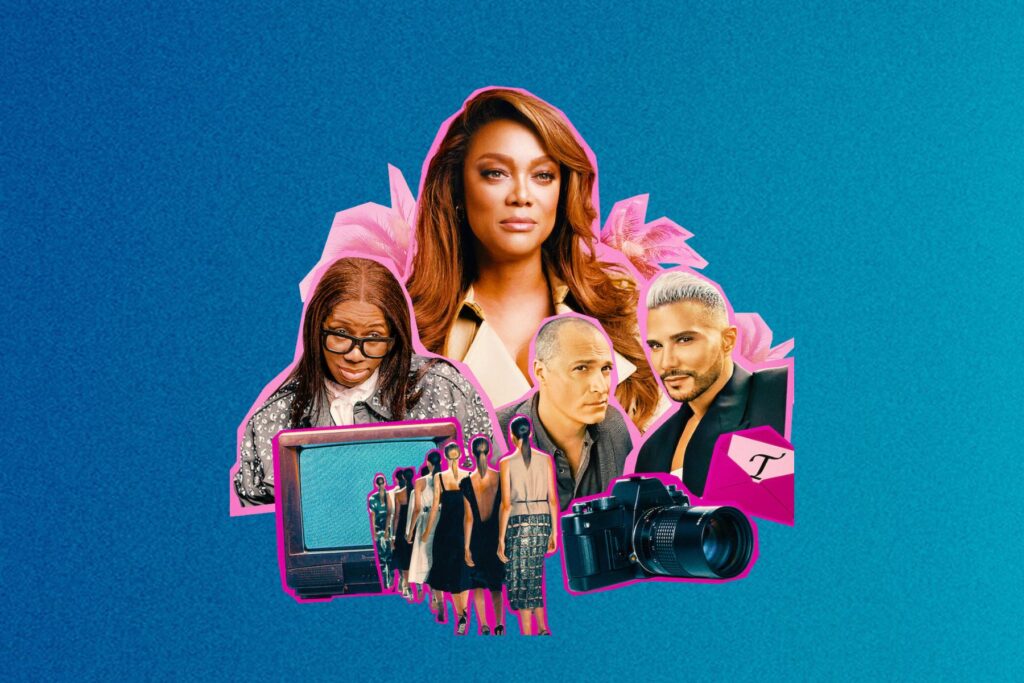
The three-episode documentary Top Model USA: The Dark Side of the Dream, released on Netflix since February 16, revisits a not-so-glorious chapter of early 2000s television: Tyra Banks’s reality show America’s Next Top Model.
Considered innovative at its 2003 inception, the show America’s Next Top Model is today reread with a very critical eye, joining television’s annals as a paragon of violence and humiliation on screen. The documentary Top Model USA: The Dark Side of the Dream (Reality Check: Inside America’s Next Top Model), broadcast on Netflix since February 16, reveals the behind-the-scenes of this machine that crushes aspiring top models.
Before RuPaul transformed drag into a global cultural machine, there already existed another television laboratory where bodies, personalities and dreams were shaped in front of an unforgiving panel. What we celebrate today as the format that revolutionized drag culture was born as a parody: RuPaul’s Drag Race was conceived as the drag version of America’s Next Top Model, one of the most influential and questionable reality shows on early-21st-century television.
In 2002, Tyra Banks, supermodel turned visionary producer, decides to translate the inaccessible world of fashion into the language of reality TV. The formula is as simple as it is effective: blend the competitive structure of American Idol with the emotional survival of Survivor. Ten young hopefuls share an apartment in New York, week after week subjected to increasingly extreme modeling challenges. It is not just about learning how to pose: one must withstand the pressure, constant exposure, and virulent judgments. The phenomenon is immediate. The show stayed on the air until 2018 and gave birth to numerous international adaptations, including a French version broadcast on M6 under the title Top Model.
Over the years, and especially during the 2020 lockdown, the early seasons resurfaced on the Internet in a new light. What was presented at the time as pedagogy now reads as an uncomfortable archive of televised humiliation. The audience no longer watches to be inspired but to be outraged. Deliberately impossible challenges, blatant intrusions into the contestants’ privacy, remarks about weight, race, gender, or sexuality transformed into spectacle. What was praised in the 2000s as daring and innovative is now revisited as structural violence disguised as entertainment.
To dissect this embarrassing legacy, Netflix mobilizes one of its specialties: the confessional documentary that promises to reveal “what really happened.” In three episodes of about an hour each, Top Model USA: The Dark Side of the Dream reconstructs the phenomenon from the inside. The narrative revolves around interviews with directors, crew members, former contestants, and even Tyra Banks herself.
The documentary also gives a voice back to queer voices who crossed the show from its early seasons, and they were surprisingly numerous. Among them, Ebony Haith, a contestant in the first edition, the only Black contestant and openly lesbian in her cycle. Her testimony reveals not only the pressure inherent in the competition, but also the extra burden of embodying multiple forms of marginality in front of an industry that did not yet know how to talk about diversity other than through a slogan and which ultimately tortures it.
If you’re looking for scandal, the documentary perfectly fulfills its mission. But this series goes beyond mere shock: it compels us to remember that not long ago, entertainment went hand in hand with humiliation and extreme violence. Top Model USA: The Dark Side of the Dream lets us look at yesterday’s television on which today’s television, even our favorite reality shows, were built.
