
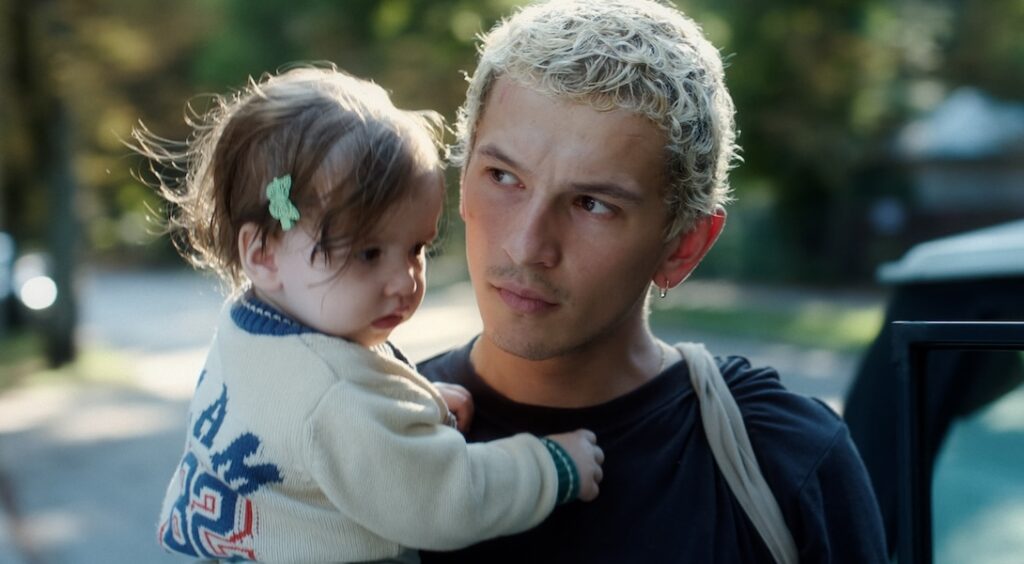
Winner of the Grand Prix at Séries Mania, Proud traces the journey of a gay partygoer forced to become a substitute father for his niece. A sensitive Polish series that gains particular resonance in a country where LGBT rights remain limited.
In March, at the Séries Mania festival, not everyone seemed to swear by Proud, the Polish series that left with the Grand Prix of the international competition. Created by Karol Klementewicz and Monika Pęcikiewicz, this new original production aired on HBO Max focuses on Filip, a gay model whose daily life is upheaved when his elder sister, with whom he lives, dies suddenly. But his mourning will have to wait: he must first take care of his niece.
The Age of Reason
The starting point evokes a well-known motif, from Charlie Chaplin’s The Kid to Jordan Firstman’s Club Kid presented at the latest Cannes Film Festival: an immature adult confronted with responsibilities he never wanted. But Proud shifts this narrative to terrain rarely explored, that of a gay man forced to become a parent in a Poland where LGBT rights remain limited. The idea was born from a personal experience. “My brother was someone irresponsible, carefree and scatterbrained. When he became a father three years earlier, he changed radically. It fascinated me to see how quickly this new parental role had affected his character in so little time”, explains Karol Klementewicz.
Arrogant, impulsive and unable to keep his commitments, Filip initially lives only for parties, sex and his own desires. Faced with tragedy, however, he is forced to reassess his priorities. Not only for himself, but for the child he now has under his care. The series accompanies this transformation with delicacy. Through long contemplative sequences where the camera follows his protagonist in moments of doubt and solitude, Proud gives us access to his interiority. Revelation of the series, Ignacy Liss, awarded the Best Actor prize at Séries Mania, portrays Filip with remarkable precision, moving from a pain-in-the-neck to a deeply endearing character.
Filip’s homosexuality is never merely decorative. It permeates his entire existence: his friendships, his loves, his habits, his way of inhabiting the world. He frequents clubs, moves within a predominantly queer circle, and multiplies his adventures. But the series does not idealize this milieu. Far from moral judgment, Proud also reveals its shadows. It notably tackles chemsex through a particularly striking scene where a supporting character throws himself from a window after a psychotic episode triggered by drug use. “I drew inspiration from a true story that happened during a sex party, says the creator. Even if it’s a secondary plot, I wanted to show the risks of chemsex. But I wanted there to be no judgment of those who practice it.”
An Almost Unintentionally Political Series
A story of a gay man raising a child would probably not be particularly subversive in many European countries. In Poland, it takes on a different dimension. Since the election of Karol Nawrocki, a figure of the nationalist right known for his hostile stance on LGBT rights, queer people continue to operate in a tense political climate. “Whether you follow the news or not, the political situation influences people’s lives, explains Karol Klementewicz. The treatment of LGBTQ people in Poland is extremely poor. One cannot marry, one cannot adopt.”
In this context, the mere act of depicting a gay man taking on a parental role gains political weight. The creator admits to having faced numerous difficulties financing the project before HBO Max arrived.“When I pitched the series, I was aware that the story of a gay man adopting a child would seem shocking, he says. That’s why it would never have found a place on a national channel. HBO allowed real freedoms.”
If the broadcaster now offers him international visibility, Karol Klementewicz hopes above all that Proud will find an echo in his own country. “I would like it to spark conversations at the table. That an ordinary person might tell themselves that they may have had a wrong judgment, that sexuality is not something monstrous that must be stigmatized.” If it resonates, it is because it carries universal experiences of grief, family, and adulthood: “My goal is to remind that we are more alike than different.” notes the director. An ambition that helps explain at least in part the enthusiasm generated at Séries Mania.
