
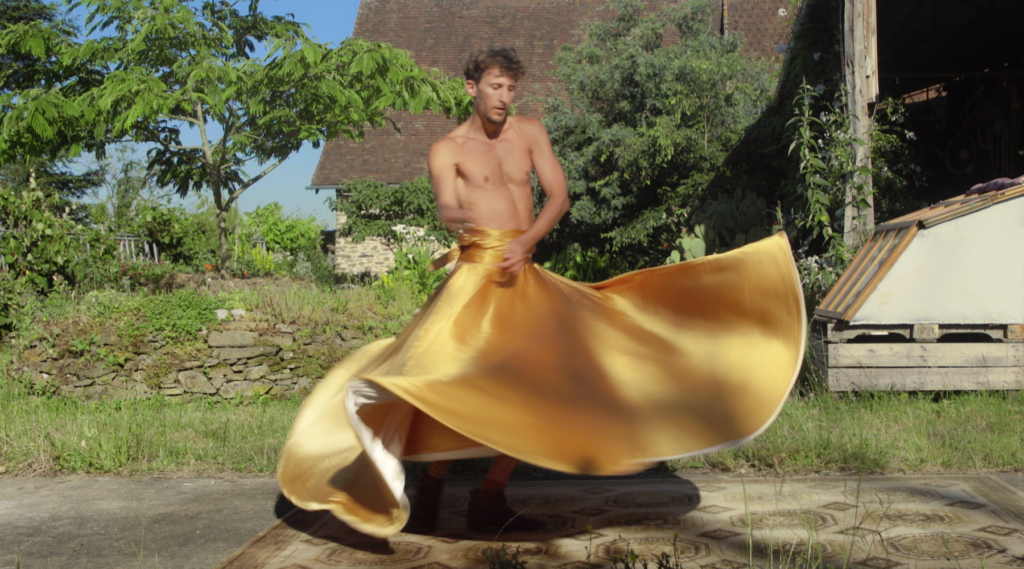
With His Camera, Antoine Vazquez Spent Three Years Filming Benoît, a Gay Man Living in the Heart of Dordogne. With Pédale Rurale, He Delivers a Touching and Optimistic Documentary Coming to Theaters This Wednesday, March 4.
After a first short film (Et des ruines que tu me laisses) awarded at festivals, the director Antoine Vazquez spent three years talking with Benoît, a gay man living in a rural setting. He presents Pédale rurale, in theaters this Wednesday, March 4, a documentary in which one follows the journey of this protagonist who, whose flamboyance had been openly expressed only behind closed doors, learns to publicly embrace his identity.
But Pédale Rurale is not only the portrait of a country gay; it is also the meeting of two gay trajectories. Behind his camera, Antoine Vazquez addresses the political dimension of his sexual orientation, while Benoît mostly speaks of the cocoon he has built within the heart of nature, where he can be himself, in complete safety. This difference in stance between the two men is revealing: living one’s homosexuality is not necessarily done the same way, and does not carry the same implications, depending on the environment in which one lives.
Designated very early by those around him as marginal, Benoît first focused on masking his difference. His love life, his taste for dresses, jewelry and dancing, he experiences them in the privacy of his home, his “paradis sans concession”. Seemingly revealing traumas in Benoît, the initial discussions with the director also sow the quiet seeds of an emancipation to come…
As the seasons pass, Pédale rurale thus takes the time to follow Benoît’s evolution, who eventually joins a local LGBTQI+ group, which the director films during their meetings. A way to emphasize both the unique identity and the varied experiences of all these people happy to find their chosen family. When the collective wants to commit to organizing the region’s first Pride march, it is a pivotal moment for Benoît: after a long period of protective withdrawal, he must come out of his shell.
With this sensitive documentary, Antoine Vazquez offers a vision beyond clichés of queer life in the countryside. If difficulties are real — on the eve of the march, strangers vandalized the decor and left a homophobic inscription on the ground — the touching evolution of Benoît testifies to the possibility of a thriving and openly embraced queer life in the countryside, drawing strength and joy from his community.
