
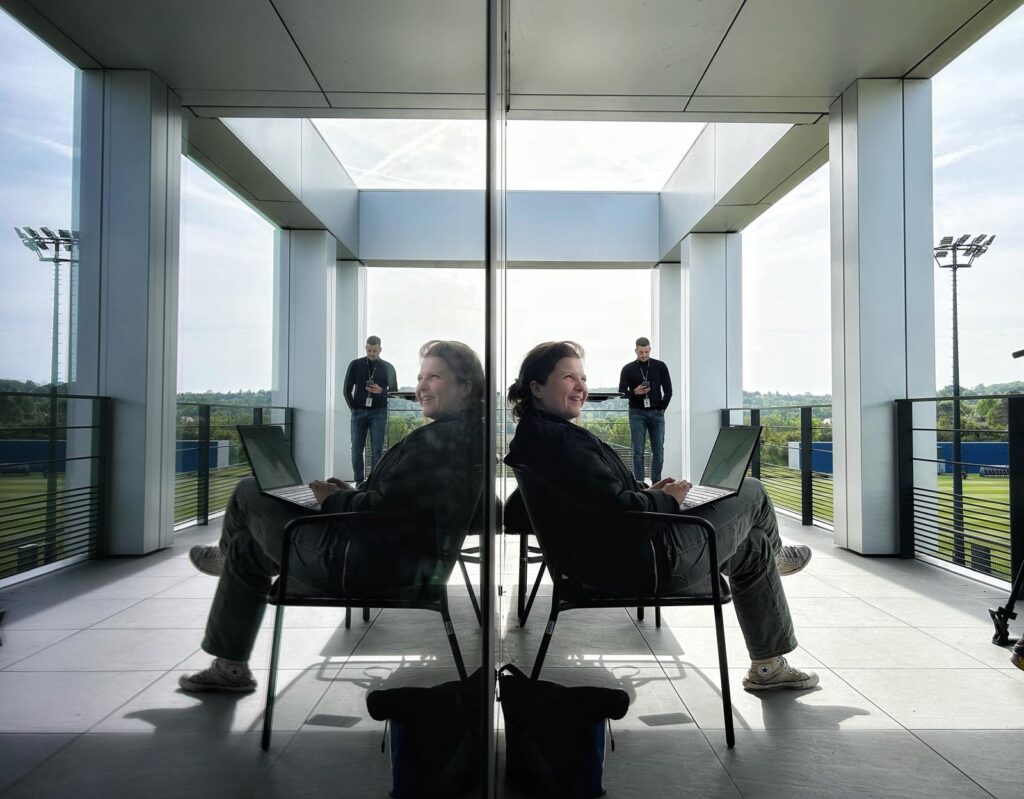
In sports journalism, women remain the exception. Of the 80 journalists from the French print press accredited to the 2026 FIFA World Cup, only two are women. Among them, Alice Lefebvre, AFP’s special correspondent to the Spanish national team.
“It’s an incredibly exciting adventure.” Since June 8, Alice Lefebvre has set down her roots in Chattanooga, Tennessee, to cover her first World Cup. AFP’s special correspondent, the 33-year-old journalist lives to the rhythm of training sessions, press conferences and matches of the team she is tasked with following, Spain, which carries her to the final this Sunday, July 19, where La Roja faces Argentina. A total immersion that she sums up in one sentence: “This is the first time in my life that I feel such intensity in my job.”
But her presence in the press boxes also tells another story. Among the 80 journalists dispatched by the French print outlets to cover the World Cup, only two are women, with Marie Thimonier for Libération. Across all media, they represent barely ten journalists among the 150 French accreditations. The sport that reigns supreme remains a male-dominated domain.
“My childhood was not at all oriented toward sport,” recalls the thirty-something. In her Normandy village, her childhood was spent between games with the neighbors, visits to her grandmother, and, nonetheless, a few improvised football games in the schoolyard. She also remembers that she was the only girl to kick the ball with the boys. “I always loved it, deep down,” she smiles, now convinced that if a women’s club had existed near her home, she would have played there.
The passion for journalism came from her father. A reporter at Le Courrier Cauchois, the weekly in Seine-Maritime, he opened the doors of newsrooms to her very early. On Thursday nights when the edition closed, he would come home late. He would take her to see the presses, tell her about the trade’s behind-the-scenes and the stories behind the articles. “I soaked up all of that.” After two years at the Institut pratique du journalisme (IPJ), she joined AFP in 2018 in the police-justice desk. Five years later, like all AFP journalists, she switches beats and discovers football. PSG, the France women’s team, Euro 2024, Paris Olympics, Euro 2025… major competitions follow one another until this first men’s World Cup.
“We must be told if we are disturbing”
In this milieu, Alice Lefebvre quickly got used to being the exception. “On a daily basis, I’m surrounded only by men: among the fifteen or twenty journalists covering PSG, I’m already the only woman,” she explains. So learning that there are only two women among the French press’s special correspondents in the United States did not really surprise her. Female visibility has nonetheless advanced in sports journalism, notably on television where journalists like Ophélie Meunier or Estelle Denis cover the biggest competitions. “If the share of women in sports desks has risen from 15% to 17% between 2022 and 2025, this evolution remains far below the feminization of the entire profession, where nearly one journalist in two is a woman,” notes the association Femmes Journalistes de Sport.
View this post on Instagram
Sophie Brennan