
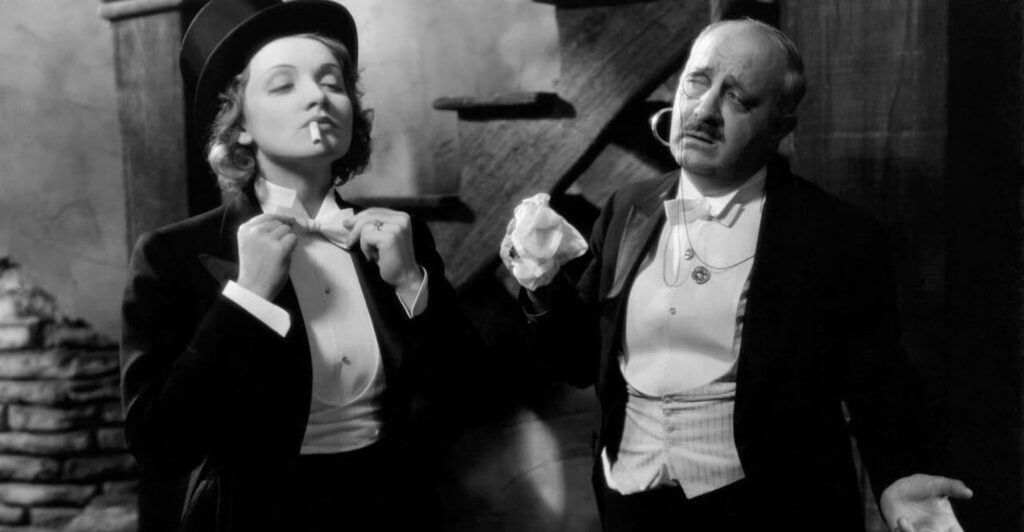
Released in 1995, the documentary The Celluloid Closet revisits almost a century of gay and lesbian representations in cinema. We revisited it for you.
As the eyes of film lovers around the world turn toward the Oscars, we plunged back into the documentary The Celluloid Closet. Released in 1995 and directed by Rob Epstein (Oscar winner in 1985 for The Times of Harvey Milk) and Jeffrey Friedman, the documentary was broadcast in France with the subtitle Les Homosexuels (re)vus par Hollywood. Exploring a hundred years of Hollywood cinema, it strings together about a hundred film clips that dialogue with figures of the seventh art such as Shirley MacLaine, Susan Sarandon, Whoopi Goldberg, Tony Curtis, and Gore Vidal. With one question: how did Hollywood learn to think about gays?
The film’s meticulous archival work highlights a well-oiled mechanism. First, the construction from silent cinema—the earliest excerpts go back to 1895—of the character of the “crazy” person, whose effeminate manners are tolerated as long as they provoke laughter. Before the first bold moves, the insinuations, the cross-dressing, the characters presumably homosexual but only suspected. This is followed by a long period under the great umbrella of the Hayes Code, a censorship imposed from 1934 to 1968 that forbade explicit representations of sexuality, a fortiori homosexuality and any content deemed immoral. The documentary probes the whole system of tricks and insinuations that arises to circumvent the prohibition: Morocco, Queen Christina, Rebecca, Rope, Tea and Sympathy, Ben-Hur, Some Like It Hot, Victim…
Après la fin du code Hays, Hollywood sort doucement du placard, mais avec quarante ans de honte collée à la semelle. Dans The Boys in the Band (1970), la réplique “Not all gay men blow themselves away at the end” sonne comme une percée. Des personnages homos peuvent enfin s’expliciter, même si l’autodérision reste une armure. Deux ans plus tard, Cabaret fait de l’homosexualité une fête. Mais les habitudes ont la vie dure. Dans les années 1980, le mot “PD” fuse dans les films comme une insulte réflexe, un levier humoristique facile. Quelques œuvres déplacent pourtant la focale. Sous son vernis de polar, Cruising montre un vrai milieu gay. Making Love (1982), lui, ouvre la voie à des personnages qui ne sont pas punis pour leur existence. La sortie du placard est amorcée.
