
Cinema does not merely reproduce reality; it constructs it and feeds it. This has been questioned thanks to the emergence of feminist and queer theories, giving birth to new modes of looking.
To better understand the scope of the queer gaze, it is necessary to read it alongside other notions that enabled its emergence, notably the male gaze and the female gaze, the oppositional gaze and even, in its extension, the trans gaze. The queer gaze then goes beyond questions of representation by becoming a particular way of filming and seeing films. Cinema thus becomes a space of political emancipation and freedom.
Origins: the male gaze
The male gaze is a theory proposed by Laura Mulvey in 1975 in her essay “Visual Pleasure and Narrative Cinema,” available in French in the journal Débordement. It can be translated as “male gaze” in English. According to theorist Laura Mulvey, Hollywood cinema and, more broadly, classical cinema impose a default masculine, white and heterosexual perspective. This perspective rests on several gazes: the camera that films, the male protagonist who looks at women, and the spectator who is forced to watch.
Thus, the film exposes women through the eyes of a desirous man. The female character is reduced to a passive object present to be contemplated, sexualized, and offering a moment of erotic contemplation. In this sense, on screen, women are not represented as whole persons but are cut and reduced to sexualized body parts. They are dehumanized and reduced to an aesthetic or sexual function.
A Developed Theory: the female gaze
Iris Brey picks up this theory, developing a theory of the female gaze in her 2020 essay The Female Gaze, a Revolution on Screen. This theory leans toward the interiority of the character; the spectator feels the emotions of the characters rather than being merely a voyeuristic gaze fixed on them. The female gaze is a horizontal gaze, with no distance between the spectators and the characters. The actors are living subjects and no longer objects of contemplation that freeze them in a dehumanizing condition, feeding sensationalism and desire.
An Example of the female gaze in Des preuves d’amours:
One can take the scene where the main character slaps a man. The usual dynamic of validating the man is reversed by the action of the main character who slaps the man. The scene is presented as a response to a crude remark from the man. The man is then in the background and is not seen as a main obstacle, relegating the couple to the foreground. It is the couple of women who is foregrounded, and not the man’s question.
A Durable Theory: the oppositional gaze
The bell hooks essay The Oppositional Gaze treats the notion of gaze as an act of resistance anchored in the colonial experience. Bell hooks shows the blind spots and the unspoken experiences of Black women spectators. They cannot identify with the white “cinematic star,” because they are depicted in racist caricatures. She critiques the inversion of white cinema that forgets questions of race in reception, subject and object. Thus, she envisions a distancing to step back and critique the power structure; this allows one to stay outside the film to analyze it. It remains vigilant about the gaze proposed in cinema.
An Example of the Oppositional Gaze in The Watermelon Woman :
The Watermelon Woman is a fictional-documentary film; it traces the documentary investigation of the filmmaker about the woman named Watermelon Woman. In this film, Cheryl, the main character and the filmmaker, refuses to become an object of the film. In this sense, the character, as subject, becomes active and speaks directly to the camera, looking the spectator in the eyes. She takes up the right to tell her own story. Finally, the film uses Cheryl’s point of view to critique the exotization of Black bodies by white people.
The queer gaze : A Gaze from the Margins
Definition and characteristics of the queer gaze
The queer gaze is a notion that draws on queer theories, born in the United States with theories about gaze in cinema (notably the male gaze and female gaze). The queer gaze rests, in principle, on destabilization. That is, the way of filming shows gender and sexuality as artificial constructions. It blurs the boundaries of “masculine” and “feminine” and it blurs the boundaries around sexuality. The gaze exposes the artificiality and performance of what is seen as normal.
Aesthetics and politics of the queer gaze: camp, radicality and representations
The queer gaze, by principle, must distance itself from the dominant culture. Molly Moss, an English journalist, writes in her article Thoughts on a queer gaze: “An authentic queer gaze does not fit into any frame; it embraces and normalizes what society perceives as strange, unclassifiable, and difficult. This places the queer gaze apart from the rigid norms of LGBT cinema.”
Its aesthetics may resemble Camp, as understood in Susan Sontag’s Notes on Camp, an aesthetics and form of expression advocating exaggeration, provocation, parody and irony. A sensibility inherent to queer culture that should be linked with a radical, almost anti-normative politicization. The queer gaze is necessarily political, feminist, anti-racist and politically radical.
Finally, and above all, the queer gaze must be thought with queer people. To bring forth a queer gaze, it is necessary to think the film with the people it concerns.
An Example of the queer gaze: The Queens of Drama
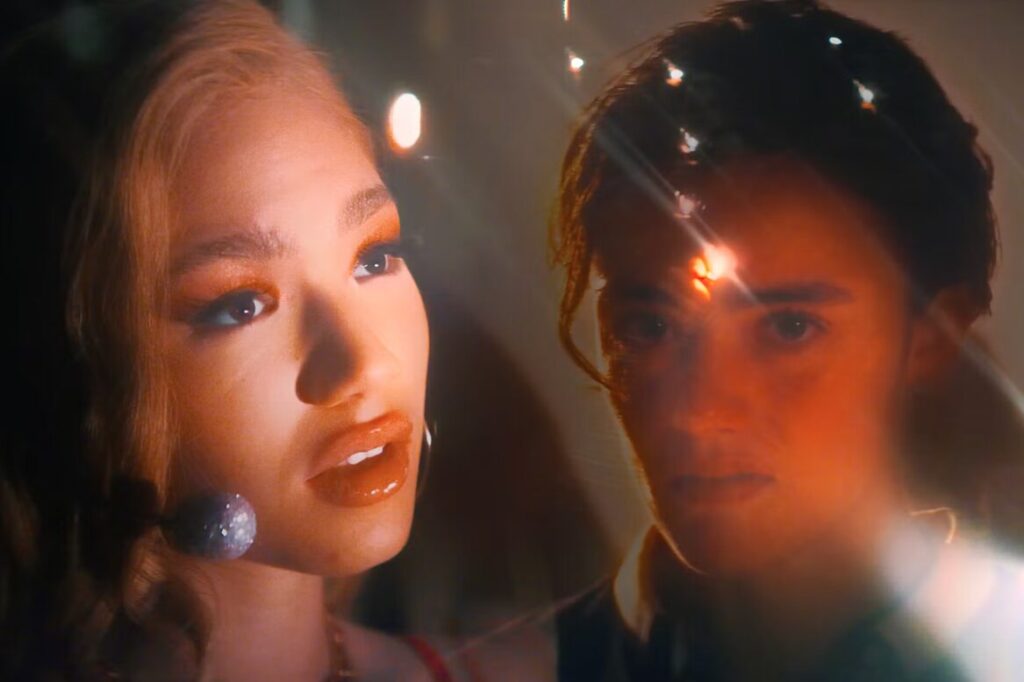
Alexis Langlois’s film lends itself perfectly to a camp queer aesthetic. That is, it is very colorful, even saturated, and it presents an assumed theatricality, etc. It is, moreover, written and directed by a queer person, Alexis Langlois, and features queer actors such as Bilal Hassani or Gio Ventura, and is aimed at queer audiences. It frees itself from the dominant external gaze by guaranteeing an internally queer direction.
The film celebrates plural bodies, fluid, outside norms, multiple aesthetics without making them a subject. It gives people the right to be complex and nuanced beyond their sexuality.
And the spectator in all this?
Moreover, the queer gaze can be read as an analysis by the spectator of the film they watch. In this way, the queer gaze can be applied to all past films, even if they are not queer. Thus, it is conceived as a position of the spectator. The queer gaze is a gaze that exits passivity and becomes active. Like the oppositional gaze, the queer gaze must create a resistance against the dominant gaze that erased queer experiences.
In the film The Watermelon Woman, Cheryl shows resistance and a search for the identity of the Black woman who was not credited in the credits. By conducting her investigation, Cheryl Dunye faces obstacles that prevent her from tracing the life of her subject. She resists this lack of archives of Black queer women by creating archives where there is a lack. For example, she incorporates a fictional love story between Fae Richards (the real identity of The Watermelon Woman) and a white filmmaker. She blurs “reality” and the dominant gaze by exposing real archives and fictional archives. This act becomes a clearly queer gesture as it appropriates the dominant discourse (and what it wished to retain) while giving representations.
Ultimately, the quote from Jonas Fontaine’s article asserts the queer gaze as a reappropriated political gesture: “To assert that the act of placing a queer and deconstructed gaze on the norm is already a form of the queer gaze. Because by reappropriating images that were not originally ours; by inventing, by imagining, by telling our stories, we build our own History.”
The trans gaze: an extension of the queer gaze
Finally, the queer gaze can resonate with the trans gaze. The trans gaze is a gaze to be connected with the cis gaze (a gaze that represents trans people in an objectifying way, notably reducing them to their bodies and reducing them to this).
It consists in opposing the cisgaze and the dominant gaze of which trans people are the object, mixing voyeurism, disgust and/or pity for their bodies. It is a gaze made by and for the people concerned who represent the trans experience (in its interiority and subjectivity, showing all its complexity, refusing justification and education), and finally that shows (not in a systematic way) a non-fetishized trans body not centered on medicalization.
To illustrate this gaze, the series Sense8 created by the Wachowskis sisters.
The queer gaze in cinema is a tool of emancipation that decentrates the dominant heterosexual, white and patriarchal gaze. It goes beyond mere representation and transforms our gaze on images and cinema. It allows us to embrace our complexities and human diversity beyond established norms. Finally, it also allows for the redirection of the imposed gaze into a multitude of gazes specific to minorities, such as the trans gaze.
