
[Feature to read in the spring issue of têtu·, already available online and on March 11 at your newsstands] In the evening, in dark cinemas, Shrek fans gather to celebrate the universe of the animated film which, 25 years after its release, has not aged a single bit as a queer icon.
Photography: Studio Louche for têtu·
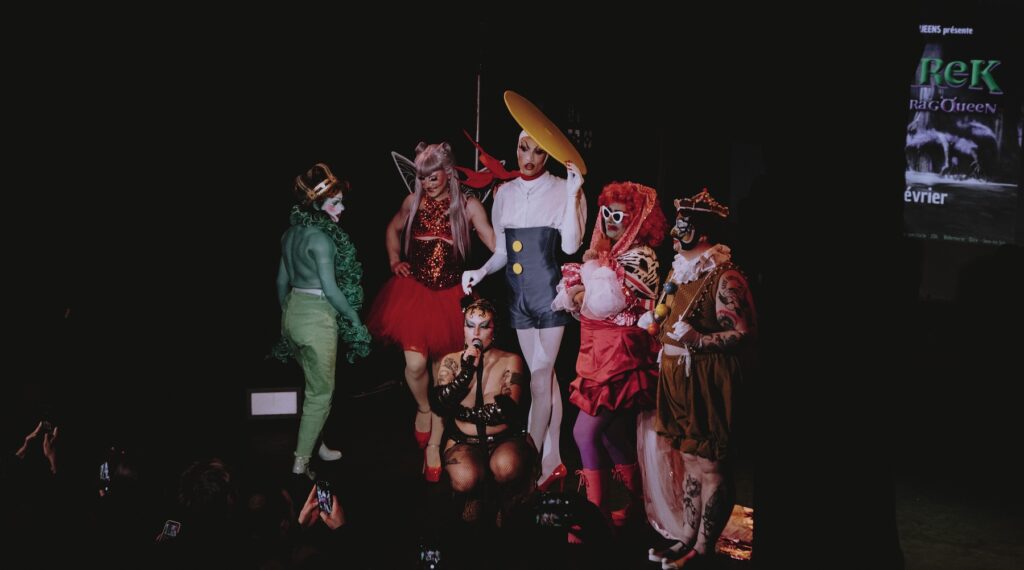
When Puss in Boots finishes his striptease, the crowd meows with delight. On the stage at Le Point Éphémère, in Paris, the Shrek characters march for a grand queer and burlesque celebration. Ti-Biscuit reveals a multicolored pom-pom thong, the dragoness undresses by blowing smoke, the prince charms us with a lascivious dance and Fiona, prouder than ever, displays her fluorescent green abs. On this February Monday evening, more than 300 people came to witness the show “Shrek is a Drag Queen”.
“There is nothing more unifying than Shrek”, says the drag queen Babouchka Babouche, cofounder with Morphine Blaze of the cabaret Screen Queens, which organizes the evening. Since their first Shrek-focused performance in 2021, for the film’s twentieth anniversary, they had to turn people away at the door. Since then, “Shrek is a Drag Queen” has established itself as their greatest success: the admissions for the five editions staged since last autumn sold like tickets for a Mylène Farmer tour. “Shrek is a very queer work,» continues Babouchka Babouche, who herself embodies Doris, the tavern keeper and ‘transicone’. The characters’ genders aren’t clear, there’s a donkey in a relationship with a dragon… And then, you’re not going to tell me that the prince charming is a cis heterosexual man!
Fairies and Acts
The queer reading of Shrek itself isn’t hard to make. In the saga produced by the DreamWorks animation studio, freaks of all kinds are rejected by a normative society. The creatures’ fight in this anti-fairy-tale against exclusion and for self-acceptance is an obvious echo of LGBTQI+ struggles. During the intermission of “Shrek is a Drag Queen,” Élisa, who came to see the show, recalls immediately connecting with the cartoon she discovered in middle school: “I found it cool to see all these enchanted characters who don’t judge each other, especially Doris, the tavern keeper. I never had to come out, and in Shrek there’s also this queer aspect that’s there but we don’t talk about, as if we don’t need to.” Jackie Fuego, who portrays Fiona and Shrek in the show, rediscovered the film as an adult: “I saw the first films when they were released in theaters. But I had this queer reading later, when rewatching them with friends. At that moment, it felt natural,” explains the artist who, in the meantime, had come out as non-binary.
In the audience of Le Point Éphémère, the average age ranges from 25 to 35. The younger crowd has elevated Shrek to a queer icon thanks to social media. After the 2010 release of the last opus, Shrek 4. It Was an Ending, the green ogre experienced “a new life thanks to the Internet, memes and fan art”, explains Italian Danilo Petrassi, PhD student in innovative humanist didactics and author of a book on shrekology. But how does a twenty-five-year-old animated film, an adaptation of a children’s book written by William Steig in 1990, speak so strongly to a generation that hasn’t lacked queer representations on its screens?
For Jack Halberstam, professor of literature and gender studies at Columbia University in New York, if the Shrek films are so ambiguous, it is in part thanks to the visual diversity of their characters, made possible at the time by the substantial advances in animation technology. But also thanks to the particular way in which they are crafted: “In cinema, it’s often one man who makes all the decisions,” he explains. “Animation doesn’t work like that; these are collaborative films. And in the teams that make these films, there are always queer and radical people…“
From Green to Rainbow
On the Parisian stage, Doris the tavern keeper is joined by a modish Pinocchio for the final lipsync: “Shrek is a Lesbian.” It took about three hours for Maddy Street, a Franco-British artist, and guitarist and drag king Juda la Vidange to compose this rock title released in the summer of 2024. Writing the lyrics, the first explains, the duo imagined “that Shrek and Fiona meet at the Mut‘ [the Mutinerie, a Paris lesbian bar, ed.].“
In France, the Screen Queens are not the only ones to drag the green ogre out of our screens: in Caen, the queer bar Spark has been hosting nights in his honor since 2024. From October 2026, it will also be possible to attend Shrek the Musical at the Folies Bergère, in Paris. The queer coloring of the show is “targeted at songs, like the famous ‘Freak Flag’”, explains its director Philippe Hersen. This song, in which the enchanted creatures celebrate their differences in unison, sparked a recent controversy. At the end of January, while the musical was being performed in Parker, Colorado, a municipal representative ordered the troupe to remove rainbow flags displayed during the song, deemed offensive in Trumpist America. The troupe refused: the LGBT+ banner will indeed continue to float over Shrek.
