
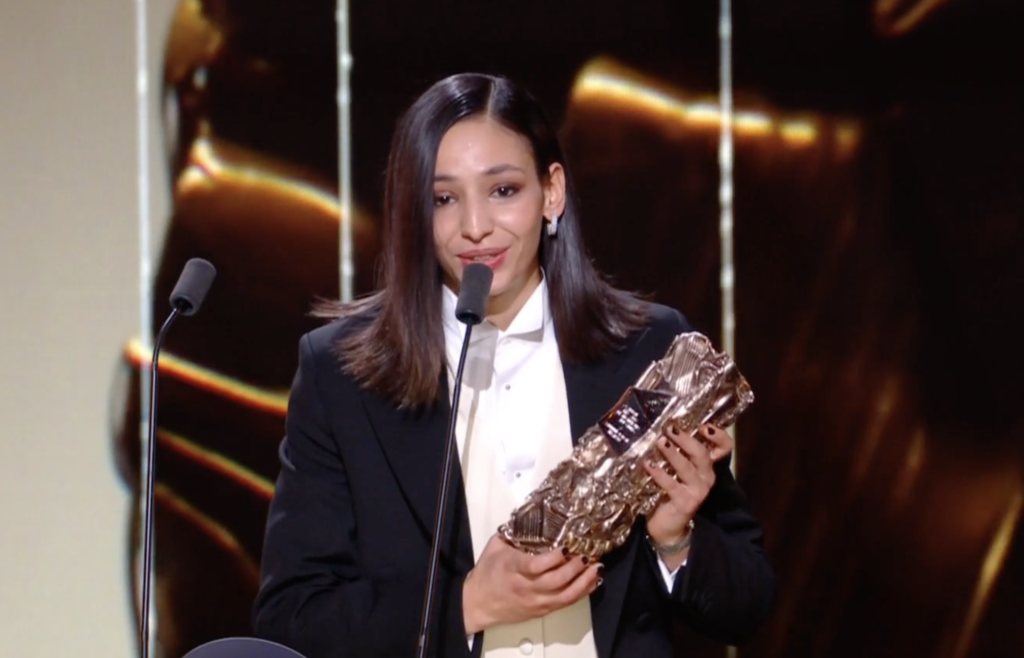
The 51st César Awards, held on February 26, honored Nadia Melliti, the lead actress in Hafsia Herzi’s La Petite Dernière.
Thursday, February 26, 2026, the 51st César Ceremony took place at the Olympia with Benjamin Lavernhe as host and Camille Cottin as president. If Carine Tardieu’s L’Attachement was crowned best film, the queer jolt of the evening bore a name: Nadia Melliti, 23, who on Thursday, February 26, won the César for Most Promising Actress for her role in La Petite Dernière by Hafsia Herzi. A prize that she will be able to store right next to her Best Actress award in the Un Certain Regard section at the Cannes Film Festival. The actress began her speech by saying that she felt she was “living a waking dream”.
After thanking Hafsia Herzi and the film’s entire team, she dedicated her prize “to people who are the very foundation of our society and to our physical and mental well-being”, citing farmers, health professionals and the education workforce as well as hospital staff. Then, the actress, who had not planned to pursue a career in cinema and who had been spotted at an open casting, addressed her mother: “I want to thank my queen, my lioness, my mother. Hi Mom, I know you’re watching me. In my childhood, I promised you the Ballon d’Or, but tonight I’m coming home with the César d’Or”.
In La Petite Dernière, adapted from Fatima Daas’s novel, Nadia Melliti portrays Fatima, a 17-year-old suburban high school student who tries to reconcile faith, family and lesbian awakening. It is the young actress’s very first film, rewarded for her magnetism and dense presence, even as she plays a taciturn character subject to upheavals that are always internalized. Nadia Melliti knows how to inhabit silences, make doubt, shame and desire emerge through micro-movements, without showy effects. La Petite Dernière had moreover been praised at the Têtu ceremony on December 10, 2025. Fatima Daas had received a Têtu d’honneur, honoring the literary and political impact of the novel from which the film is adapted and Hafsia Herzi the ally of the year.
Many queer nominations
If La Petite Dernière had been nominated seven times (Best Film, Best Direction, Best Adaptation, Best Editing, Best Original Score…), the ceremony highlighted many queer productions such as La Pampa, by Antoine Chevrollier, nominated for Best First Film, which follows Willy (Sayyid El Alami) and Jojo in a rural France where teenage friendship clashes with diffuse homophobia, or L’Étranger by François Ozon, adaptation of Camus’s novel. On the short film side, Big Boys Don’t Cry by Arnaud Delmarle followed a group of boys unsettled by the return of an old friend, while Deux personnes échangeant de la salive imagined a world where kissing becomes a capital crime. A dense selection that nevertheless was not awarded this Thursday.
