
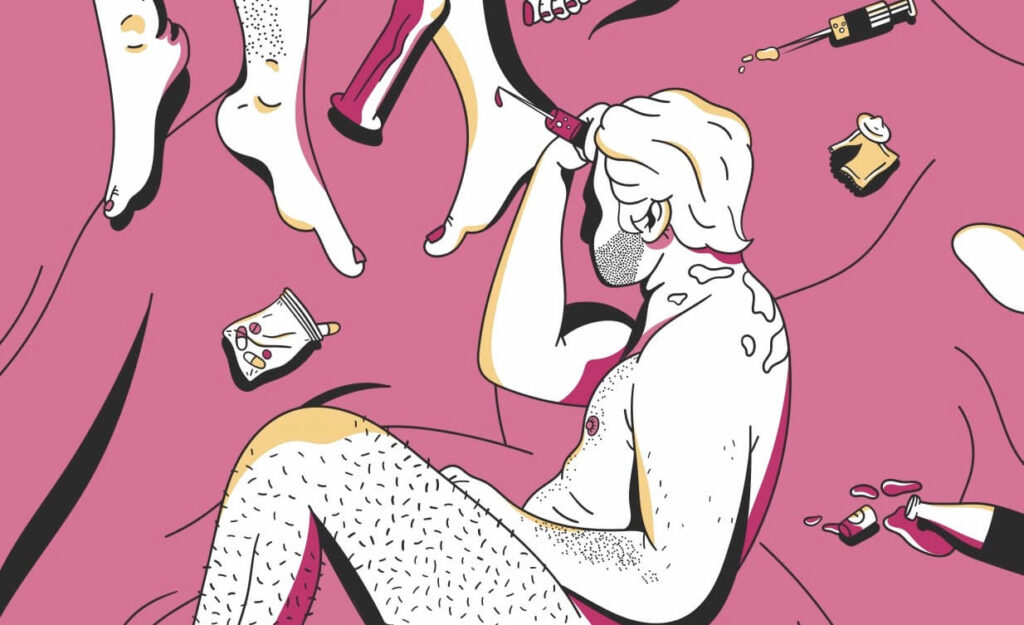
Field-based organizations at the forefront of preventing risks linked to chemsex, including Chems Pause, Actions Traitements, and the Fédération Addiction, urge public authorities to acknowledge the dangerous effects of anti-drug repression, arguing that deaths could be prevented.
Bordeaux, Lyon, Tourcoing, Paris: the local press regularly reports on men dying within the context of chemsex, often reveling in unnecessary details… Without ever addressing the real question raised by these tragedies: how many of these deaths could have been avoided if the people on site had called for help in time?
Drug-related deaths are neither isolated news items nor inevitabilities, but the symptom of a public health problem worsened by an outdated legal framework. In France, consuming drugs exposes individuals to fines and imprisonment. And this penalization is not theoretical: in many situations, when assistance is requested for an overdose or a vital distress, the police arrive on the scene with the firefighters and the Samu.
This reality produces a dramatic and well-documented effect by on-the-ground actors: fear. Fear for the victim as well as for the person trying to help, of being questioned, fined, prosecuted, fear of lasting legal consequences. Consequently, in the face of an emergency, people hesitate, delay, and try to “manage.” Sometimes too long, and people die when they could have been saved.
Major barrier to emergency services
What is observed in the context of chemsex concerns, in reality, all forms of drug use. Opioid overdoses, mixtures of substances, festive or solitary consumption: everywhere, the penalization of use is a major brake to calling emergency services and, as a result, to access to care. This finding has been shared for years by health professionals, harm-reduction associations, and community organizations.
Continuing to penalize simple drug use today amounts to a deadly blindness: as recent statistics show an uptick in consumption, this policy does not reduce drug use or lessen risky practices, nor even combat trafficking as many political figures claim. On the contrary, it helps to reinforce the stigma surrounding the affected individuals, to push them away from prevention and care services, and to create situations where the criminal law becomes literally deadly.
Neither normalizing drugs nor denying the risks
Depenalizing drug use does not mean normalizing drugs, nor denying their risks. It means, on the contrary, equipping ourselves to reduce them. It means sending a clear message: in the face of a medical emergency, the absolute priority is human life, not repression. It means enabling witnesses to a malaise or overdose to call for help without fearing prosecution. It means placing public health, prevention, and support at the heart of drug policy.
Many countries have already made this choice, with convincing results: fewer deaths, improved access to care, stronger harm-reduction policies. In France, persisting in an ineffective punitive approach is no longer tenable.
It is time to change the law. Depenalizing the simple consumption of drugs is not an ideological option: it is a health and human necessity. Each day that passes without reform exposes more people to avoidable deaths.
Signatories:
Fédération Addiction
Aides
Actions Traitements
Act Up-Paris
Chems Pause
ENIPSE
Inter-LGBT
