
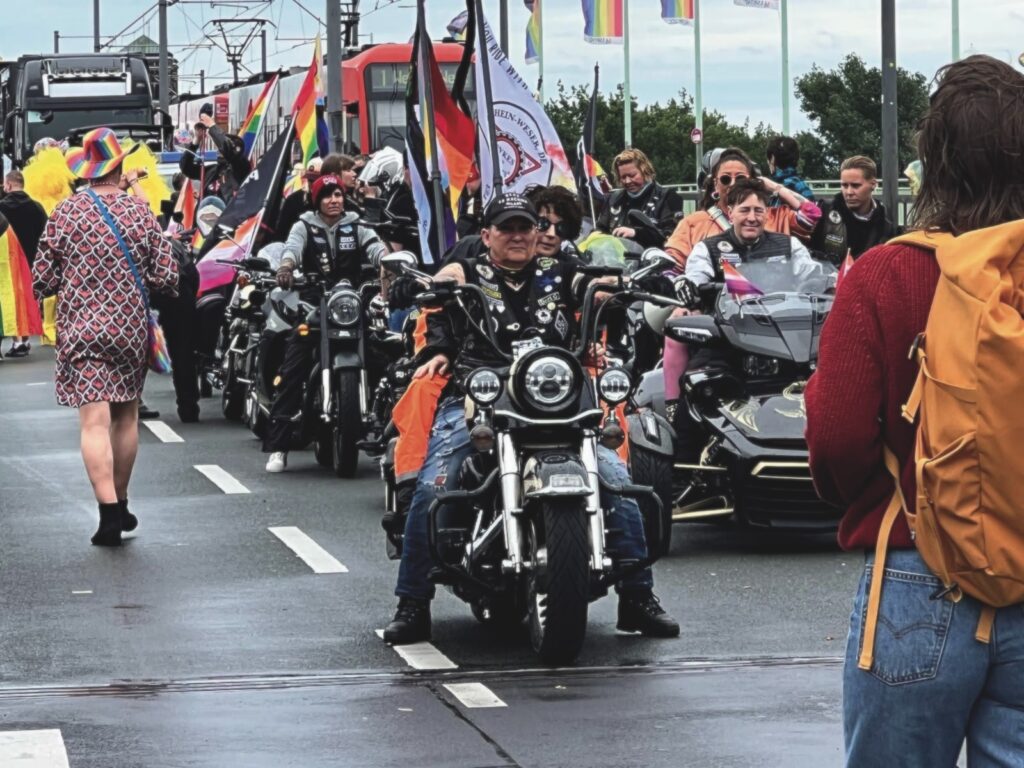
[Article to be found in the têtu· spring magazine, available at your newsstands or by subscription.] From fetishized gay virility to the lesbian armor, from leather fantasies in the 1950s to today’s queer clubs, our motorcycling culture has always ridden the line between desire and resistance: a history of engines and solidarity.
By Maurine Charrier & Tessa Laney
“The butt-hugging jeans of the era, with the buttocks spread over the motorcycle seats… I couldn’t take it anymore.” Robert, 77 years old, founder of Le Keller, Paris’s historic bar-club in the gay fetish scene, remembers with relish long sessions spent, in his young man’s room in Calais, deconstructing gay magazines like Olympe or Nous les hommes. Where it all begins with images, a printed fantasy, this tension between leather, machinery and desire.
In the late 1960s, when leather culture was still in its infancy in France, Robert Keller set off to seek elsewhere what did not yet exist at home. Across Europe, from Stuttgart to London via Amsterdam, he frequented bars most prized by motorcyclists, offering associations to host them in his parents’ inn for their annual conventions. The family hotel regularly filled to bursting with dozens of men in full-board, entirely clad in leather, their bikes lined up on the parking lot. Together, they share their passion for motorcycles and for the boys, in the safety of a private space. “No one suspected a thing” laughs Robert today. This memory says a lot about the era: the imposed discretion, the joyful clandestinity, the silent solidarity. Even before Pride marches were born, gathering to ride together, to wear your colors, already counts as a political gesture.
The gay biker, sexual icon
The erotic gay imagination around motorcycling takes shape in the United States, in the mid-1940s. Many young homosexuals return from the war, where they experienced male camaraderie, bodily discipline, the uniform. Returning to civilian life, they long for a freedom unattainable in McCarthy-era America. Popularized in 1953 by the film The Wild One, by László Benedek, with an unforgettable Marlon Brando as the rebellious Johnny, the figure of the leather-clad biker offers a counter-model to the heterosexual stereotype. This imagery becomes sexualized and codified in the 1960s–1970s. Through erotic drawings, a Finnish cartoonist fixes the erection of the gay biker into a sexual icon: embracing exaggerated attributes, Tom of Finland’s hyper-masculinized bodies are outrageously desirable. Leather becomes a second skin, the motorcycle an extension of the body, the jacket a manifesto.
View this post on Instagram
Sophie Brennan