
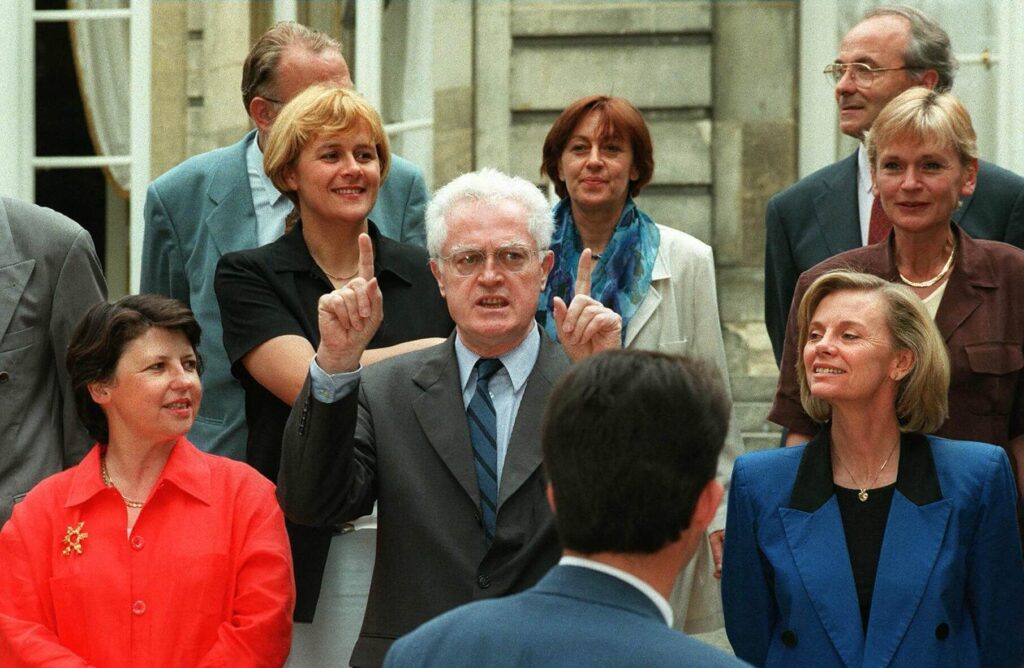
Socialist figure and leader of the united left to govern, Prime Minister from 1997 to 2002 before withdrawing from political life on the evening of the historic April 21, Lionel Jospin died this Sunday, March 22, at the age of 88.
Lionel Jospin always knew how to stage his departures gracefully. The former Socialist Prime Minister, who had announced his retirement from political life on the evening of the famous April 21, 2002, died this March 22, 2026, a Sunday of municipal elections, at the age of 88. In January, he had indicated that he had undergone “a serious operation”, without giving further details.
Born in 1937 in Meudon, in the western outskirts of Paris, into a Protestant, left-leaning family, Lionel Jospin studied at Sciences Po and then at the ENA to enter in 1965 the Ministry of Foreign Affairs, aiming for a diplomatic career. A Trotskyist activist, he joined in 1971, after the unification Congress of Épinay, the Socialist Party (PS) led by François Mitterrand. Following Mitterrand’s victory in 1981, his campaign director Lionel Jospin, elected deputy for Paris, was entrusted with the leadership of the PS until 1988, then the Ministry of National Education after the socialist president’s re-election. It was the era of dinners at Dalida’s place, with Bertrand Delanoë and Jack Lang, also the time of Feuilles mortes, by Yves Montand, which he would perform in 1984 on a Patrick Sébastien program on TF1.
From the Broad Left to the Catastrophe
In 1995, the surprising renunciation of the PS’s announced candidate, Jacques Delors, former president of the European Commission and father of Martine Aubry, gave Lionel Jospin his first chance at the Élysée. But it would be the penultimate failed dissolution of the National Assembly, in June 1997 by Jacques Chirac, that allowed the man who had become PS First Secretary again in 1995 to enter Matignon after legislative elections widely won by the “broad left.” Just like the Nouveau Front populaire in 2024, this alliance of left-wing parties was cobbled together in haste after the surprise announcement from the President of the Republic, bringing together the Socialist Party, the Radical Party of the Left (PRG), the Movement of Citizens (MRC), The Greens and the Communist Party (PCF). A coalition that would form a plurilateral majority in the Assembly as well as a cohabitation government that would last five years, a record under the Fifth Republic.
Powered by a favorable economic climate, the Jospin government managed to lower unemployment and implemented several emblematic measures of the left in power: the reduction of the working week to 35 hours, under the leadership of Minister Martine Aubry, universal health coverage (CMU), as well as the civil solidarity pact (PACS), the first legal recognition possibility for same-sex couples, nearly fifteen years before the adoption of same-sex marriage under François Hollande. “We must credit the government of Lionel Jospin and the broad left majority with having enabled France to end the century by taking a giant step toward equality”, hailed Têtu after the adoption of the text on October 13, 1999. The former scout, raised in Protestantism, would not go any further: defining himself religiously as “a rigid who evolves, an austere man who smiles, an atheist Protestant”, he would say in 2002 to Têtu, that marriage “is, by definition, an institution that concerns the mixed couple wishing to start a family”.
Powered by his record, Lionel Jospin launched his bid for the 2002 presidential election. But the left was more divided than ever: besides the Socialist candidate and three of the radical left (Arlette Laguiller, Olivier Besancenot and Daniel Gluckstein), The Greens ran alone behind Noël Mamère, the PRG behind Christiane Taubira, the PCF behind Robert Hue, and the MRC behind Jean-Pierre Chevènement. If the entire formerly plural left gathered more than 12 million votes in the first round, Lionel Jospin was eliminated after a campaign that Jean‑Marie Le Pen, having drawn 4.8 million votes, surpassed him by 0.68 points, becoming the first far-right candidate to reach the second round. On the evening of the famous April 21, 2002, faced with a devastated left, Lionel Jospin declared: “I fully take responsibility for this failure and I am withdrawing from political life.” A grave moment in political history, this figure of a principled but compromise-capable left to govern.
