
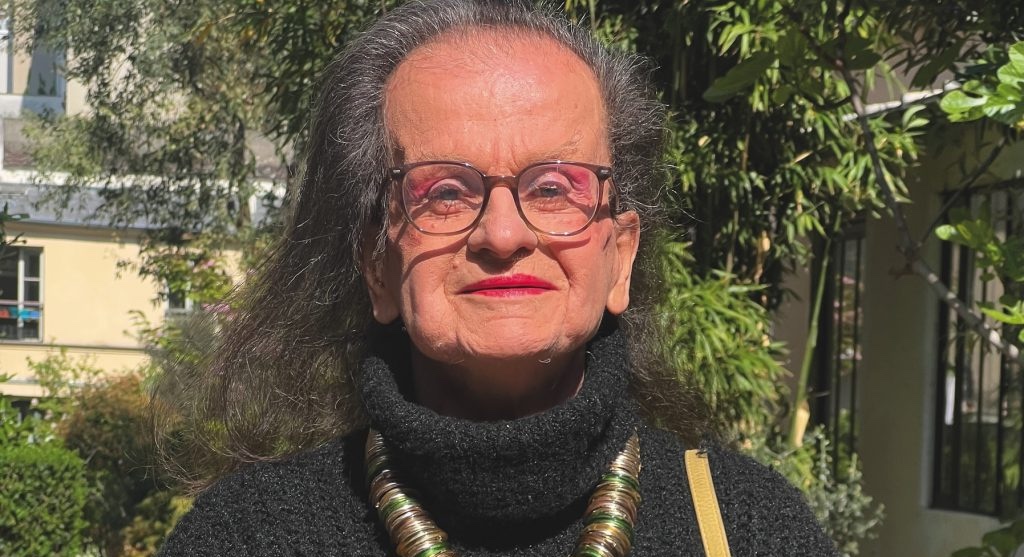
[Portrait to be found in the spring issue of têtu·, available at newsstands or by subscription.] The documentary Hélène Trésore Transnationale, by Judith Abitbol, in cinemas this Wednesday, April 1st, traces the journey of the trans activist and journalist Hélène Hazera, who is now 74 years old. We met her at her home in Paris, surrounded by her books, records and memories.
“I was raised with the idea that I could never do better than my parents, who were resistance fighters during World War II. I have fought a few battles, but that has nothing to do with the dangers they faced.” One can be in their seventies, having led a life as an activist and a journalist, and never feel equal to the family legacy.
A brilliant student at Janson-de-Sailly High School, in the fashionable districts of Paris, Hélène Hazera feeds early from her father’s library, an organization engineer, and from her mother, an administrative assistant. Genet, Rimbaud, Verlaine and the Situationists thus contribute to her intellectual and identity formation. At home, her father displays an imposing, if not toxic, masculinity, while her mother rejects the signs of her nascent masculinity.
“Leftists, unclench your buttocks”
As a teenager, the young woman secretly steals her mother’s scarves and red lipsticks, and cries upon realizing she cannot fit into her size-38 high-heeled shoes. “Young gays come out of the closet, young trans people go into their mother’s closet”, jokes the journalist, now retired, during our interview at her home, a den whose walls are covered with books, records, audio cassettes and loose sheets. “When I began to realize myself as a woman, it was horror toward my parents. If they didn’t accept it, they didn’t throw me out. But I could no longer dine with them. Their gaze, especially my father’s, hurt me too much. This is what led me to turn to street prostitution”, she recalls.
Not yet an adult, Hélène Hazera tastes freedom with a group of “crazy women” within the Front homosexuel d’action révolutionnaire (FHAR). Then, she participates in the Gazolines movement, created in 1972. Despite the disparate ideas of its members, this small group of about fifteen people – of whom five have undergone a gender transition – agrees on its hatred of the injunctions to think and of the “ideologies that imprison”.
“We wanted to mock the leftists, who had a strong intellectual aura and who compromised themselves by defending a regime. In the FHAR, many people had been crushed by Maoist militancy”, she recalls. Using laughter as a weapon to destabilize the opponent, she invents the FHAR’s most famous slogan: “Proletarians of all countries, caress yourselves”, and also “Leftists, unclench your buttocks”. “I would, however, not want my life to be reduced to a few moments when I behaved like a fool”, the interviewee adds. Indeed, the following years take on a more serious tone.
Woman and journalist
Hélène Hazera completes her transition in 1973 and it is as a woman, the first openly trans person to write for a newspaper, that she makes her place at Libération, introduced by Michel Cressole, who at the time hopes the daily newspaper will hire LGBT people. There she works particularly on television: “My goal was to write cheeky pieces about programs I hadn’t always watched, so that readers who hadn’t watched the program could talk about it at work”, she recalls with a broad smile. She also signs the first articles on trans identity and on the change of civil status, carried by radical senator Henri Caillavet in 1982.
Thanks to Libé, the journalist rediscovers maternal pride in her mother’s eyes: “She told me that one day, while she was in a taxi, she saw an issue of the newspaper the driver had just set down. She boldly told him that I wrote in this newspaper, and he did not want to make her pay the fare”, she reports. Later, when Hélène obtained a France Culture program devoted to popular song — her great passion —, her mother keeps the radio on all day so as not to miss it. At her death, Hélène notes that she had cut out each of her articles to collect them.
In the mid-1980s, in the midst of the AIDS epidemic, despair sets in. FHAR friends die one after another and the funerals at Père-Lachaise cemetery follow. “It was urgent that the community, composed of people diametrically opposed, unite”, she says. Contaminated, Hélène joins Act Up-Paris where she regularly takes the megaphone to denounce the absence of prevention policy and to defend the rights of trans people and sex workers. “I moved from the occupation of street prostitution to that of journalist. I will always defend prostitutes”, she proclaims in the documentary. Much later, in June 1999, she writes in têtu· a long article, entitled “The Sisters of Boulevard Ney,” about Algerian trans prostitutes, “one of the pieces of which she is most proud”.
