
[Article to be found in the spring issue of têtu magazine, available at newsstands or by subscription.] At the Jeu de Paume in Paris, the exhibition “Global Warning” dismantles the idea of Martin Parr as purely cynical. Died on December 6, 2025, the British photographer watched crowds, the middle classes, and the margins without condescension, returning our ridiculousness right in our faces.
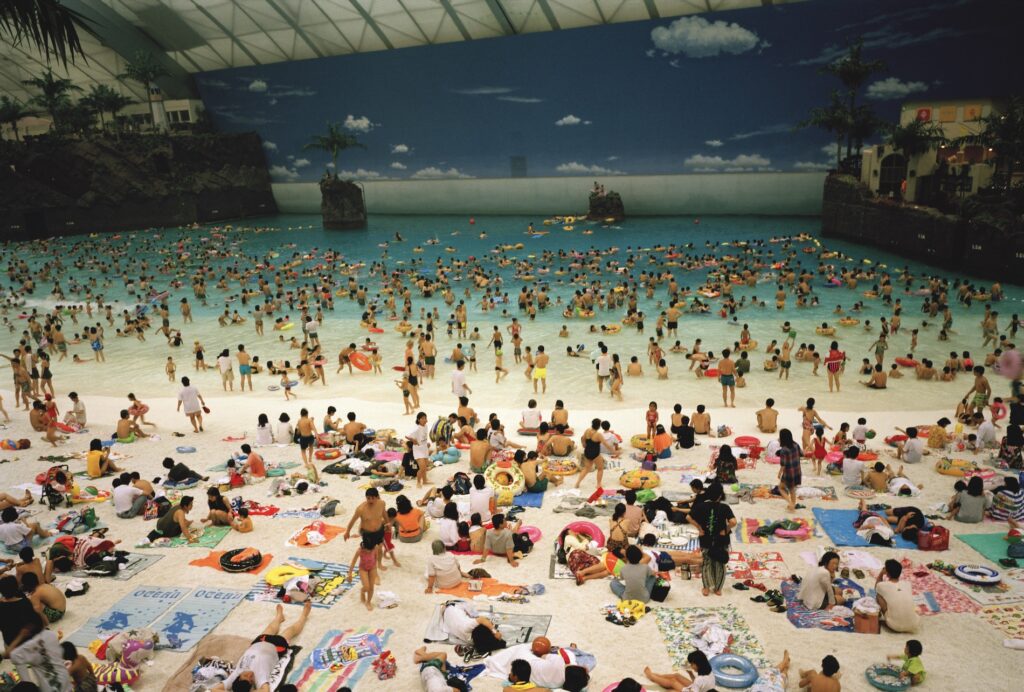
Tourists in socks-and-sandals, crab-red Britons compressed on crowded beaches, plates dribbling photographed with flash like culinary crime scenes… The photographs of the English photographer who died at 73 have now become part of our collective imagination. From The Last Resort (1983-1985), the foundational series made in New Brighton, a seaside town near Liverpool, capturing working-class families out for a good time, to Benidorm (1997), where bodies seem swallowed by concrete, Martin Parr made us laugh. Often with a yellow tint. But his seaside series marked a decisive aesthetic turning point in the world of photography. As early as 1982, he adopted color in a documentary field still largely dominated by black and white. A choice then considered vulgar, which he radicalized by using flash in broad daylight, crushing bodies and details to better reveal the violence of mass leisure.
But as we still search for a distinctly British irony in the photographer’s work, the exhibition “Global Warning,” presented at the Jeu de Paume in Paris until May 24, dismantles a lazy reading of a mocking photographer with easy banter. Co-designed by Quentin Bajac, director of the Jeu de Paume, in close collaboration with the artist, it gathers nearly 180 photographs from the 1970s to the 2020s. The curator and art historian explains: “It was about stepping off the beaten path and not showing only the iconic images. And, without making a retrospective, we wanted to represent all periods of Martin Parr’s work, notably his work of the last fifteen years.” The themes are those that have always inhabited the photographer: mass tourism, technological addictions, relation to animals, transformation of contemporary landscapes – a gaze that has always been nourished by his parents’ passion for ornithology and the great outdoors. “Global Warning,” or “Global Alert” in French – a nod to global warming – offers a rereading of the work in light of contemporary disorder.
Photographing without a Superior Gaze
To understand Martin Parr, one must go back to his career and his origins. As a teenager uneasy in the school setting, Martin Parr was not a “good student,” but he already clung to a marginal ambition: to become an art photographer, at a time when photography was almost exclusively divided between reportage, fashion, and advertising. He discovered the medium thanks to his grandfather, a passionate amateur photographer, who introduced him at a very young age to the meticulous observation of reality.
Born into the British middle class, Martin Parr has always spoken from within the crowd. “He was a photographer of the middle class photographing the middle class. The beach and tourism were part of his own practices. He photographed from the inside,” explains Quentin Bajac. “He absolutely refused any superior vantage, which he hated and distrusted.” The artist himself had confided: “I am part of the problems I photograph. I am not a moralizer. I do not propose solutions. I show without seeking to prove.” His refusal to moralize is probably what makes his work so universal. “He was never judgmental. Otherwise, it would not have produced great works”, insists Wendy Jones, biographer, who collaborated with the photographer on the book Completely Lazy and Absent-minded (Michel Lafont edition, 2025).
His images leave space: anyone can enter and project their own reading onto them. And his humor, although devastating, is never gratuitous. “He used humor to capture the viewer’s attention and prompt reflection on situations, issues, and problems”, explains Quentin Bajac. The laughter acts as a trap: one thinks one is mocking, before realizing that one is looking at oneself.
“We crash into the wall, all together”
This approach would earn him for a long time the misunderstanding of his peers, including within the prestigious Magnum Photos agency, which he joined in 1994 after heated debates. At the time, the world of photography was still dominated by a polished, serious aesthetic, considered noble. “What created tensions at Magnum was mainly that its culture was very different from that of its elders, cuts in Quentin Bajac. Martin Parr himself summed it up with disarming causticity: ‘My frontline is the beach.’” He was criticized for cynicism, for a taste for the grotesque, for his refusal to heroize. What his peers fail to understand is that the artist did not seek to capture the “beautiful.” He aimed for accuracy by showing lived experience, without ironic distance and without fetishization. Where others aestheticize misery or sanctify the margins, Martin Parr documented our contradictions. Dissents that would not prevent him from presiding Magnum from 2013 to 2017.
View this publication on Instagram
Sophie Brennan