
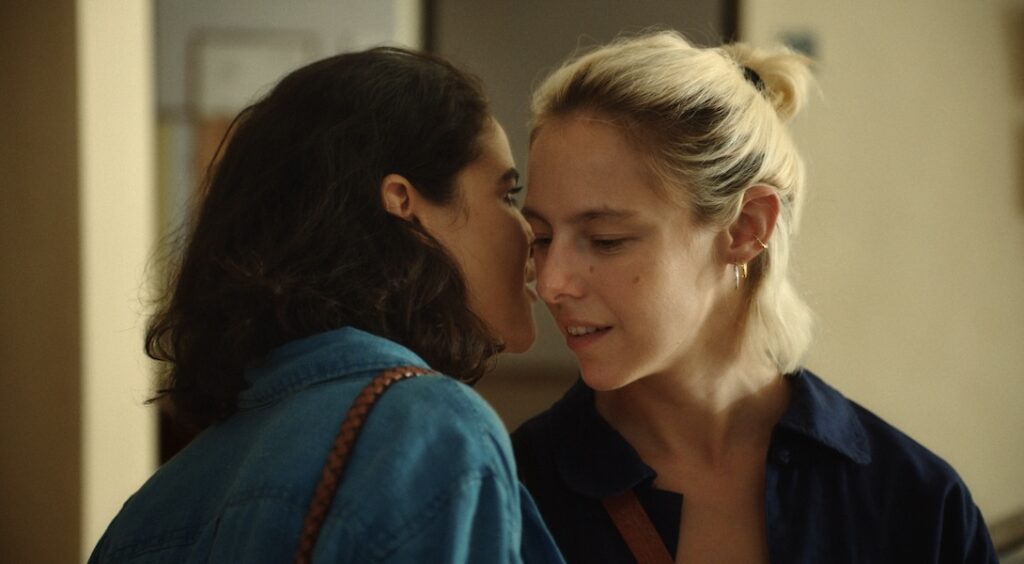
Five years after A Tale of Love and Desire, the director Leyla Bouzid returns to her native Tunisia with In a Low Voice, in cinemas this Wednesday, April 22. A particularly rich mourning narrative where the weight of traditions, repressed sexuality, and ghosts of the past intertwine.
In In a Low Voice, the new feature film by the Franco-Tunisian filmmaker Leyla Bouzid (A Tale of Love and Desire) in theaters this Wednesday, April 22, everything begins with a death – that of Daly, found dead in the street, half-naked. Lilia, his twenty-something niece who has lived in Paris for several years, returns to Sousse, Tunisia, for the funeral. She quickly notices that all members of her family, starting with her own mother, do not want to dissipate the fog around the circumstances of her uncle’s disappearance. Faced with this general avoidance, the young woman embarks on a quest for truth with risks to her future and her relationships with her family.
Lilia did not come to Sousse alone but with Alice, her girlfriend, whom no family member knows exists. Or, if they know, it’s as her “roommate” in Paris, who came to lend her support during the mourning. When she realizes that her uncle was homosexual in the closet, Lilia cannot help projecting her own story onto his. Yet, after internal tumult that sometimes rocks her relationship with Alice, the young woman arrives at a conclusion: she will not conceal her lesbian identity.
An Open Secret
In a Low Voice was born from a very personal desire of Leyla Bouzid to tell part of her past. “The film is inspired by my uncle’s life, she continues. Even if my family history carried even more violence than what we see on screen, I wanted Daly’s life not to be merely sacrificed but to serve someone else, to Lilia. It’s a story about how we prevent history from repeating itself, how traumas can become a strength rather than a weight.”
When one reads the official synopsis of the film as displayed on Allociné, nothing forebodes that it is a story about homosexuality. “The choice not to reveal this aspect of the story was made to maintain a neutral gaze, explains the director. So yes, it remains a film about family, about how to be oneself within one’s own family. But I think a segment of people would not go to see it if they knew it spoke about homosexuality, yet I want it to be visible to the broadest possible audience for the message it carries.”
An Untold Lesbian Heroine
In Tunisia, homosexuality is penalized, with a sentence that can go as far as three years in prison. However, and this is also what In a Low Voice shows in a key scene with the local police, female homosexuality is not taken seriously and also suffers from a glaring lack of representation. To address this, Leyla Bouzid aimed to offer generous and sensual images of cinema, far from clichés and devoid of modesty: “I make cinema where characters exist with their flesh, their desire, it’s something that lives in my films. I could not skip their physical attachment. It had to be felt and above all that we could see the strength of the desire that binds these two characters.”

The director shares her broader aim to show on screen queer people and their community: “These are people who accept their identity but must be in permanent vigilance. It was important to show that these individuals exist and to show them. Moreover, some truly queer people agreed to appear in the film… and not necessarily in queer roles!”
The death of Daly and her almost phantom-like presence throughout the film allow In a Low Voice to blend several strong issues: police repression, the weight of traditions and religious conservatism, the transmission of shame within a family… For all that, the director chose to keep a part of light: “It is a film deeply rooted in Tunisian culture that is not a culture of individualization, so I had to preserve the familial aspect while being a bearer of hope. The ending is an invitation to form a family, to show that we can live together. It is a proposal of possibility.”
