
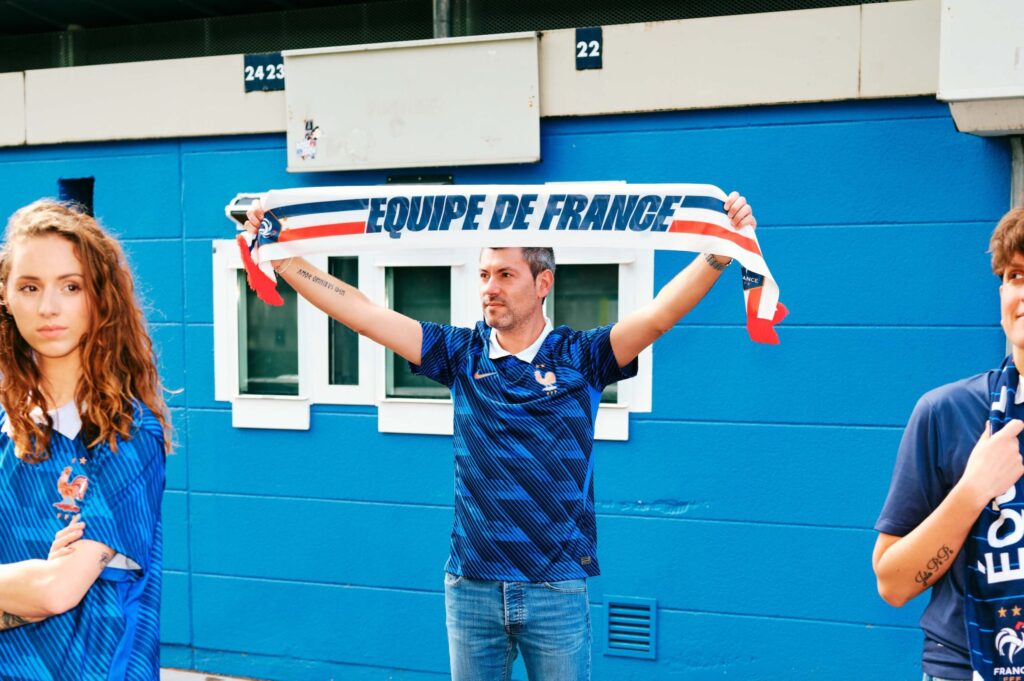
[Article to be found in the summer magazine, on newsstands or by subscription.] Who said that gays don’t love football? President of Bleus et Fiers, the only LGBT+ supporters’ club affiliated with the French Football Federation (FFF), Jean-Baptiste Montarnier will follow this summer’s France team in North America, just as he did in Qatar. He tells us about his passion for football and his Sisyphean battle against homophobia.
Photographie : Guillaume Blot for têtu·
Jean-Baptiste Montarnier knows French stadiums by heart: the Blues’ away trips, the flares brandished in the stands, the chants that rise before kickoff… and the insults that fly a little too quickly. Born in Le Creusot, in Saône-et-Loire, into a family more into rugby than football, he now lives in Paris, which is rather convenient for a PSG supporter subscribed to the Parc des Princes.
At 43, the president of Bleus et Fiers breathes football. Yet, at 15, he stops playing when he realizes that his attraction to men is not limited to the beauty of their penalties. “I didn’t feel at home anymore,” he confides to us. “There was all that macho side that we still see today, and the homophobic insults that went with it. ‘We’re not fags,’ ‘it’s a fag’s shot’…” Very quickly, the teenager tells himself that silence would be safer than coming out. The homophobia he describes isn’t always frontal. It’s diffuse, banalized, so integrated into the football backdrop that it ends up invisible to those who produce it. “People always tell you: ‘It’s not serious, it’s folklore’, he continues. Sey that when you’re 13 and you hear this all the time, you quickly understand that you must not talk about it.” It would take him more than ten years to truly come to terms with himself. In the meantime, he dated girls to try to fit in with “normality”.
“It’s not possible that there aren’t any gay players”
Once the cleats are hung up, Jean-Baptiste nevertheless keeps going to the stadium, following PSG and the French team. With, despite everything, this persistent feeling of loving a milieu that doesn’t seem to love you back in return. Even today, he finds it hard to see where the progress regularly boasted by French football actually is. In the stands, homophobic chants remain frequent. And on professional men’s pitches, no top player currently active has publicly come out in France. “Mathematically, it’s not possible that there aren’t any gay players”, he sighs.
Jean-Baptiste, for his part, no longer tries to play it discreet. In the stands or in bars, he goes to see supporters who roar homophobic insults, introduces himself, calmly explains that he is gay and asks them to stop. Most of the time, he says, the exchanges go surprisingly well. “People often say they hadn’t realized.” A phrase that fairly well sums up French football’s relationship to homophobia: ubiquitous, but banalized.
But sometimes, the violence spills beyond mere “folklore.” During a France-Israel match at the Stade de France in the Nations League, with the boy who accompanies him, they are targeted for holding hands in the stands. “We were called ‘PD’. The craziest thing is that security officers wanted to eject us because we were ‘provoquing’ the French supporters”, he recalls. Jean-Baptiste alerts the leaders of the other supporter groups on their common WhatsApp group. “I wrote: ‘Careful, they want to kick me out of the stadium.’ And everyone showed up.” In the end, it was the insulters who were expelled from their supporters’ club.
It is precisely to avoid being isolated in such situations that he founded Bleus et Fiers in 2018, upon returning from the World Cup in Russia. In French stands, he heard the same insults and the same heavy jokes, but he also met other LGBTQI+ supporters who told him they avoided certain groups for fear of rejection. The club idea was born there: to create a space where queer supporters can exist without having to shrink away.
The disappearance of the rainbow
Today, the association brings together a small hundred members from all over France. Bleus et Fiers operates like any supporters’ group: trips, matches, endless discussions and good-natured rivalries. “One of my best friends is from Marseille”, jokes Jean-Baptiste. If a PSG-OM friendship exists, it proves that anything remains possible.
The association is now the only one affiliated with the French Football Federation (FFF), a recognition formalized in 2022 after several years of administrative ambiguity. Bleus et Fiers thus now benefits from the same provisions as other groups: access to ticketing, shared seating, direct exchanges with the Federation. Still cautious on LGBT+ issues, the FFF nonetheless organizes a Pride Tournament around May 17, the International Day Against Homophobia.
The overall situation remains far from rosy. Jean-Baptiste even judges the situation “on the decline” in Ligue 1. He notably points to the progressive disappearance of rainbow symbols in campaigns by the Ligue de Football Professionnel (LFP). After jerseys and then badges, the LFP replaced in 2026 the rainbow flocking with a broader and indistinct campaign against “all discriminations”. Thus, during the last 31st matchday of Ligue 1, the players wore simply the victims’ first names on their backs, without specifying whether they referred to racism, homophobia, or sexism. “Saying we fight all discriminations without specifics doesn’t mean anything anymore, he protests. If you want to hide the subject, you can’t do better.”
“In France, people always say it’s too complicated”
For Jean-Baptiste, the persistent impunity of homophobic chants in French stadiums sums up the situation quite well. “In England, in case of a homophobic chant, you identify the person who started it and they are banned from the stadium for five years, and sometimes for life. In France, people always say it’s too complicated.” Yet, he recalls, effective tools are available: stopping the match, playing behind closed doors, disciplinary sanctions, stadium bans. “The arsenal exists. It just needs to be applied.”
The president of Bleus et Fiers looks with envy at the other major European football nations. “In Germany or England, there is an LGBT+ group almost in every club”, he notes. Arsenal has its Gay Gooners since 2013, while the England team relies on Three Lions Pride during international competitions. “You watch a Premier League match, you see rainbow flags in every stadium!” In France, no equivalent has yet emerged in Ligue 1, and the rainbow does not enter the stadium.
The year 2026 is naturally important for the supporters’ club: there is a World Cup! The tournament is hosted by the United States, Canada and Mexico. Several European groups have already announced that they would not display visible presence in Donald Trump’s country, citing concerns about the rollback of LGBT rights. About twenty Bleus et Fiers members, however, plan to travel, as they did in Qatar. “Not going would be giving them reason,” argues Jean-Baptiste. In Doha, he did not bring his flag into the stadiums, “to be sure to get in and watch the match”, but he unfurled it at a FIFA-organized fans’ gathering. “The aim, above all, was to show that we exist.”
