
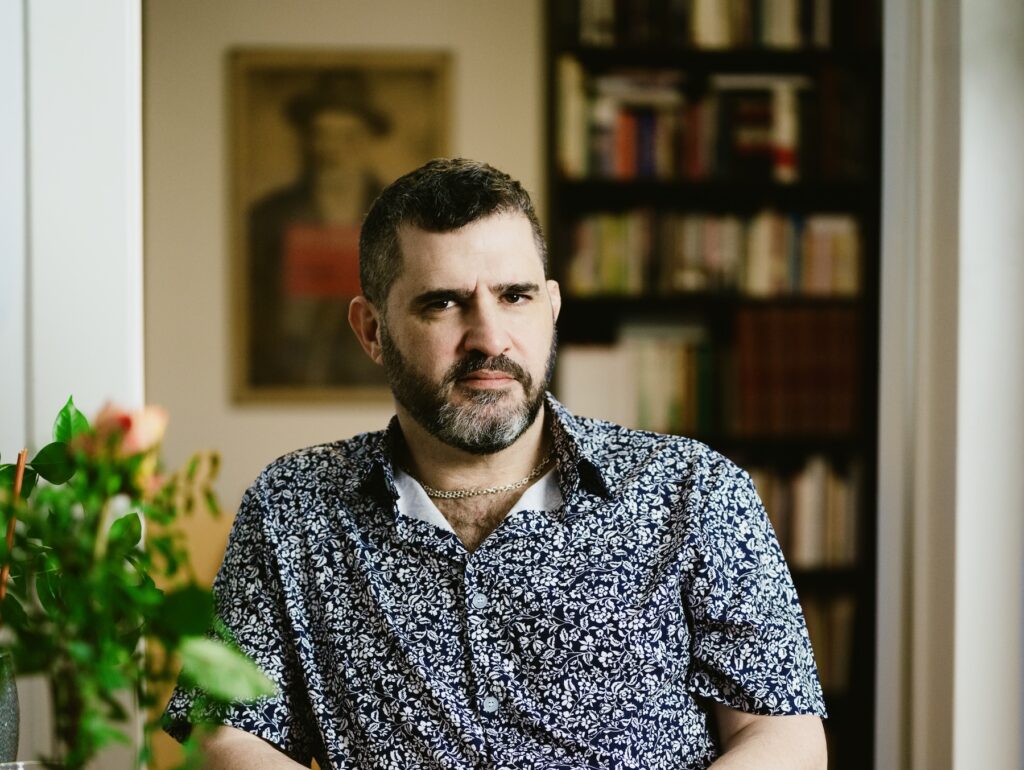
In The Gorilla, published by Grasset, the Israeli poet and translator Dory Manor, based in Berlin, recounts his childhood with a father who was a bodyguard to high‑ranking politicians. In this autobiographical narrative, he explores family secrets, the discovery of his homosexuality, exile, and the legacy of a masculinity he has spent his life trying to cast off. We met him during his visit to Paris.
How does one construct themselves as a gay poet when growing up in the shadow of a “gorilla”? In the book whose title comes from this nickname, published this spring by Grasset, Dory Manor recounts his childhood with a father who was as charismatic as he was crushing, who was the bodyguard of Israeli leaders, in a family where secrets circulate more freely than feelings. A gay teenager in an environment dominated by codes of masculinity, he finds an outlet in French literature, discovered thanks to a teacher who will change his life. Written in the language of Baudelaire and Apollinaire to better free himself from the patriarch, The Gorilla is at once a family narrative, a story of emancipation, and a meditation on exile. For têtu·, Dory Manor, now settled in Berlin with his partner and their one-year-old daughter, looks back on his journey from Tel‑Aviv to Berlin, via Paris, and on how literature allowed him to build himself beyond borders and the cult of traditional virility.
In The Gorilla, you revisit your childhood, your family, and the milieu in which you grew up. What perspective do you have today on this world?
Dory Manor : When I think back on it, I see a family devoted to secrecy, almost to clandestinity. The secret concerned not only my parents’ professional activities, who worked in Israeli security. This culture of secrecy had contaminated all of family life. For me, it was poison. I’m still trying to understand this mechanism. Writing the book helped me digest certain things better. And then I became a father. My daughter is one year old today. This experience has allowed me both to better understand my parents and, paradoxically, to understand them even less. I think especially of the episode I recount in the book: they left for Africa for a month when I was only three weeks old. When my daughter was that age, I would not have been able to leave her for an hour. So four weeks… That remains unthinkable to me. The Gorilla is neither a book of vengeance nor a book of rage. It is a book of repair. It recounts, in particular, the path that brought me closer to my father at the end of his life.
One does not expect the reaction of your father when he learns of your homosexuality: against all odds, he welcomes your partner as a son.
Me neither, I did not expect it. It was at that moment that I understood that something deep had changed in him. It took me years before I could forgive him and reopen dialogue, but I understood then that he was no longer the same man. At first, I tried to find simple explanations. I told myself that age might have softened him. But it was much deeper than that. He showed me that a human being can change. I also think of the memory of his uncle, gay, who committed suicide in the 1940s. Perhaps that played a role. I will never know. But there was also the evolution of Israeli society. In the 2000s, the country was no longer that of my childhood.
Precisely, how has the situation of LGBT people evolved in Israel? Tel Aviv presents a very queer-friendly image.
From the mid-1990s, Tel Aviv indeed became a very queer city. Gays and lesbians were highly visible there. Pride became a municipal project. Rainbow flags were everywhere. There were artists, writers, singers openly homosexual. When I was a teenager, there was practically no representation. By the late 1990s, it changed very quickly, faster in Tel Aviv than in Paris. The generation that followed mine finally had role models.
Is Tel-Aviv’s case, in your eyes, used for Israeli “pinkwashing”?
Yes, because that reality was used to mask other realities. The government highlighted this modern and tolerant image because it was profitable in terms of international communications. But when you looked at Israeli Palestinians, trans people, refugees, or foreign workers, the reality became much less flattering. All these populations endured discrimination that remained invisible in the official narrative. Even today, as Gaza is destroyed, press trips are still organized to praise Tel Aviv. It no longer makes any sense.
Your confinement in psychiatry when you were a teenager is a landmark episode in the book. You recount how you were taken by force while listening to Kate Bush in your room…
I think my parents mainly saw a teenager who was not doing well. I was depressed, I wasn’t going to school anymore, they didn’t know what to do with me. They thought they had found a solution. Homosexuality probably played a role, but indirectly. My parents didn’t know I was gay. I hadn’t fully articulated it myself yet. On the other hand, the psychiatrist did understand it perfectly. I came across a very influential figure in Israeli psychiatry, a man who waged a crusade against homosexuality. I believe that because of people like him, homosexuality continued to be treated as a psychiatric problem in Israel long after its decriminalization.
This period also marks your discovery of French. Why did this language become so important to you?
French represented a total detour. I did not know anyone who spoke it. Then I met an extraordinary teacher who transmitted to me the love of French literature. I began reading Baudelaire, Apollinaire, Rimbaud, with a dictionary in hand. I translated every word, every sentence to understand. Little by little, this activity became a profession. For twenty years, I earned a living by translating French literature into Hebrew. French gave me another world. It allowed me to build an identity that escaped the categories into which people wanted to place me.
Is translation also a way of inhabiting several countries at once?
Yes, or of inhabiting none. Today, I live in Berlin. I have German citizenship, but I am not German. I never felt entirely French either when I lived in Paris. As for Israel, I was born there, but I no longer recognize myself there. My true homeland is literature.
Your departure from Israel for Berlin, in 2019, is political?
I was very politically engaged but the country was hardening dramatically. Many artists, writers, filmmakers, and intellectuals left Israel before me, then after me. I was also personally targeted. I lost a position as editor-in-chief for political reasons. Later, while I hosted a radio show, I began to experience forms of censorship. The atmosphere was becoming more and more openly racist. It is at that moment that I decided to leave.
Why Berlin? What did you find there as a gay man, a writer, and now a father?
Berlin remains a deeply queer city. I feel at home there, even if it wasn’t love at first sight as Paris was when I arrived. As a parent, though, it is extraordinary. The city loves children. The infrastructure is everywhere, and same-sex parent families are extremely visible. My daughter’s nursery has almost as many gay or lesbian parents as heterosexual parents.
Since October 7, 2023, LGBT Jews have said they feel marginalized in queer spaces. Do you observe the same in Germany?
Personally, no. I have participated in demonstrations against Israeli policy without ever being rejected because I was Israeli. People knew who I was and accepted me because I was part of that protest. That said, when I hear antisemitic remarks in certain activist circles, it makes me furious. There is sometimes confusion between legitimate criticism of Israel and recycling old antisemitic clichés. It is especially painful when it comes from the left. In Germany, the situation is different for historical reasons. The accusation of antisemitism is sometimes used so expansively that it also targets Jews who are critical of Israeli policy.
Where do you stand today regarding Israel?
I left Israel for political reasons. When I look at what is happening today in Gaza and the Palestinian territories, my dominant emotion is shame. It is the country where I grew up. I am deeply attached to it. But I no longer recognize it. I still have friends and family there, and I stand in solidarity with them. But we must face reality: today, Israel is not the victim. It is the aggressor. I am not very optimistic about the future. I simply hope that a change will become possible.
