
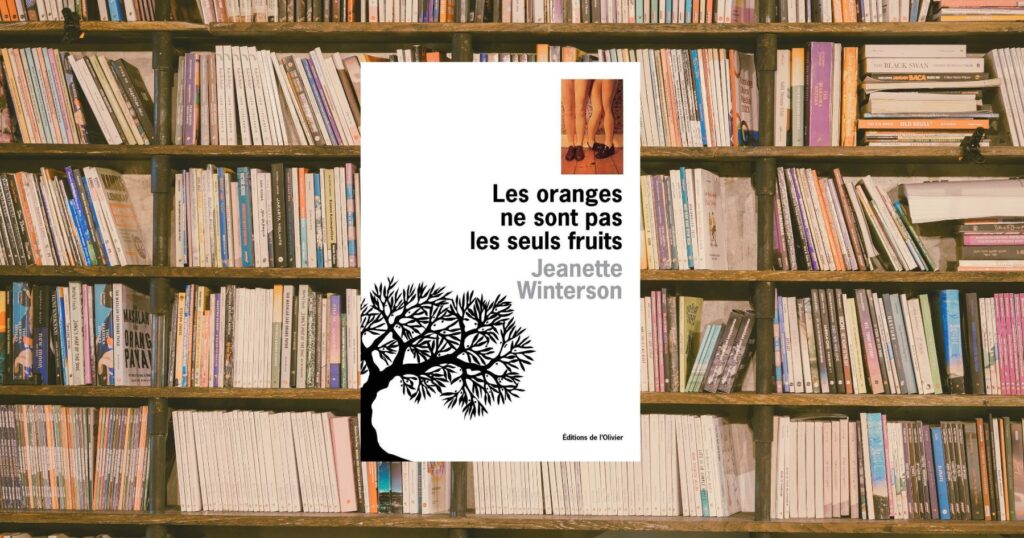
Having become a classic of lesbian literature, Oranges Are Not the Only Fruit draws on Jeannette Winterson’s childhood to tell the emancipation of a teenage girl raised within religious fundamentalism. A must-pack novel to slip into your suitcase this summer.
“Every life is a rewriting; we reinvent ourselves by telling our story.” Half a century before this interview published in Vogue, Jeanette Winterson was born in Manchester in 1959. She was adopted six months later by the Wintersons, a Pentecostal couple from Accrington, a working-class town in the north of England. “My father loved watching wrestling matches, my mother, she loved to wrestle; it didn’t matter against who or what. She was always ready to climb into the ring”, writes the author in the incipit of Oranges Are Not the Only Fruit.
First published in 1985, it is the writer’s first semi-autobiographical book, which sets the scene of a childhood under the authority of a stern, unloved and, all too often, abusive mother. A domestic tyrant who tolerates only the Bible for reading, and whose sole ambition is to turn her daughter into a Christian missionary.
While she often complies with the education and beliefs of a matron who seems straight out of a Roald Dahl novel, the young Jeannette is a bright child, endowed with a strong spirit of contradiction and a capacity to live on the margins. She develops a passion for books very early, which she hides under her mattress. A stratagem whose discovery will provoke an auto-da-fé of the enraged prude.
Autofiction
Is this cruel tale pure fiction or reality? Both? The writer does not untangle. Continuing this literary project of autobiographical rewriting, she published, nearly thirty years later, in 2012, Why Be Happy When You Can Be Normal? Here, she revisits her story more openly, this time without the makeup this time of a fictional narrative. She writes there: “People often ask me, in the manner of multiple-choice questions, what is ‘true’ or ‘false’ in Oranges. […] I am unable to answer these questions. I can say that in Oranges there is a character nicknamed Elsie-the-Miracles, who sometimes takes care of little Jeannette and serves as a porous shield against Mother, the force-born. I created this character because I could not bear that she not be in the story. I created her because I would have wished that things would go this way.”
Could this novel, for Jeanette Winterson, be an attempt to forge false memories, to negotiate with her traumas by outmaneuvering a heritage too heavy to bear? “The problem with a book is that you never know what it contains until it’s too late”, teases the opening of Why Be Happy… The answers belong to the author. It remains a foundational novel, which continues to touch the queer soul with its biting humor and its breath of gentle tenderness despite its subject. A success from its first publication, the novel was adapted in 1990 by the BBC. Last year, The Times announced the preparation of a musical adaptation across the United Kingdom by the Royal Shakespeare Company. The message remains relevant: oranges are still not the only fruits.
