
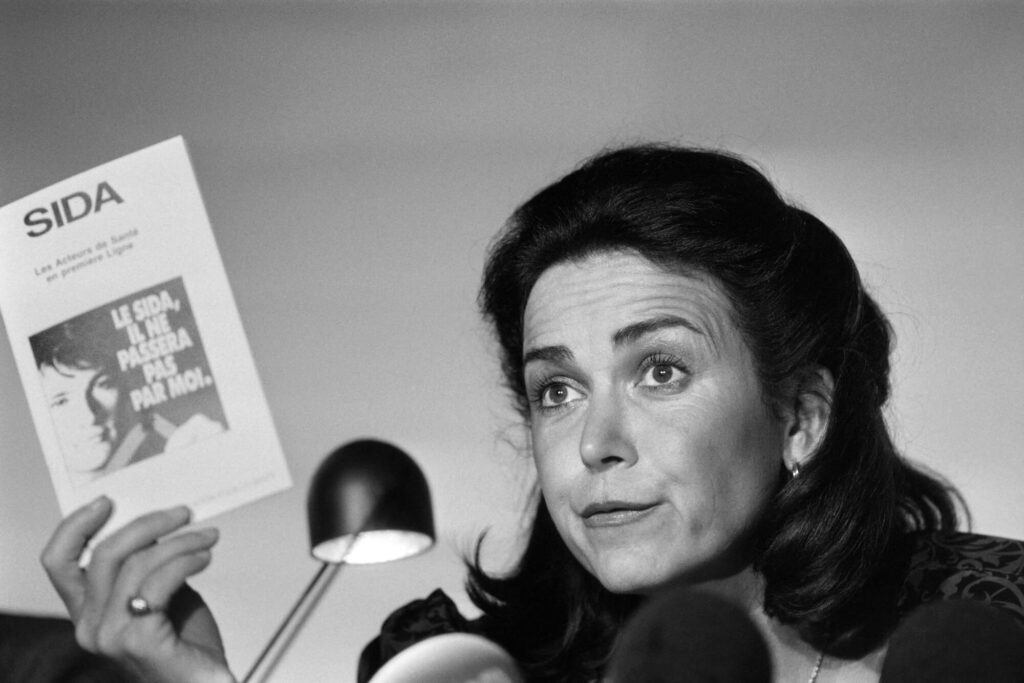
Jacques Chirac’s Minister of Health from 1986 to 1988, Michèle Barzach died at the age of 83. In the midst of the AIDS epidemic, this right-wing woman had imposed several decisive measures for HIV prevention, in contrast to the repressive and stigmatizing discourses of the time.
She had made the condom a public health issue, at a time when its advertising was still prohibited. Michèle Barzach, minister of Health in Jacques Chirac’s cohabitation government from 1986 to 1988, died this Monday, October 26, in Paris, at the age of 83, from a stroke. Trained as a gynecologist, this figure of the social right will be notably associated with the first major public policies to fight HIV/AIDS in France.
Born in 1943 in Casablanca, Morocco, to a Jewish family, Michèle Barzach grew up in an environment that, she would say later, helped her understand the fragility of the female condition. She went to study medicine in Paris and became a gynecologist. In the 1980s, she joined the Rally for the Republic (RPR), the Gaullist party founded by Jacques Chirac, of which she became national delegate for social affairs before entering the government. In March 1986, when she was named Minister of Health, the epidemic was ravaging, particularly among gay men.
Prevention of Prejudice
Faced with the progression of infections, Michèle Barzach makes several decisions that break with the taboos of the time. She notably sees a reform adopted authorizing advertising for condoms, previously prohibited, promulgated in January 1987. The minister also launches large national information campaigns on AIDS. In January 1988, assessing her action, she states that 58% of gay or bisexual men had used condoms in 1987, compared with 35% in 1986.
Another major decision: in May 1987, she authorized the free sale of syringes in pharmacies, without a prescription. A measure aimed at limiting infections among users of injectable drugs, who until then had to present a medical prescription or disclose their identity to obtain them. Upon the announcement, a federation of pharmacists’ unions demanded a “conscience clause” allowing their members to refuse to dispense syringes to drug users. Michèle Barzach upheld her decision. The decree bearing her name constitutes a foundational act of France’s harm-reduction policy.
Le Pen and the “purveyors of fear”
The strongest oppositions come from the far right. While the National Front (FN, later Rassemblement National) calls for coercive measures against HIV-positive people, its deputy François Bachelot proposes the creation of “sidatoriums” to isolate the patients. On May 6, 1987, on Antenne 2, Jean-Marie Le Pen compared people with AIDS to lepers and claimed that HIV could be transmitted by sweat, tears, or saliva. A week later, Michèle Barzach answered him in the National Assembly: “Yes, Mr. Bachelot, Mr. Le Pen, AIDS is scary! But you scare me even more with your excesses and demagogy.” She then accused the FN leaders of being the “purveyors of fear”.
In June 1987, the minister also opposed the amendments by the far-right deputy François Bachelot aimed at challenging the scheme of anonymous and free testing. She instead defended the development of voluntary testing, with respect for medical confidentiality. In October, before representatives of 128 countries gathered in Paris for an international symposium, she stated that no measure should lead to “the exclusion of patients or to systematic and mandatory testing of the population”. In January 1988, she announced the opening of at least one anonymous and free testing center in each department, in accordance with a law passed the previous summer. In a briefing presented to the Council of Ministers, she insisted: “Testing is and must remain voluntary in some cases but always systematically offered, freely consented, and covered by medical confidentiality.”
Her tenure at the ministry earned her strong media popularity but also enmities within her own camp. Elected as a deputy for Paris in 1988, then as an assistant to the mayor of the capital, Jacques Chirac, she opposed notably Charles Pasqua, whom she denounced for his “rightward drift”. She left the RPR in 1990. After stepping back from political life, Michèle Barzach continued her commitments in health and humanitarian work, notably with Doctors of the World and the World Health Organization. She also chaired a foundation supporting access to care for women and children in sub-Saharan Africa, then UNICEF France from 2012 to 2015. Although her time in government lasted only two years, some of her decisions durably changed the fight against HIV/AIDS in France.
