
[Article to be found in the autumn issue, at your newsstand or by subscription.] Have sexual preferences become identities? On dating apps and networks, the injunctions to move beyond the active/passive labels, deemed limiting or immature, multiply. To the point of making versatility a new norm?
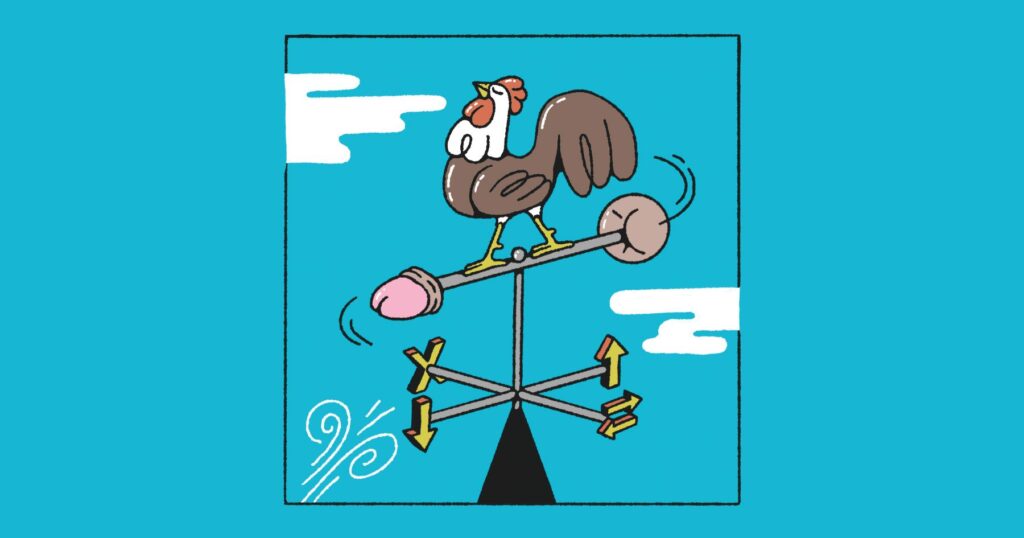
Illustration: George(s) for Têtu
“Active or passive?” This perennial question is an integral part of the lexicon of gay dating apps. Some even choose to save time by defusing it from the outset, displaying on their profile their preferred sexual role. This sometimes hinges on a simple arrow: up for tops, down for bottoms.
Active and passive preferences obviously did not wait for Grindr to exist in Sodomiland, but apps have given these preferences unprecedented visibility. Where they were once private, they now appear at the same level as height, age, or profession. By turning tastes into categories, apps facilitate encounters, but also give the impression that everyone should pick a side. This is what annoys Jordan, 32, convinced that “to consider only this data in the equation marks a narrow-mindedness” and who finds “it’s a shame to reject someone on this sole criterion”. The same caution is echoed by Fouad, 29, who sees in it a reproduction of a heteronormative pattern: “As if a relationship between two men had to be penetrative, with one playing the man and the other the woman. It’s outdated!” Luke, 26, pushes the reflection further. “As gay guys, we can do anything, so why limit ourselves? It would be stupid to miss out on a beautiful connection just because we’re not open enough sexually.”
My preference, mine
The versatile ones would have understood everything. The others would be narrow, heteronormative boys, trapped in their habits… even immature and selfish. All that! But since sexual roles occupy such a place in gay exchanges, it’s also because among men, penetration implies a certain complementarity. It is to avoid incompatibilities that Thibault, 33, prefers to clearly display his preferences. “I’ve tried both positions and I know today that I am exclusively passive, he explains. I am open to the idea of exploring more in the long term, but at the start of a relationship, I don’t want to compromise on what makes me get going.”
Unlike the traditional heterosexual script, where the division of roles is largely assumed, among men, assumptions rest more on stereotypes of masculinity. Pierre, tall Congolese man of 41, willingly specifies on his profiles that he is passive, in order to defuse projections. “Many assign sexual roles based on appearance and many automatically imagine that a man like me will be active.” In addition to these clichés, there are also prestige dynamics. In the gay collective imagination, being active remains often associated with a valorized masculinity, while many passives still recount having suffered “bottom shaming,” the devaluation of partners considered less virile.
But what happens when a preference becomes an identity? We move from “I like being penetrated” to “I am passive.” An intriguing shift to examine in the course of endless discussions, but must we necessarily view it as a confinement? “One must trust people to know what they like, dismisses the sexologist doctor Patrick Papazian. Tant qu’elles sont en accord avec leur sexualité et qu’il n’y a pas de souffrance, j’ai envie de dire : ’Circulez, il n’y a rien à voir.’”
That does not mean that everything is fixed. Sexuality remains a field of learning at any age and, like Taylor Swift’s albums, our preferences can go through several “eras.” Diego, 43, thus discovered he was passive late, thanks to a regular casual partner. “My position today depends on the connection I have with my partner. I’ve had periods where I was more active, others more passive, and others where I only slept with versatiles”, he explains. Fouad recounts a similar evolution: “My first partner was 100% active. That conditioned me a bit to be bottom. Then I met someone very kind with whom I could explore the role of top. It completely unlocked me.”
Fixed labels or customizable bracelets
Patrick Papazian notes that there is “a tendency to see a sexual label as an electronic bracelet that assigns us to residence. Or, to extend the metaphor, we should rather view it as a bracelet that we can change, customize, wear on one arm or the other…”
It remains to distinguish what we choose from what we deprive ourselves of. “I see patients who tell me they have always thought of themselves as passive but would like to be active. Yet they are self-conscious because they feel too small, not muscular enough or think their genitals aren’t big enough to permit it”, explains Patrick Papazian. His colleague Pierre Cahen refers to the opposite case: “I’ve had many patients who desired to be penetrated, but for whom the act proved painful. In these situations, psychological support or pelvic floor physiotherapy can lift certain blockages.”
Conversely, staying in the same position for life can be a freely chosen option as well. “Staying in the same role doesn’t mean getting bored, smiles Nicolas, 59. Being 99% active, I’ve explored, to vary pleasures, other practices I might not have discovered if I had changed position.” Jesco, 33, admits finding “a little sad” not to ever break free from his habits, before immediately adding: “If someone is 100% passive and perfectly happy like that, it’s their strict right. It’s even useful information for me: perhaps we are simply not meant to meet.” And if sexual freedom, above all, was that each person takes care of their own moon?
