
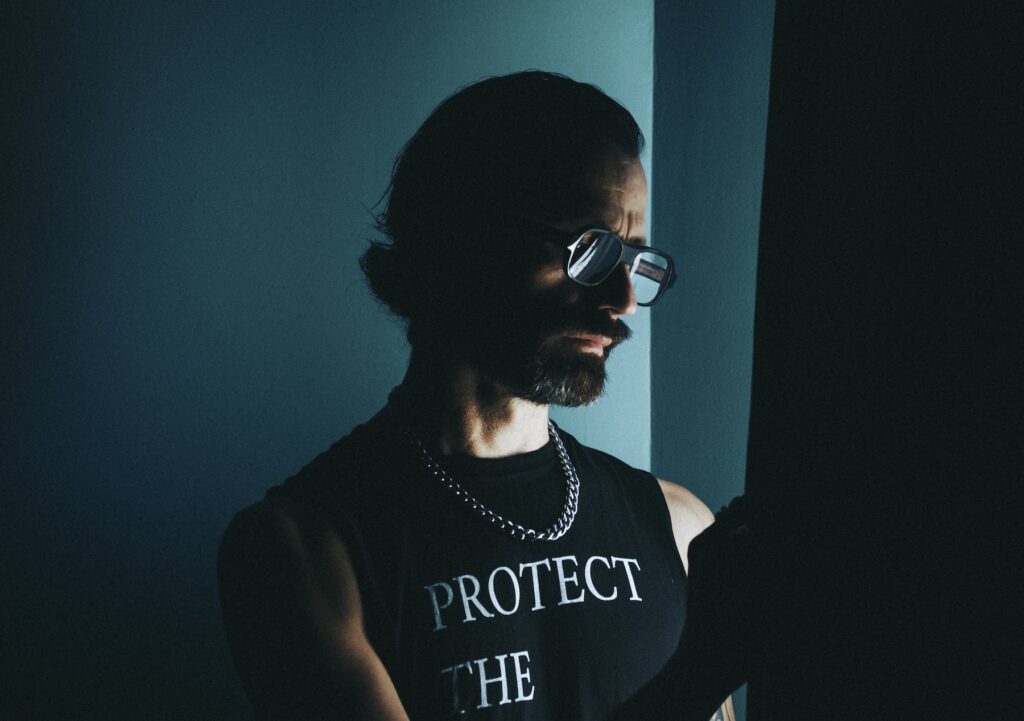
[Portrait to be found in the autumn issue, at your newsstand or by subscription.] With his second novel, I did not come to bring you peace (Le Diable Vauvert editions), Nicolas Martin mobilizes horror and the fantastic to lay bare patriarchal violence. For the former France Culture journalist, the imagination is both a refuge and a political weapon.
Photo: Antoine Doyen / Mirage Collectif pout têtu·
When we welcome him at his home in Paris, Nicolas Martin sums up in two sentences his relationship to fiction. And perhaps, as well, his literary project: “Imaginary monsters saved me because they allowed me to bear real monsters. And they allowed me to admit myself as a ‘monster'”. In Je ne suis pas venu vous apporter la paix, his second novel after Fragile/s, the journalist and writer thus makes the monstrous the revealer of the traumas left by patriarchal domination.
Like the rest of the Dorothée generation, the 50-year-old author first forged his imagination through anime from Japan. “In Goldorak, it was the golgoths that I loved, he recalls. I was always eager to discover the monster of the week.” At home, his parents nurture this fascination by introducing him to genre literature. His father passes on his taste for science fiction and fantasy, his mother for crime novels. “I think Agatha Christie planted seeds in me that I continue to cultivate today. Why do we harm others? Why does someone kill someone? What is malice?“
In the fifth grade, while he has not yet become aware of his homosexuality, malice ceases to be fiction. “That year, several things happen to me. I begin to be raped by my downstairs neighbor. I lose my grandmother, who was very important to me. And then, the other students at the school started beating me up.” He will publicly testify in 2021 about these rapes endured in childhood. Faced with these violences, the imagination becomes a refuge, a way to hold on. Later, after becoming a journalist, he continues to make reality and fiction dialogue. Including when he takes the helm of La Méthode scientifique on France Culture in 2016. “From the start, I said: ‘If we do a scientific program, we are making science fiction.’
Hell is with Our Own
At the moment of the debate on same-sex marriage, Nicolas Martin reclaims a vocabulary that is familiar to him: that of designating LGBTQI+ people as monsters or threats. He then engages in activist agit-prop. “I would go to Frigide Barjot while she spoke to the camera, and I would tell her: ‘You who defend the family, you are literally precipitating children into depression, into suicide. You have blood on your hands.’” In 2020, his columns “Radiographies du coronavirus” trigger against him a campaign of online harassment. After a burnout, he leaves Radio France to devote himself fully to writing.
In 2024, Fragile/s appears, “a novel in anger” in the face of the rise of the extremes. With Je ne suis pas venu vous apporter la paix, Nicolas Martin shifts the focus toward patriarchy. “The question of the book was: how do we break free from a model we have swum in for more than two thousand years?” Centered on a dying father watched over by a rebuilt-into-siblings brood, this family thriller tilts into horror and the fantastic when ancient forces resurface… Here, writing primarily serves to lift what is transmitted from one generation to the next. Patriarchal violence is not only that of one man: it contaminates relationships, shapes behaviors and ends up being reproduced even by those who seek to escape it. Nicolas Martin is precisely interested in this mechanism of transmission. How to break with a model whose rules one has learned oneself? How to build oneself when the family, supposed to be the first refuge, also becomes the place where domination relations are exercised? Horror is a means of giving a very concrete form to this inheritance.
For the author, these genres are never about a mere taste for the macabre. They offer a language to say what ordinary discourses sometimes struggle to grasp. “The body is the last boundary of the intimate”, he sums up. Body horror, with its metamorphoses, its hybrids and its excesses, stages what societies seek to discipline: desires, identities and the freedom to inhabit one’s own body. Their function is also cathartic. “Horror is harmless. Reading horror, watching horror, is harmless. Turning on the news is horror, but with no protection”, proclaims the man who is today working on a survival guide for queer children. The imaginary monsters that saved him are now the ones he entrusts to others.
