
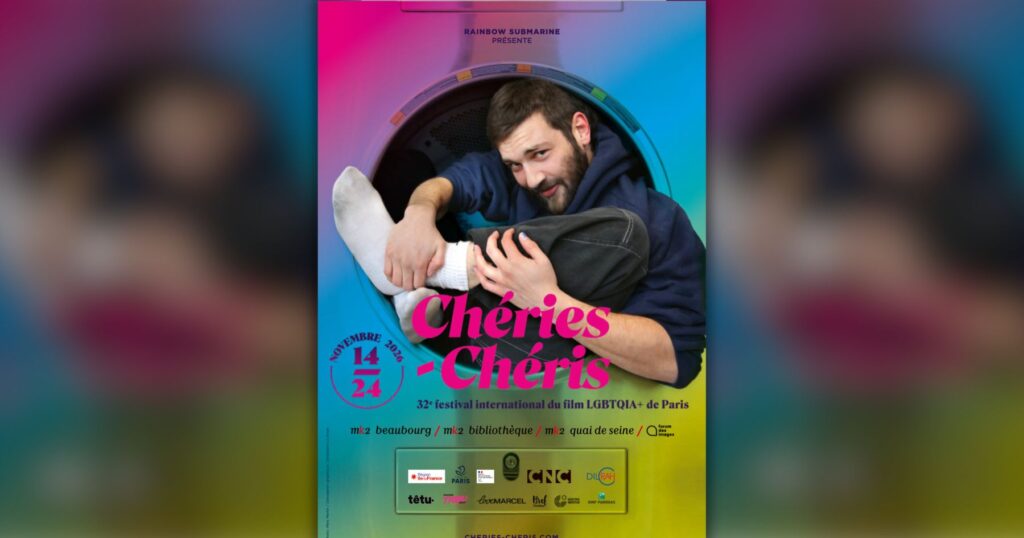
From 19th-Century Scotland to War-Torn Ukraine, via Tennis Courts and First Teenage Loves, here is our selection of films to discover at the LGBT film festival Chéries-Chéris in Paris from November 14 to 24, 2026.
Chéries-Chéris, the international LGBTQIA+ film festival in Paris, returns from November 14 to 24, 2026 for its 32nd edition, in the mk2 Beaubourg, Bibliothèque and Quai de Seine cinemas, as well as at the Forum des images. Between passionate romances, historical dramas, animated films, and intimate narratives, we have selected nine works not to miss at this cinephile rendezvous.
I Rarely Wake Up Dreaming, by Isabelle Stever
In Kyiv, Oleh’s gender transition upends his love story with Olya. A lesbian, she struggles to recognize herself in their relationship, now perceived as heterosexual. Then Russia invades Ukraine, and martial law bars men from leaving the territory. To reach Germany, must Oleh present himself as a woman at the border, even if it means denying his identity as a trans man? Shot in part in Kyiv, this Isabelle Stever drama avoids spectacle to capture the contradictions of its characters. Between marital quarrels and air-raid sirens, the war creeps into their intimacy.
The Education of Jane Cumming, by Sophie Heldman
Edinburgh, 1810. Jane Pirie and Marianne Woods run a boarding school for girls, far from any masculine guardianship. Until Jane Cumming, a mixed-race adolescent rejected by her peers, accuses them of having an affair. In this drama inspired by a true story, Sophie Heldman films a desire that dares not speak its name, before finally making clear the attraction between the two teachers. Yet behind the scandal unfolds a power struggle where racism, class contempt, and moral preconceptions intertwine. The director thus focuses on the accuser, a victim of the racism of a society whose prejudices she reproduces. A power play more devious than it appears.
Méli-mélo, by Leah Nelson
In the 1990s, Sarah, a queer illustrator, sees her life topple when her mother receives a diagnosis of Alzheimer’s disease. Returning to her hometown to be by her side, she tries to preserve their relationship while the memories of the one who raised her fade away. Adapted from Sarah Leavitt’s autobiographical graphic novel, Méli-mélo is a delicately crafted animated feature debut that precisely targets the exploration of memories and the unspoken within families. Thanks to its elegant black-and-white animation that puts emotion front and center, the film treats illness with infinite sensitivity without ever tipping into pathos.
Six Months in the Pink and Blue House, by Bruno Santamaría Razo
In Mexico in the 1990s, Bruno’s 11-year-old childhood is upheaved by two founding events: his first feelings for his best friend Vladimir and his father’s illness. Thirty years later, he revisits that period through a film that blends fiction and documentary. With Six Months in the Pink and Blue House, filmmaker Bruno Santamaría Razo turns his own memories into a poignant work about grief and how family ties evolve when past wounds are reopened. Moreover, it offers a moving look at the impact of HIV in the 1990s and the silences that surrounded it.
The Black Ball, by Javier Calvo and Javier Ambrossi
Across three periods of Spanish history, The Black Ball follows the destinies of three men confronted with the weight of social gaze, the wounds of the past, and the quest for a free identity. Inspired by an unfinished project by Federico García Lorca, the film by Javier Calvo and Javier Ambrossi (Veneno, La Mesías), which represents Spain at the 2027 Oscars, crafts an ambitious queer fresco on repression, memory, and community transmission. Beyond its star-studded cast that includes Glenn Close and Penélope Cruz, one remembers the film for its grandiose direction, overflowing with poetry, which moves us.
At the Top of the Pile, by Louis-Julien Petit
Arthur and Maxime are nearing thirty and have only one dream: to start a family. But between administrative and legal hurdles and the sometimes clumsy involvement of their relatives, their journey proves far more complex than they imagined. At the Top of the Pile moves beyond the simple societal debate around surrogacy and, more broadly, LGBTQ parenting, to tell, with much clarity, the struggle of two men determined to become parents. Carried by Aliocha Schneider and Anthony Bajon, surrounded by Alexandra Lamy, Yvan Attal and Corinne Masiero, the film alternates French-family-style humor and pure emotion to question new forms of parenthood without losing sight of the essential: love and the desire to transmit.
Forty Love, by Pierre-Ange Carlotti
At 21, Sacha Gallo has only one goal: to win his first major tennis title. But the arrival of a new rival unsettles his balance and gradually turns the competition into an unexpected attraction. With Forty Love, his first feature film, fashion photographer Pierre-Ange Carlotti unfolds an intimate sports romance where desire confronts family expectations, masculinity, and self-acceptance. Beautifully anchored by the duo Paul Kircher and Romeo Beckham, the film favors emotion over spectacle and even dares to venture into a slightly camp tone that lands.
Plainclothes, by Carmen Emmi
In the 1990s, Lucas, a young undercover police officer, is tasked with trapping gay men in public restrooms in order to arrest them. But when his mission leads him to meet Andrew, a genuine attraction upends his certainties and forces him to confront what he has always tried to repress. Long awaited, Plainclothes is at once a drama about shame and institutional homophobia and the blossoming of a first love that upends everything. It also gives us a chance to reconnect with Russell Tovey, unforgettable as a sexy boss in Looking and also in Years and Years.
Above the Noise, by Axelle Vinassac and Maël Caradec
Let us close this Chéries-Chéris selection with a special mention for the French short Above the Noise. Directed by Maël Caradec and Axelle Vinassac, it sits somewhere between fiction and documentary to depict the meeting between Maël and Émilie, two youths in the midst of a love-sick malaise who find comfort in each other’s arms, with the Paris 2024 Pride march as a backdrop. A film full of authenticity that valorizes the power of hope in moments of trouble, whether personal or societal. In other words, it arrives just at the right moment…
