
[Article to be found in the autumn magazine, at your newsstand or by subscription.] Chaotic schooling, repeated burnout, depression, addictions or relational difficulties… For years, our witnesses believed they were monsters of laziness, unstable, “broken,” before receiving, in adulthood, a diagnosis of ADHD and/or autism spectrum disorder. This notification profoundly changed their view of their own life.
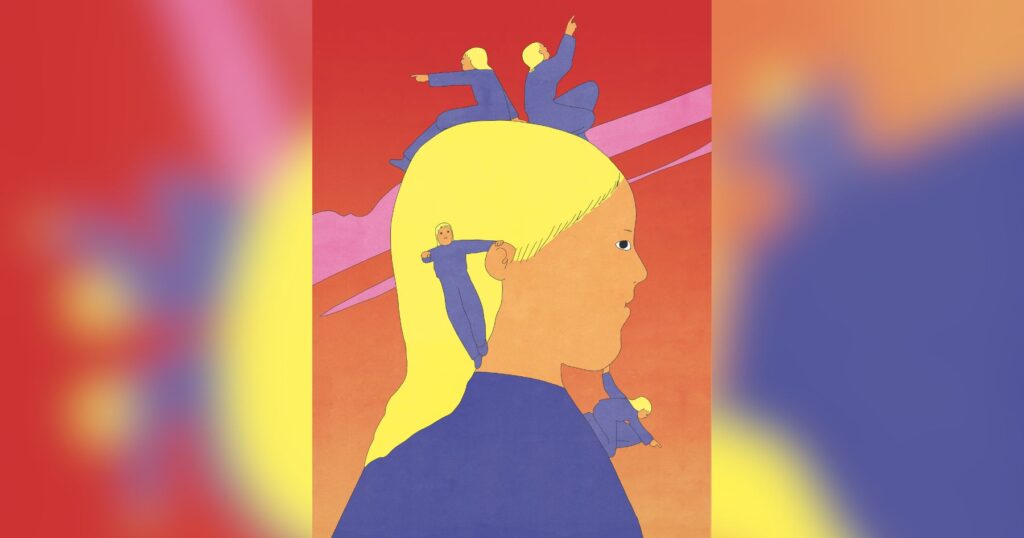
Illustration : María Medem
“In school, things went well as long as everything was framed. But at university, as soon as there was a need to hand in a dissertation, I couldn’t manage. I did two master’s programs without ever finishing them. I told myself there was a problem”, recounts Nathan, 37 years old. Morgan, 38 years old, speaks of a brain “that spins like a hamster in its wheel”, capable of hours of concentration on a subject without noticing the time passing, before being unable to start any task.
Both live with a disorder of attention with or without hyperactivity (ADHD), a neurodevelopmental condition affecting nearly 3% of adults. Far from being limited to concentration difficulties, ADHD can also complicate organization, time management or the completion of a project, while being accompanied by impulsivity, physical or mental hyperactivity and sometimes periods of hyperfocus.
In 20% to 30% of cases, ADHD is associated with an autism spectrum disorder (ASD). This is manifested notably by a different way of interacting with others and perceiving one’s environment. Some people struggle to decode implicit social rules; others exhibit hypersensitivity to sounds, smells, certain textures, or experience a strong need for routines. “I may have trouble grasping certain jokes, knowing how to behave in society, and I feel uncomfortable in conversations with more than three people”, explains Sasha, 40 years old. She also tolerates very poorly certain smells as well as “tight and itchy clothes”.
Far from caricatures
Among many neuroatypical people, these particularities go unnoticed for a long time because they learn to mask them in order to meet social expectations. This constant effort, called “camouflage,” can lead to deep exhaustion. Yann, 35 years old, remembers repeated burnout, but also real shutdowns: “For three days, I couldn’t leave my house. It was mental exhaustion.”
For a long time, neither they nor their entourage understood what was happening to them. Until recently, representations of ADHD and autism were largely limited to a few caricatures: the troublemaker unable to stay in place, like Bart Simpson, or the mute and brilliant child popularized by Rain Man. Between these two figures there are, however, millions of adults who do not recognize themselves in either. Specialists now describe these disorders as spectrums with very diverse manifestations, which partly explains the rise in adult diagnoses.
The trigger often comes from a loved one, from social networks or from fiction. “I was watching a series in which an autistic character could not stand music or strobe lights at a party. The same thing happened to me at a drag festival I was taking part in. I recognized myself”, confides Yann. For Sasha, who received several erroneous diagnoses before her ASD and ADHD were finally identified, it was a psychologist who “immediately twigged and steered her toward a colleague who specialized in the field. “I felt I was broken, ill-suited“, she summarizes. The journey remains full of obstacles. There are still few specialists, and waiting times, especially in the public medical sector, can stretch for months, even years.
The paradox of the diagnosis
This diagnostic phase sometimes arouses ambivalent emotions. Sasha recalls feeling as if her disorder suddenly took all the space, causing her to miss appointments or objects. Nathan says he talked about his ADHD with all his close ones, to the point of tiring them. Morgan, meanwhile, sighs: “I was able to put words to my pain… But I also understood that it was the beginning of trouble.” For Lucas, 37, the months that follow resemble a mourning: “After the diagnosis, my depression worsened. I had to give up the person I thought I could become.”
Because the diagnosis does not transform the person. It mainly changes the view they have of their past. Sasha reconsiders “the little girl who was a bit lost” that she was, the school harassment, the professional and romantic difficulties. Yann rereads his childhood differently, his inability to speak in public before the age of 12, but also some behaviors of his parents, which he now regards as “neuroatypical people who are unaware of it”.
Little by little, anger or sadness gives way to pragmatism. “I listed my compensation mechanisms and my limitations, analyzes Nathan. I understood that it made no sense to force myself to take notes just because everyone did it.” This is where the diagnosis takes on full meaning. It does not cure, but it allows better self-knowledge and adaptation of daily life. “I camouflage less and I tire less”, notes Sasha. Some people obtain recognition of the right to work as a disabled worker, opening the door to workplace accommodations: a quieter desk, remote work… Others change their lives more profoundly. Nathan left a partner who did not support him. Sasha now distances herself from relationships where she feels she must constantly mask how she functions.
“Earplugs”
The diagnosis also opens access to psychological care: cognitive-behavioral therapies, cognitive remediation, peer groups or, for some people with ADHD, treatments based on methylphenidate, such as Ritalin. Antoine, 42 years old, compares the first effects of the medication to “earplugs“: finally, what matters becomes more audible.
All, however, share a common regret: not having known sooner. “Many difficult moments probably wouldn’t have lasted as long” judges Antoine. Diagnosed a few days before our meeting, Mathieu, 48 years old, still speaks of anger: “I was told all my life that I wasn’t enough of this or too much of that, when I couldn’t help it!” The diagnosis does not erase years of misunderstanding or the daily difficulties. But it offers many people something that had always been missing: their own personal instruction manual. From there on, it is no longer about becoming someone else, but about no longer trying to look like everyone else.
