
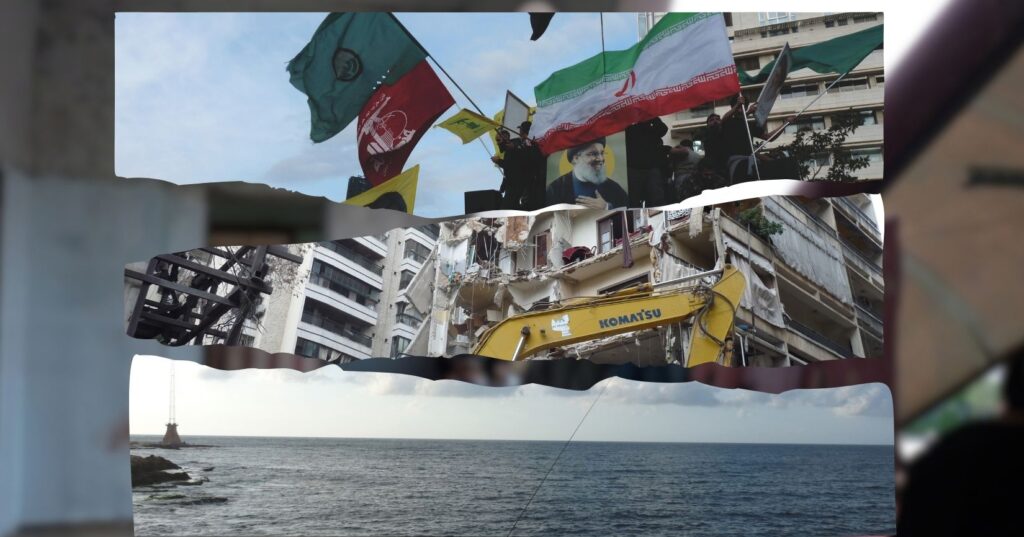
[Report to be found in the autumn magazine, at your newsstand or by subscription.] In Lebanon, the resumption of Israeli bombardments has driven more than a million people onto the streets. But for LGBT+ individuals, shelters opened by the state remain often inaccessible, forcing associations to fill the gaps.
Photographs: Céline Mochart & Safa Benmeriouma
At first glance, the apartment, located in Beirut, looks like any ordinary dwelling. A large, through living area lined with houseplants opens onto two balconies, and two bedrooms each host two bunk beds. A kitchen and a bathroom complete the layout. A few elements betray the space’s nature: the décor is sparse, there are no photos or personal items, and in one of the bedrooms a small backpack resting on a mattress without sheets signals a recent arrival.
Here, photos taken from the windows and balconies are banned to prevent identifying the building’s exact location. The people who live there are forbidden to share the address. To see loved ones, they must meet them a little farther away, and they are never dropped off directly in front of the door by taxi. That door will soon be replaced by a sturdier steel one, and surveillance cameras will be installed in the stairwell to strengthen the building’s security.
Just like the lodging on the opposite floor, this apartment is managed by the Mosaic association. In peacetime, it ran a refuge for LGBT+ people evicted from their homes or victims of violence. With the return of Israeli bombardments since March, the priority has changed and the organization opened a second apartment to increase its capacity to shelter and respond to the emergency. The war between Israel and Hezbollah has forced more than a million people to flee their homes, particularly in southern Lebanon and the Bekaa Valley, where dozens of villages have been evacuated. The displaced populations find refuge with relatives, in tents, or in shelters opened by the state.
Karim adamantly refuses to join one of these shelters. “I would rather die than go to a collective shelter”, declares this young gay man, forced to leave his home in Dahiya, the southern suburb of Beirut, heavily bombarded by the Israeli army. To explain his position, he first cites “the humiliation of having to go to a collective shelter where people must live on top of one another and wait for poor-quality food”. There is another reason, he whispers: “I would be forced to live surrounded by homophobic men…” So, when the bombardments began, Karim found refuge with an acquaintance in the Geitaoui neighborhood, in the northeast of the Lebanese capital. A zone he fears after being beaten in the street there three years ago by members of God’s Soldiers, a Christian far-right group. Since that assault which earned him a month in hospital, the young man has redoubled caution regarding how he dresses and avoids risky places at all costs.
“We had to push the walls”
Executive Director of the LGBT+ organization Helem, Sandy Mteirek understands that queer people do not feel safe in the collective life of shelters. They are not even welcome there, she notes. “The national action plan implemented in response to the war has not been inclusive at all, not only for LGBT+, but also for single women, people with disabilities, and, generally, all people who fall outside norms.” Faced with this oversight by the Lebanese state, Helem opened three places to respond to the community’s homelessness crisis from the previous flare-up of the conflict, in 2024, during what was called the Third Lebanon War, pitting Israel and Hezbollah. Two years later, the association hoped that lessons had been learned and that the reception of marginalized populations would be improved. Alas, sighs Sandy Mteirek, “again this year, the admission criteria for collective shelters left a great many people without a housing solution”. Shelters, she sums up, have always tended to accept only traditional families.
This de facto exclusion is not even announced, she notes, and more often than not, it is unconscious. Simply, no real effort is made for better inclusion. In practice, demand is so strong that spaces must be used as efficiently as possible. Solo individuals are thus often refused, so as not to block a room where a whole family could settle. Yet, regularly rejected by their biological families, queer people tend to live alone. While advocating for improvements, Helem tries to palliate what it can: “In times of war, we have become a daytime refuge”, explains Sandy Mteirek in front of the reinforced door of her association’s premises. “When the Israeli army issues evacuation orders for entire neighborhoods, members of the community come here to take refuge until the bombardments stop.”
Needs for aid do not stop at housing. In war-torn Lebanon, there is a shortage of food, blankets, psychological support… Difficulties that, for LGBT+ people, add to a situation already difficult. “The government did not wait for the war to neglect minorities, notes Karen, a social worker at Mosaic. Normally, even if a queer person goes to the police to file a violence complaint, the police mock them, or worse…” Her colleague Samar, herself displaced from her home in Dahiya, adds: “Phone calls intensified with the war. We therefore had to push the walls and sometimes accommodate more than our limit, because the people who call us are the most marginalized and have no safety net left.” On her desk, just during our visit, the waiting list for the shelter had grown by four more names.
Sixteen people currently live in Mosaic’s two apartments, provisionally. Some stay only a few days, others for several months. “We accompany them during this transition period, the time to find housing and regain a foothold”, Karen explains. From the window, Samar points to the neighboring buildings with a smile: “There, there are two apartments where queer people live; on the other side, there used to be the offices of a LGBT+ media; and the grocery store downstairs is also very queer-friendly. We’re in a good neighborhood!”
Solidarity helps compensate for the lack of funding, notes Bechara Samneh, director of Mosaic: “For example, 80% of the furniture in our first apartment comes from donations. When a crisis arrives, the community comes together to support each other!” This mobilization, however, is not enough to dispel the sense of abandonment that grows during conflict. Karim offers an illustration. “Last week, I went to see my parents in the Bekaa village. My mother was listing things for which God must help us: the war, the bombardments near the house and… the homosexuals, he bursts into laughter. If only she knew!”
