
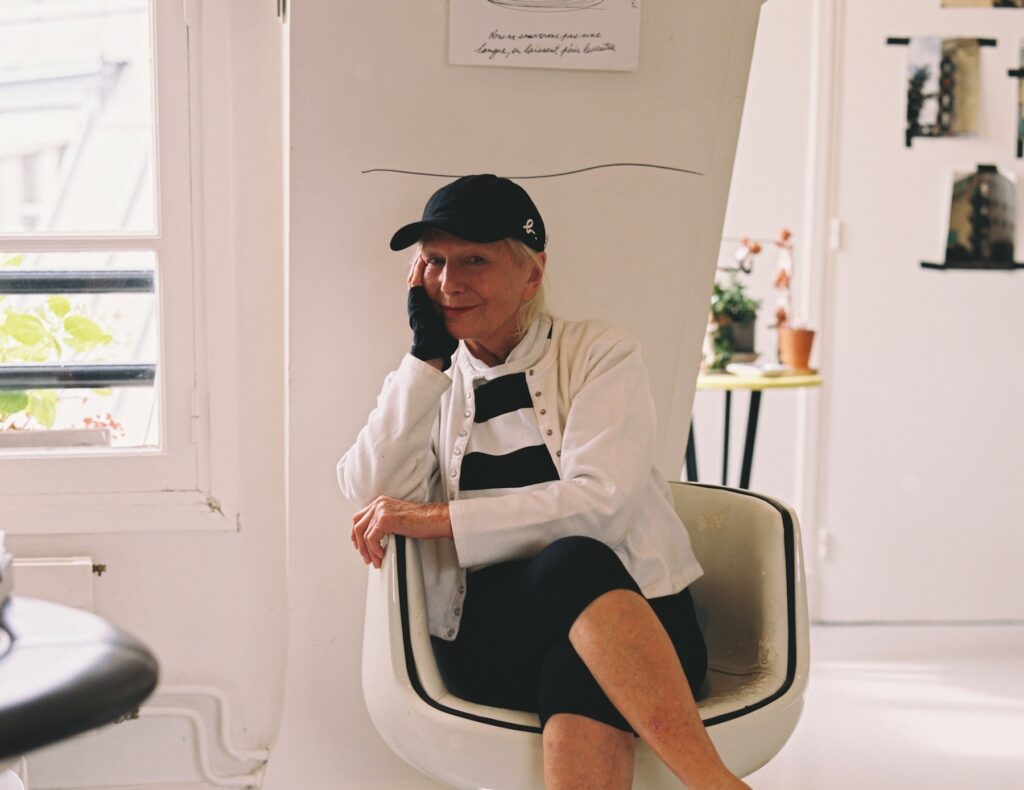
[Interview to be found in the Spring issue of the magazine, on newsstands or by subscription.] Agnès Troublé does not like fashion or the left today, but she remains optimistic and holds onto the hope that love will save the world. We spoke with her to discuss style, politics… and God.
Agnès Troublé prefers that her first name and the name of her brand be written in lowercase. But for us, she remains an Ally with a capital “A.” When we meet her in her vintage-decorated office on Rue Dieu, in the 10th arrondissement of Paris, she welcomes us warmly, as if we had known each other forever. A Versailles-born Catholic of the left, one doesn’t see that combination very often. A stylist, philanthropist and art collector, she belongs to the small circle of powerful women in the fashion world. Her brand, founded in 1975, by repurposing the “b.” from Christian Bourgois, her first love, is the definition of rock-chic style, and her buttoned cardigan is a reference worldwide, from Tokyo to New York. True to her commitments, she has never ceased supporting associations for migrants, the homeless and people living with HIV/AIDS.
On vous retrouve après le défilé homme automne-hiver 2026-2027. Qu’est-ce qui vous a inspirée pour cette collection ?
I love watching the young people here, along the Canal Saint-Martin, or the students around the Sorbonne. In Paris, the youth have very few clothes—a jacket, a scarf, a cap, a beanie—but they are well dressed! I pay more attention to the boys than the girls; I prefer to dress them. When I prepare the men’s collection, I play a little with a doll! For this season, I had thought back to the Nouvelle Vague, to black-and-white films. I had in mind the image of Jean-Paul Belmondo, very young, with a tweed jacket, a black tie, and a white shirt.
Comment définissez-vous le style parisien ?
Elegance through simplicity. Paris is, after all, the idea of chic in the world. I am often on the side of Place des Pyramides [a very touristy area along the Tuileries Garden, Ed.]. I immediately notice foreign tourists. Right now, they are wearing a lot of synthetic fur. It’s terrible!
À Paris, on parle davantage de style que de mode.
Yes, of course. I am a stylist. I love that term, because you can style anything. Even in my office, you see, the posters can be replaced whenever we want; it’s always style. And then, the African furniture, which I also love. I am fascinated by Africa; I have shown many African artists: Malick Sidibé, Frédéric Bouabré…
Le style des jeunes vous inspire… Que pensez-vous de la nouvelle génération dans l’art et le cinéma ?
It’s a talented generation. Even the models I work with make music, art; they live life at the same time as they are models. And we see many talents arriving who aren’t from Paris… It proves that there are beautiful people with talent everywhere. They just need the chance to emerge, but that isn’t always the case.
Est-ce toujours évident, après 50 ans, de concevoir de nouvelles collections ?
I like eternal clothes. It’s wonderful when a garment lasts. Like jeans. It’s beautiful, the Americans with their jeans… These are things that will last forever.
Pour vous, les vêtements sont comme les diamants, éternels…
That’s right.
Et qu’en est-il de la transmission de la marque agnès b. ? Avez-vous déjà abordé le sujet ?
Yes, it will continue. There are teams, there are people. We will bring in someone who resembles me, who has the culture of clothing and who knows its history.
Vous vous êtes toujours définie comme optimiste de gauche. Arrivez-vous à garder votre optimisme ?
I was born in 1941. At two years old, I walked alone down a corridor during bombardments. I will always remember the bombs, the German soldiers, the sound of hobnails, Versailles deprived of light. It was frightening. Then there was the landing. I remember the Americans throwing chewing gum to us on a country road in the Perche. And two days later, delighted, I told my father that they must be bother the Germans. I was four. I had already made my choices.
On voyait déjà la militante. Qu’est-ce qui, plus tard, vous a fait aller vers la gauche ?
The Algerian War. It marked me so much. I was younger than Christian Bourgois’s friends who were coming back from it. They had refused to torture and had deserted. That was the first turning point. After Christian Bourgois, there was the PSU [Unified Socialist Party, ed.]. I met Pierre Mendès France there, who became my stepfather [Agnès had as partner Jean-René de Fleurieu, son of Marie-Claire Mendès France, wife of Pierre Mendès France, ed.]. We would take the Mini Moke and go eat couscous. He was dieting, but with me, he allowed himself anything! We were very close. When others fought, he would look at me with a roll of the eyes.
Comment a commencé votre engagement contre le VIH-sida ?
I had lots of young friends and it was a catastrophe. I immediately proposed free condoms in my shops, even though they cost 10 francs. Whenever there is a cause to defend, I try to act as much as possible. I became very involved during the Saint-Bernard Church undocumented-people movement in 1996. We walked down Boulevard de Magenta, each with a letter to write “Vive l’Afrique!” And to make the exclamation mark, one of us did cartwheels. It was very beautiful!
Que pensez-vous de la gauche d’aujourd’hui ?
That’s not my left, at all. It doesn’t speak up enough, it’s too afraid of the far right. We must deal with this despicable Front National [the former name of the RN]. I’m going to create another left; it would be called the PSE, the bet of social and ecological. The French love to bet; for me, that’s the right choice.
Quelles mesures mettriez-vous en place ?
The rich must share, pay their taxes. They are capable of hiring tax specialists to avoid taxes. I find that ridiculous! They don’t even know what to do with their money! Those aren’t the people I socialize with. I would legalize the teuchi too, as in other countries. There are too many tragedies because of that. But it must be separated from cocaine. Cocaine, that makes you stupid. You can put it big: Agnès b. says that it makes you stupid!
Et le joint ? Le cannabis, ça rend quoi ?
It makes you active. It makes you an actor. It makes you an artist. It works for me.
Et si vous deviez voter pour un des candidats actuels…
I like François Ruffin; I appreciate what he says when I see him on TV. But I’m not a Mélenchon supporter. I knew Jean-Luc Mélenchon from his time fighting for the homeless with Abbé Pierre; he gave lectures. He was brilliant, he was wonderful, but now I find him tiresome; he doesn’t interest me, I don’t want to see him.
Qu’est-ce qui nourrit le plus votre optimisme ? Dieu, la politique ou le cannabis ?
God.
Toujours ?
I thank Him every day, my God, for all that He gives me. And I also love Saint John [the Apostle, traditionally credited with writing one of the Gospels]. When you read him, he reads like a Libé reporter following a star. It’s a bit like the first journalist.
Et on peut terminer sur l’amour… Vous reprenez le slogan “Give Love” [“Donne de l’amour”] de 2013 pour une collection capsule. Pourquoi maintenant, treize ans plus tard ?
Because it always applies. We are nothing without love.
