
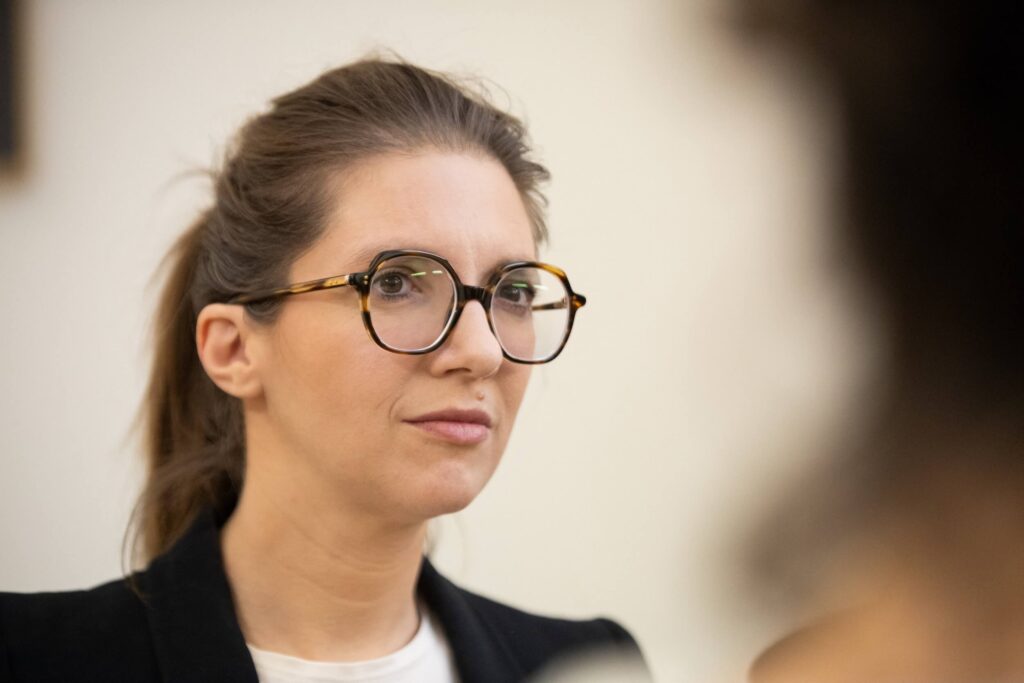
To combat the scourge of homophobic ambushes, the State has brought together four dating apps, including Grindr, to develop an action plan and a charter of commitments that the minister responsible for combating discrimination, Aurore Bergé, details for us.
How do you frame the issue of ambushes targeting gay men on dating apps?
Aurore Bergé : A portion of society still unfortunately believes that homosexuality is a choice, a fault, and even a deviance that should be corrected. The perpetrators of these ambushes even claim their acts on social media with pride. When you target people because of their sexual orientation, by trapping them with a date, you commit a premeditated act. These ambushes are not ordinary assaults.
How can we combat this phenomenon?
The digital environment facilitates the act. That is why we have initiated work with the dating platforms to ensure they undertake measures to strengthen prevention and reporting of ambushes and to better protect those targeted. Behind a screen, the authors think they can escape justice. That is false. We will simplify coordination between the apps and law enforcement who will have access to the data of those who set traps. We will strengthen bans so that it is no longer possible to re-register once excluded, and we will facilitate dialogue between platforms.
Are the apps dragging their feet when it comes to taking responsibility, how can we trust them?
The collaboration between the State and the platforms has been effective. Tinder, Grindr, Bumble and Happn recognize that it is also in their interest to create a safe environment for their users. This also helps to reinforce the legal framework and the values of the Republic, while disseminating best practices on platforms that are not always specifically dedicated to an LGBT+ audience.
How to reconcile strengthening security with the legitimate need to remain anonymous on these apps?
A verified profile is a good way to achieve this. With a selfie and identity verification, you can prove that it really is you while remaining pseudonymous on your profile. It is not about lifting anonymity, but about allowing users to filter the proposed profiles according to whether they have been verified or not. For many LGBT+ people, dating platforms have been and remain essential spaces of freedom. The idea is not to restrict this freedom, but that it never be accompanied by insecurity.
Data from associations and the Ministry of the Interior show a continued rise in homophobic violence: how can we break this dynamic?
We have progressed in training law enforcement so that everyone is respected and encouraged to file complaints, so that victims’ voices are heard to name the facts, to characterize the offenses in order to better condemn the perpetrators. In every police precinct there is now a LGBT+ referent and a general delegate for victim assistance. We have massively strengthened our support for the FLAG! association, which has created an app to report violence and quickly connect with the right interlocutors. Furthermore, we are moving forward on the creation of LGBT+ centers on the mainland and in the Overseas, with the clear objective of one center per department. There will be 57 by the end of the year (compared with 34 in 2022), far beyond the 2022 commitment to create ten new ones.
Just over a little more than ’one year from the meta charset=”utf-8″>’presidential election, our LGBT voting intentions poll shows 27% for Jordan Bardella’s National Rally (RN). How do you analyze that?
The National Rally capitalizes on both a security-focused discourse and an identity-based one with respect to religious matters. We defend the freedom to be who you are across all territories, in large cities, in working-class neighborhoods, in rural areas of the hexagon and in the Overseas. It is important to be candid that there are still places in the Republic where, for cultural or religious reasons, saying who you are is more difficult without facing rejection, insults, or violence. We must convince that we do not overlook any violence suffered by LGBT+ people. The RN gives the impression of confronting this issue; the problem is that it treats it as if by principle, because of a background, one would necessarily be LGBT-phobic. No one can be reduced to a cultural origin. The fight against anti-LGBT+ hate must never become a pretext to inflame other hatreds and to try to polarize the French between them.
Since you became minister, you haven’t spoken much about transgender issues. How do you approach gender identity?
My position is unequivocal: you do not choose your sexual orientation, nor your gender identity. Homophobia and transphobia kill; transgender people are still too often victims of violence, and it is unacceptable. In periods of constrained budgets, the government has continued to strengthen support for associations, because their role is essential to assist all concerned individuals, including transgender people.
Are you in favor of simplifying the procedures for changing gender in the civil status records?
For now, what matters to me is that the law is applied in the same way throughout the country. That is why the Keeper of the Seals signed a circular to remind of the law and the procedures. Harmonizing decisions already constitutes an important step. It seems to me that the law has found a balance that guarantees the autonomy of individuals.
We are just over a year from the end of Emmanuel Macron’s second term. How do you view this election-year campaign?
My obsession is to convince that neither the National Rally nor La France Insoumise are a solution for 2027. In this ministry, you confront the worst as well as the best of society. And the best is precisely the level of engagement within society. It is up to us to protect it, to fight the fractures, to repair what has been damaged. I will watch over it.
