
On the occasion of the cinema release, on November 11, of George Michael : The Faith Tour, a look back at the career of the British singer. In 1998, his arrest in a public restroom sparked his coming out. Rather than letting himself be smeared by tabloids, the pop star would answer them with a hit that became a symbol of sexual freedom.
We are in 1988. With Faith, his first solo album released a year earlier, George Michael established himself as one of the biggest stars on the planet. With perfectly styled hair, a three-day beard, the former Wham! singer captivates fans during a monumental tour of 109 concerts in 16 countries. It is this idol in all his splendour that one finds in George Michael : The Faith Tour, to be shown in cinemas from Wednesday, November 11.
Filmed on May 30 and 31, 1988 at the Palais Omnisports de Paris-Bercy, the concert resurfaces thanks to footage long considered lost, now restored. The film is also accompanied by a short film by Mary McCartney, which features unheard recordings of the singer. At the time, George Michael cultivated an image of heterosexual sex symbol and kept his homosexuality secret. Ten years later, it would dominate the tabloids. But the singer does not intend to let himself be humiliated without striking back.
The price of success
The question of his sexuality has pursued George Michael since his early days. With Andrew Ridgeley, his partner in Wham!, he won a largely female audience, while the British press obstinately seeks to know who lies behind the heartthrob image. In 1988, a journalist directly asks him if he is gay. The singer answers in the negative, while reminding that his private life concerns no one.
At that time, George Michael still struggled to reconcile his success and his identity. In an interview with the British daily The Independent in 2005, he would revisit the gap between his private life and the persona he had built: the more famous he became as a heterosexual seducer, the more he realized his homosexuality. A contradiction hard to live with for a star whose image also served as a commercial argument.
In 1991, during a concert in Rio de Janeiro, the singer meets Anselmo Feleppa, a Brazilian stylist with whom he falls in love. For the first time, George Michael experiences a true love story with a man. But a few months after their meeting, Anselmo learns he is HIV-positive. The singer navigates this period in great solitude, unable to share his anxieties with his family, who still did not know his homosexuality.
Anselmo Feleppa dies in 1993, from an AIDS-related illness. George Michael pays him homage with the moving “Jesus to a Child”, then dedicates his album Older, released in 1996, to him. He then reveals his homosexuality to his parents, but continues to shield his romantic life from the media.
A coming out under the flashbulbs
On April 7, 1998, everything changes. George Michael is arrested by a plainclothes police officer in a public toilet at Will Rogers Memorial Park, in Beverly Hills, for an “obscene act”. The affair spreads immediately through the media. In front of his Los Angeles home, more than fifty television crews crowd the place, while paparazzi stalk every image of the singer.
For the British tabloids, it is easy prey. The Sun devotes nine pages to the affair and twists the Wham! hit Wake Me Up Before You Go-Go into “Zip Me Up Before You Go-Go”, i.e. “Zip up my fly before you go.” Photographs taken without his knowledge in the same park the previous year suddenly gain considerable value. George Michael finds himself fed to a press that seeks not only to report an arrest, but to ridicule his homosexuality.
But the pop star does not intend to let others dictate his conduct. A few days after his arrest, he grants an interview to CNN, facing journalist Jim Moret. George Michael publicly confirms that he is living with a man and has not had a relationship with a woman for nearly ten years. While he acknowledges having put himself in an embarrassing situation, he categorically refuses to be ashamed: “I feel absolutely no shame. And I don’t think I should.”
David Bowie and Elton John had already spoken publicly about their sexuality in the 1970s. But George Michael did not choose to reveal his homosexuality: his coming out was imposed on him by his arrest and the media furor that followed. On May 14, 1998, he is sentenced to a fine of $810 and 80 hours of community service. The court also requires him to undergo psychological counseling and bans him from returning to the park where he was arrested. But rather than allow himself to be humiliated, the singer decides to turn the scandal to his advantage.
“Outside”, the disco comeback
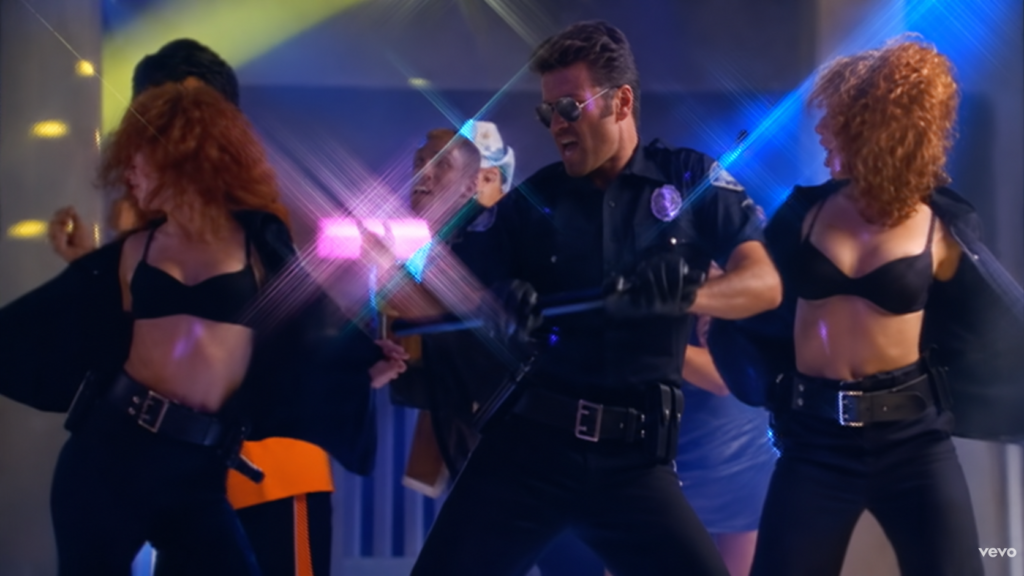
Six months later, George Michael releases “Outside”—an irresistible disco track, accompanied by a video that pushes provocation far beyond what the tabloids could imagine. Dressed as a police officer, baton in hand, the singer writhes in public restrooms turned into a disco, complete with glitter balls and gleaming urinals. Elsewhere, helicopters and surveillance cameras track gay and straight couples in the act. Up to that final scene where two policemen, convinced they are out of sight, end up kissing.
The message is hard to miss. With razor-sharp humor, George Michael mocks his arrest, but also those who claim to monitor and control others’ sexuality. What was meant to humiliate him becomes the pretext for a openly provocative clip, where homosexual desire has nothing to hide. The singer reverses the roles: this time, it is the police officers and voyeurs who find themselves in the spotlight.
This newfound freedom is reflected in the rest of his career. George Michael addresses his homosexuality more openly in his songs, notably “My Mother Had a Brother”, where he speaks of the suicide of an uncle whom his mother believed to be gay. A family tragedy that, according to him, had fed his mother’s anxieties about her own sexuality. In “An Easier Affair”, released in 2006, he celebrates living without trying to conform to others’ expectations.
George Michael was not the first singer to publicly own his homosexuality. But after being exposed against his will, he refused to play the repentant, insisting on his desire for men without trying to make it more acceptable in the eyes of the public. A freedom that, even years later, is not a given for all gay artists. In September 2026, Troye Sivan told Cultured magazine that as a teenager he avoided listening to George Michael, fearing that his musical tastes would reveal his homosexuality. Hard to imagine today such a confession from the Australian singer, who openly displays his desire in his videos and songs. A strange paradox: George Michael had been forced to come out in front of cameras around the world, while Troye Sivan feared making his own coming out by listening to his records.
View this post on Instagram
