
[Feature to be found in the spring issue of têtu·, available at your newsstands or delivered to your home by subscription.] In the capital of Iraq, young LGBT people are redoubling their ingenuity to try to live despite the hardening of state homophobia.
Photography: Pauline Gauer for têtu·
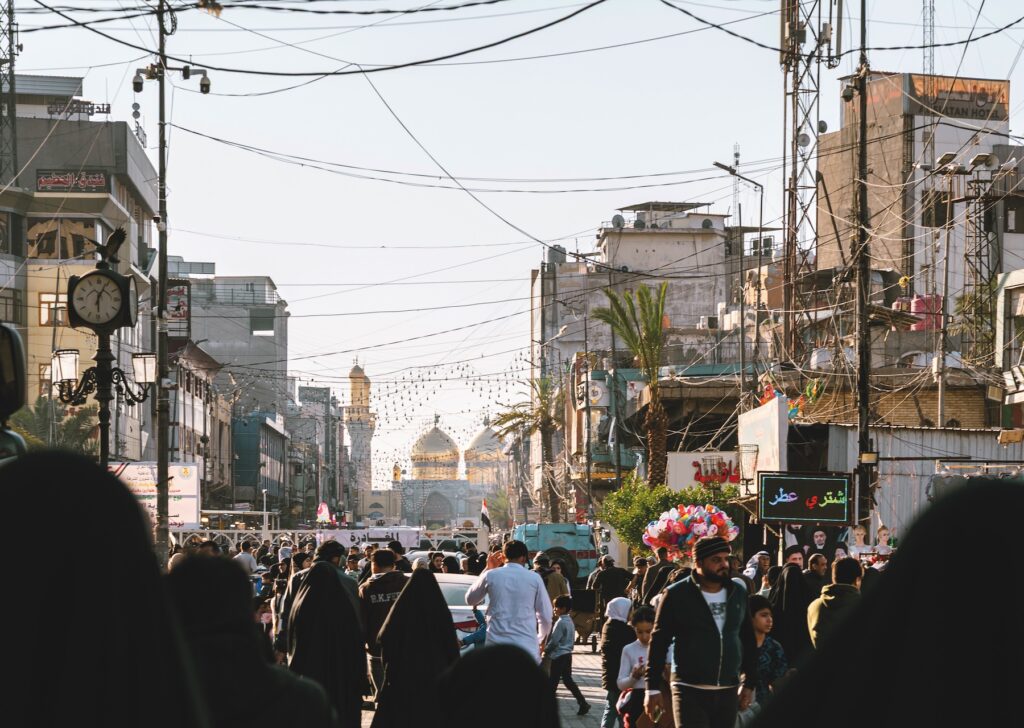
The al-Mutanabbi Street in Baghdad, the capital of Iraq, buzzes with life. Faded dinars exchange hands among calloused palms, the murmur of voices blends with the scents of hot tea and faded ink. Stalls sag under yellowed manuscripts and old engravings that are thumbed through with practiced ease. While engines cough, men smoke in front of cracked façades, their eyes fixed on the ceaseless ebb and flow of passersby. In this chaotic ballet, a woman strides forward, unfazed by the glances. She does not weave through the crowd, she does not hurry her pace.
It is the city that opens up to her as she passes, as if compelled to welcome her. Her loose jeans sweep the cobbles, while her long coat trails behind her. A bright red handbag, in harmony with her lipstick, her hair neatly styled in a precise bob: Batoul [for safety reasons, the first names in this report have been changed, ed.] does not go unnoticed, and she knows it. She has been advised to keep a low profile. But what for? She has never learned to be discreet.
Two at Ground Level…
As the 24-year-old woman slips into a narrow street lined with antique shops, her voice takes on nostalgic accents. A few months earlier, amid these leather-bound volumes and time-worn objects, her hand brushed Noor’s in a clandestine tremor. It is in the city’s oldest book market that the lovers used to meet to steal a few carefree moments. The place is ideal: lively enough that no one notices two women brushing past each other, loud enough to mask a compliment.
Today, Noor is gone, leaving Batoul alone among the silent shelves, fear still lurking in the shadows. In Iraq, homosexuality is not only a taboo subject, stifled by the weight of religion and tradition, it is a red line whose crossing can yield grave consequences. State-sponsored homophobic repression has intensified in recent years.
On April 27, 2024, the Iraqi Parliament thus adopted amendments to the 1988 anti-prostitution law that impose ten to fifteen years in prison for same-sex relationships. A first version contemplated the death penalty. Following a trend now commonplace in all homophobic states, the mere “promotion” of homosexuality is now punishable by seven years in prison and heavy fines. The law also targets transgender people, prohibiting gender-affirming surgeries and prescribing sentences of one to three years for individuals and doctors who violate it. Under this heavy umbrella, queer people live an existence on hold, where any gesture or word could tip the balance.
As always, even in the most retrograde societies, queer life nonetheless finds a path. On encrypted messaging apps, in carefully chosen places, through discreet codes and endless precautions, meetings are organized. Here, forbidden loves, whether for a night or a lifetime, require meticulous logistics. “Pseudonym required, VPN activated, systematic verifications and meetings on neutral ground”, lists Saif, 21, already adept at evading surveillance. For five years, he has, despite himself, explored the arsenal of subterfuges necessary to meet other men. He has drawn bitter lessons from it: on two occasions, he found himself talking to an undercover policeman on Grindr. Fortunately, he foiled the trap before the face-to-face. If he now scrutinizes every profile, he prefers to linger in cafés to try to guess a connivance behind appearances. A riskier approach, but where instinct outruns algorithms.
Queer Life Finds Its Way Always
Today, the young man has reunited with his friends in one of these establishments where people speak softly, beneath the clinking of cups. A luxury the small group grants themselves despite warnings: “We know we should avoid meeting in groups, but hey… It’s more fun. Our hunting grounds are the neighborhoods and chic cafés,” says one of the boys. “If you’re going to risk a lot, might as well do it in style,” adds Abbas, 25, a biology student, with a laugh.
Suddenly, the conversation is interrupted. A waiter arrives. “He knows. He’s an ally”, one of the men at the table whispers. Relieved, the group resumes their conversation. “To spend moments with my conquests, the best remains the holy days,” explains Abbas. My parents go to Najaf and Karbala [holy cities located more than 100 km from Baghdad, editor’s note] to pray, and I have the apartment to myself.” Admiring, Saif doubles the stake with his own trick: “Personally, I go straight to Najaf and Karbala with my dates. It’s easier to rent a room… who would suspect devout young men?”
“I’m afraid of the day my family will marry me off. I will have to pretend”…”
The joking mood fades as memories of horrors surface. “Do you remember the Shiite militias in 2009? They glued glue into the gays’ anuses and forced them to take laxatives,” recalls Yasin, 20, before confessing that he thinks he is on one of the blacklists kept by the militias persecuting gays due to his activism on social networks. A heavy silence falls, interrupted by a chilling statement from Abbas: “If my family knew, they would kill me without hesitation.” Then he plays along with the imposed game. A neatly trimmed beard and a phone shell adorned with Qur’anic verses, he projects a protective religiosity and, on the heart front, presents himself as a man hopelessly in love with a woman. But this masquerade comes at a price. “I’m afraid of the day my family will marry me off. I will have to pretend with a woman”, he says with resigned air.
In this compulsory clandestineness, Abbas nonetheless finds cracks where the air becomes more breathable. He loves these secret evenings when people gather behind closed doors, in the flickering glow of neon. There, beneath the bass that makes the walls tremble, he can, for the space of a night, forget the fear. There is first that gesture, trivial elsewhere but charged with meaning here: applying a dark nail polish to his nails without fearing deadly glances. In this bubble, trans people can also reveal the first name they would not dare whisper elsewhere. But these escapes are rare: denunciations are increasingly frequent, triggering police raids.
As the net tightens, resistance is woven in the shadows. It has been more than ten years since Hussein has been trying from Baghdad to find concrete solutions to LGBT-phobic persecutions. He knows where to find a room away from prying eyes, which doors to knock when one must disappear urgently, who to contact to organize a discreet evacuation toward the Kurdistan region. On two occasions, he himself had to flee, change neighborhoods, or protect his identity after threats that had become too precise. These are insane risks, which he takes as an ally. “I am not part of the community, but it is precisely because I am heterosexual that I must help,” he explains, defining himself as a humanist and a communist. These are hours when we should not be silent…”
Helping the Community in Iraq
Help is also strengthening from outside. Recently, IraQueer, the first Iraqi LGBTQ+ organization founded in 2015, has intensified its actions. In 2024, it provided support to more than fifty people in danger, ensuring shelter, psychological follow-up, and emergency aid to those in need. Some were able to flee the country for safer lands. For those who remain, the organization published a detailed safety guide, a survival manual for hostile territory: how to secure communications, avoid online traps, recognize warning signals… In parallel, it threads clandestine networks, adapting its strategies to the most conservative regions, where even the shadow of a suspicion can be fatal.
In a nondescript alley of Baghdad, behind a door known to only a few insiders, they gathered one last time to remember, before this space itself would become a target to be struck off the map. Once, this place filled with music, lively discussions, and light laughter. People dared to speak of desire; workshops on sexuality, safety, and navigating a homophobic world were improvised there. “It was a place of life, a refuge where everything seemed normal”, whispers Abbas as he scrolls through old videos on his phone with a nostalgic smile. On his screen, silhouettes sway to electro rhythms, bodies freed from prying eyes vibrate with a fragile freedom. But the music has fallen silent, freezing the house in a heavy stillness. With police raids, the missing have become too numerous, the meetings have dwindled.
Hussein checks his phone.
Sixty minutes have passed. He looks up, nods his head softly. Without a word, the ritual begins. Everyone knows what they must do. They do not leave in a group, they do not linger at the door. One by one, the boys rise, wait a few minutes before disappearing, the air indifferent, into the labyrinth of Baghdad’s streets. The most disciplined, or the most discouraged, return to the apparent conformity of their daily lives. Others, despite the risks, will continue to wander a little longer, roaming the city in search of a meaningful glance, a sign of complicity, a possible encounter. “For me, it’s true love or nothing”, says Yasin with a defiant smile, before disappearing.
