
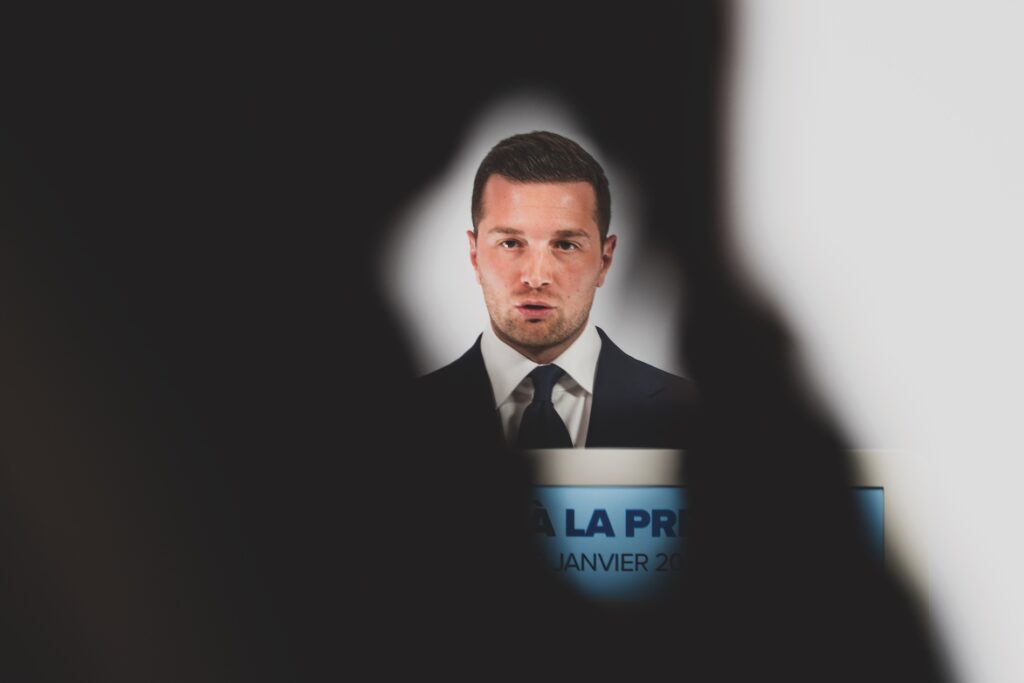
[Article to be found in the spring issue of the têtu· magazine, available at newsstands or by subscription.] While opposing every advance of LGBT rights, Marine Le Pen’s party, now chaired by Jordan Bardella, has for fifteen years been conducting a sleight-of-hand operation aimed at winning over an electorate worried by the ongoing rise of homophobic violence.
Toulon, September 3, 1995. Mayor of the Var town for the Front National (FN), Jean-Marie Le Pen hosts the party’s Summer University in a tense moment. A few days earlier, the suspicious death of his chief of staff, a certain Jean-Claude Poulet-Dachary, provided an opportunity for disclosures about the victim’s private life: gay porn magazines were found at his home, next to a portrait of Marshal Pétain, and Libération reports that not later than the night of his death, the man had gone to L’Olympe, a gay bar where he frequented and was known by the nickname “Gloria.” The affair unsettles the Front’s inner circle, which presses Jean-Marie Le Pen to clarify his stance on homosexuality in the party he leads. He complies at the Summer University podium: “If I learned that there are homosexuals in the FN, I would not be surprised and I would not hide under the table. There must be homosexuals, but there are no queers. The queers, we send them to be seen elsewhere.”
Indeed, the presence of homosexuals within Front networks is an open secret. In his book Nationalist Right and Homosexualities in France (SUP), published last year, historian Mickaël Studnicki lists among the party’s most fervent supporters of Jean-Marie Le Pen, such as writers Roger Peyrefitte, author of Particular Friends, or his friend Jacques de Ricaumont, cofounder of the gay-rights group Arcadie. Within the party’s ranks, one can also cite its communications director, Alain Vizier, or Lorrain de Saint Affrique, the patriarch’s communications advisor. “There is a dichotomy,” the author notes. “In private, Jean-Marie Le Pen has always interacted with homosexuals, while publicly defending a line that homosexuality is a social contagion and instrumentalizing the AIDS epidemic.” Indeed, the FN president, who had stated in 1987 on television that “the AIDS sufferer is a kind of leper,” has since Toulon confirmed the party’s opposition to rights advances: “The FN criticizes militant homosexuality demanding broader rights.” A few years later, during the debate on civil solidarity pacts (PACS), he would declare again that Parliament “has no right to legislate in favor of organized lobbies, claiming to impose their deviant behaviors as a normative social model.”
The Le Pen Family Against LGBT Rights
This stance, his daughter Marine Le Pen would embrace after taking the party helm in 2011. During the examination of the bill opening marriage to homosexuals, in 2013, she shot back: “Marriage was only an ultra-minority demand carried by a microlobby, which is the LGBT microlobby, before which the President of the Republic lay flat.” And she promised: “Yes, I will abolish it.” A line she would maintain in 2017 during her presidential campaign, during which the FN president continued to pledge to abolish the Taubira law, but also to block the opening of medically assisted procreation (MAP) to lesbians.
Against the PACS, marriage for all, the opening of adoption to same-sex couples and MAP for lesbians… the National Rally and its allies have always fought against LGBT rights: pic.twitter.com/cb4HFJe6zD
— têtu· (@TETUmag) June 11, 2024
On his side, his father recalls to the public with recurring homophobic outbursts that earned him three court convictions. In March 2016, in a video diary he posts online, he links homosexuality to pedophilia: “I believe pedophilia, which has found its noble letters… forbidden, but nonetheless, in the exaltation of homosexuality, calls into question all professions that touch children and youths.” A few months later, asked by Le Figaro about the representation of homos within the party he founded, he replies that “homosexuals are like salt in soup: if there aren’t enough, it’s a bit bland; if there are too many, it’s undrinkable.” The following year, after the Islamist terrorist killed police officer Xavier Jugelé on the Champs-Élysées in Paris, Jean-Marie Le Pen laments that the partner of the victim was given a voice at the national tribute: “That family particularity must be kept away from this kind of ceremony, which would benefit from more discretion.”
A Squad of Gay RN Deputies
To try to erase the heavy legacy of his father, in 2018 his daughter expelled him from the party, which she renamed the National Rally (RN). The next legislative elections, in 2022, provide a genuine about-face: Marine Le Pen, placed second in LGBT voting intentions in an Ifop poll for têtu·, told reporters, while a mother held her baby born from MAP: “I will not withdraw any rights from any French citizen.” In the National Assembly, the RN immediately sent 89 deputies, of whom about a quarter are gay, the largest bloc of openly gay parliamentarians in the institution’s history. So what happened?
In reality, Marine Le Pen had from the start woven the question of homosexuality into her strategy of “dedemonization” of the FN. She found an angle that could reconcile the party’s obsessions with this strategic reversal… On December 10, 2010, in a speech before activists in Lyon, the future party president stated that street prayers by Muslims reminded her of Occupied France, adding: “In some neighborhoods, it is not good to be a woman, nor homosexual, nor Jewish, nor even French or white.” A year later, têtu· looked into this strategy. “Danger, Marine Le Pen’s plan to trap us,” warns the magazine, which elaborates: “For several months, the Front National leader has been tossing nods toward homosexuals. Surfing on community tensions, she tries to instrumentalize gays, like other minorities, to form an anti-Islam front.” Questioned about her “flirtation with gays,” she repeats her argument: “It is easier to stage kiss-ins in front of churches than in front of mosques.”
Marine Le Pen & Geert Wilders
A meeting determined this new line of argument: that with the Dutch Geert Wilders, an openly gay man who founded in 2006 his far-right movement, the Party for Freedom. “In the early 2010s, Marine Le Pen had a sort of intellectual crush on this man who achieves impressive electoral results in his country,” recalls Marie-Pierre Bourgeois, journalist and author, in 2016 in Rose Marine. The year 2010 is also when a certain Renaud Camus, a French gay writer, develops his theory of the ‘great replacement,’ arguing that Muslim immigration aims to produce a civilizational change in Europe. For Geert Wilders, the solution is simple: ban the Qur’an, which he compares to Mein Kampf. Not enough to make Marine Le Pen’s daughter startle, who calls during the 2013 European elections for collaboration between her party and his. The following year, the first foray: in the wake of La Manif pour tous, Sébastien Chenu, cofounder of GayLib, the LGBT association of the liberal right, bolts from the UMP (the former name of the right-wing party Les Républicains), denouncing its conservatism, to join the FN. To his former comrades who denounce treason, he retorts: “I do not want to be reduced to my sexual orientation; it’s a part of my life like any other.”
The historic step of Taubira’s law did not help Marine Le Pen, squeezed between her normalization project, now embodied by Florian Philippot – whom she named strategic director of her 2012 presidential campaign, and later vice-president of the FN – and the party’s Catholic wing, represented by her own niece Marion Maréchal‑Le Pen, openly at war with LGBT rights. An episode illustrates this split: questioned by BFMTV about the absence of the top lieutenant of her aunt in the La Manif pour tous parades, where she herself attended, niece Le Pen lets slip: “We can guess the reasons for his absence…” Florian Philippot’s homosexuality was not yet public (he would be outed in 2014 by Closer), but the far-right weekly Rivarol seized the opportunity to headline: “Mme Philippot wasn’t there.”
The passage of the Taubira law, however, opened a new perspective for wooing the gay electorate. The reasoning relies on on-the-ground feedback and polls: now that equality is achieved in law, gays aspire to another priority—safety. Year after year, SOS Homophobie reports and data from the Ministry of the Interior show a steady rise in LGBT-phobic violence. Marine Le Pen can then bank on a security populism that, internally, does not cause splits. The gambit pays off: from 19% of LGBT voting intentions in 2012, the far right climbs to 23% five years later, to 30% in 2022, and finally to 32% today. In every report, têtu· notes that voters justify their RN support by the Islamist threat and the rise of phenomena such as homophobic ambushes, against which the left is seen as offering no answers. “In essence,” sums up, roughly, a lawyer on the fringes of the ambush case, “a gay RN voter is nothing more than a former gay left voter who was assaulted…”
A Gay Festival in a RN Commune
In Paris, this openly gay-right extremism now displays itself without any embarrassment. It is not uncommon to meet RN deputies at Docteur Love or at Chez Mylène, a bar near the Seine, where supporters no longer hesitate to request selfies. In Hénin-Beaumont, Marine Le Pen’s stronghold in Pas-de-Calais, mayor Steeve Briois, who is dating deputy Bruno Bilde, outright organized in November 2025 a “Festival of Tolerance and the Fight Against Homophobia,” a first in a city run by the RN. Gay deputy Bruno Clavet attended to speak under the LGBT flag, while in the theatre hall hosting the event, educational panels on discrimination faced by homosexuals at work or at school were set up — but not a word about transphobia. The day ended with a cabaret show.
Meanwhile, the party’s gay recruits continue to roll out and intensify the message aimed at whispering in LGBT ears. “We defend everyone’s sexual freedom; today, the enemies of freedom are the Islamists,” boasts Sébastien Chenu. “Islamic rigor replaces Catholic rigor, with a higher risk of violent acts,” adds Thomas Ménagé, another gay deputy from Loiret. And Jean-Philippe Tanguy, a gay deputy from the Somme, rejects the claim of Islamophobia: “I do not hate Islam, but bigotry, the kind that leads to violence against homosexuals.”
And here is the RN repainted as a party of sexual freedom and secularism, accusing La France insoumise (LFI) of sacrificing these values on the altar of the fight against Islamophobia. In December 2025, during the examination of the bill on repairing prejudices linked to the repression of homosexuality up to 1982, Sébastien Chenu addresses Jean-Luc Mélenchon’s troops: “The death penalty is required in Iran, in Saudi Arabia, in Yemen, in Sudan; in Gaza, homosexuality is considered a moral and religious crime, subject to Sharia. (…) I am surprised that the left never addresses this subject…” The following month, during the examination of a resolution to place the Muslim Brothers on the list of terrorist organizations, Deputy Laurent Jacobelli provokes an uproar with this line addressed to Mélenchon supporters who oppose it: “The Muslim Brothers want to stone homosexuals; if you want to stone homosexuals, vote LFI!”
RN’s Allies
So has the RN shifted sides? Not so fast. For its own foreign ties are telling: Marine Le Pen and her troops remain part of the reactionary international. To whom does the party leader request a support video for her 2022 presidential meetings? The Hungarian Prime Minister, Viktor Orbán, who bans Pride parades. Who launches the call “Free Marine Le Pen!” after her conviction for misappropriation of public funds in the European Parliament assistants affair? Donald Trump. And when Jordan Bardella co-organizes a “Transatlantic Summit” in Brussels, it is with Giorgia Meloni’s national-conservative party, which brings in the big names and the fringe of the global Christian far-right.
In France, several movements nonetheless continue to advocate for an RN alliance with the LGBT-phobic far right embodied by Éric Zemmour and Sarah Knafo. This is notably the case for the Eros collective, led by Yohan Pawer, a pseudonym for a gay influencer advocating “the union of the right” to “end wokism.” This marks the new fault line within Marine’s FN. “If the National Rally were to unite with Éric Zemmour, it would be a rupture,” says Thomas Ménagé, reporting: “On social media, we are far more targeted by movements of the Civitas type, for which the RN would be a brothel run by a lecherous gay lobby, than by the far left!” Belonging to the far right does not always shield one from being its target. In 2019, Jean-Philippe Tanguy learned this the hard way after his phone was stolen during a knife attack. “Part of the content was dumped on Twitter with totally homophobic arguments, fueled by Alain Soral, claiming that I was the pretty boy of my first boss, Nicolas Dupont-Aignan, and that he could prove it because he had found my phone,” he testifies. Chasing the natural…
Ultimately, within the European and global far right, the Gert Wilders–Marine Le Pen strategy is the exception, and the national-conservative line the rule. “Marine Le Pen’s relative liberalism on moral questions is undoubtedly a fundamental difference with the other far-rights in Europe, but also with the history of nationalism,” notes historian Marc Lazar, author in 2025 of For the Love of the People. History of Populism in France – 19th-21st Century (Gallimard), who adds that Jordan Bardella appears more cautious on these issues. That is the problem with populism: their discourses adapt to the times, but the direction of the wind can change abruptly.
