
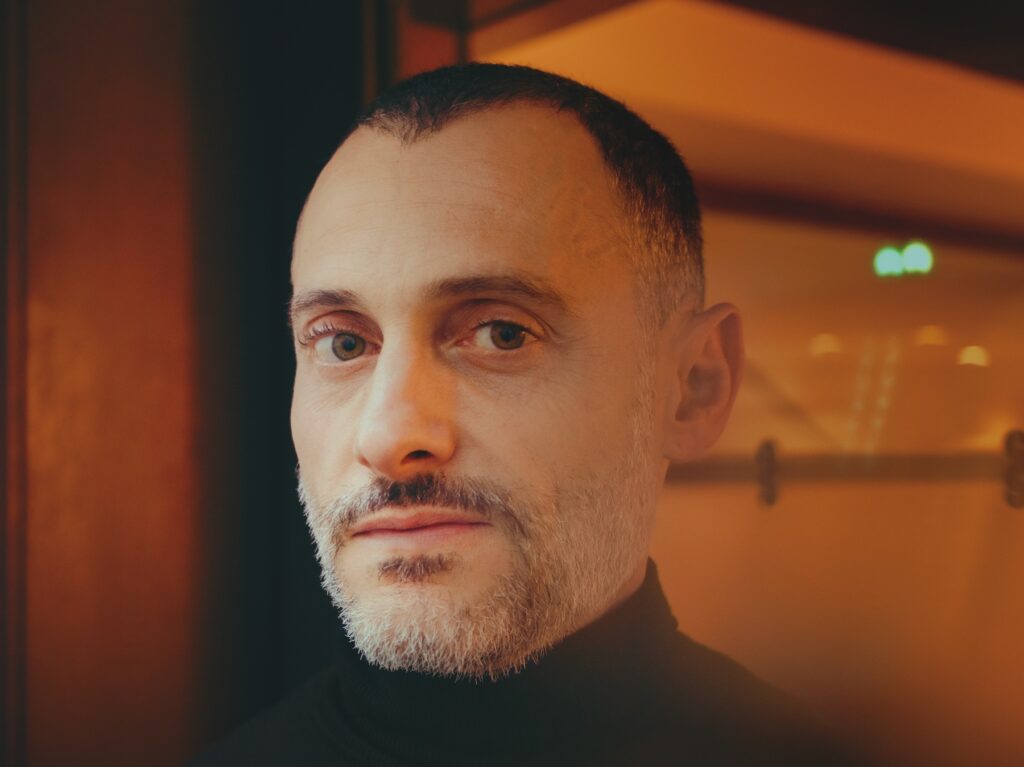
[Portrait to be found in the Spring magazine, on newsstands or by subscription.] In six novels and a few handsome prizes to reward it, Jean-Baptiste Del Amo has established in the literary landscape a singular voice, capable of varying genres without ever losing the thread of a work written from the body and its tugging, its shadow and its desire.
Photographie : Antoine Doyen pour têtu·
We meet him in the basement of a Japanese tea room, in Paris. The dim lighting and the hushed atmosphere of the place suit well with what Jean-Baptiste Del Amo radiates. With graying hair cut short, a black turtleneck and dress pants, the novelist plays the card of discretion. Since the publication of Une éducation libertine, which earned him the 2009 Goncourt Prize for a First Novel, the 44-year-old writer has carved out a place in French literature with austere and sensual fictions.
While passing through the capital, the Tours-born-in-spirit (he was born in Toulouse) author came to meet a master sculptor of Noh theater masks, whom he had encountered a few years earlier during a residency in Kyoto. “I’ve always been sensitive to culture and Japanese arts, because there is a porosity between elements, between the living and the inert, between the living and the dead”, he explains. That porosity reappears in La Nuit ravagée (Gallimard), his latest novel published in 2025, where the boundary between the real and the imaginary dissolves. In this horror fiction set in the France of suburban housing during the 1990s, those of his own youth, five teenagers take a bit too keen an interest in an abandoned house whose walls reveal intimate desires and fears… “I mobilized almost everything that could be my own adolescent fears, summarizes the author.
A raw vision of a cruel world
Like his characters, Jean-Baptiste Del Amo has experienced school harassment. “I was rather frail and effeminate, and the other children frequently pointed this out in a rather harsh way”, he emphasizes with the calm that seems to accompany him at all times. He also quickly became aware of the weight of masculine domination: “I long had difficult and conflicted relations with my father. But he was never violent.” The novel also conveys the generational experience of young people discovering their homosexuality in the 1990s, those before rights, and the HIV/AIDS epidemic that decimated the gay community: “It was growing up in secrecy, in concealment, in fear of disappointing loved ones. It was growing up facing the violence of other children who sense your difference. It was also building one’s sexuality with the fear of the disease, because we were at the peak of the AIDS epidemic.”
The specter of the virus that haunted the discovery of desire and sexuality continues to darken his erotic representations, associating them with a form of anxiety, danger. Nevertheless, he has developed a sensibility rooted in the senses. “Very early, I understood that my relation to the world was built through the body, through what I could feel from the outside: the smells, the colors, the perfumes, the textures.” The relation to the body, to flesh, is central in the work of Jean-Baptiste Del Amo. In Pornographia (Gallimard, 2013) or Règne animal (Gallimard, 2016, Prix du livre Inter), it is described as a sum of fabrics, skins, fats and muscles that sometimes suffer, sometimes enjoy. This raw, somewhat cruel vision also reflects his literary influences: Sade, Genet, Guyotat, Wojnarowicz. “Reading them, I understood that everything was possible in literature, that the imagination and the representation of the body had no limits.”
When fear takes shape
If violence marks his work, it is more out of fear of an atavism, as in Le Fils de l’homme (Gallimard, 2021, Prix du roman Fnac). “My father was a very angry man, and I am angry too. Yet it’s a personality trait that I hate”, he confides with the calm from which he seems never to depart. Moreover, he engages against all forms of violence, whether patriarchal – he notably led a writing workshop with women victims of sexist and sexual violence at the Maison des femmes de Tours – or related to animal exploitation, as in his essay L214. Une voix pour les animaux (Arthaud, 2017).
It is also as a remedy to the violence in the world that Jean-Baptiste Del Amo seeks, in writing, fragments of poetry. “In literature, language has such a transcendent power that it can make the beauty of the universe arise from the darkest universe”, he says. When we ask him about his next novel, he hesitates to reveal the plot but concedes that “the text explores the themes of love, homosexual identity, the relationship to art and reality”. The political climate, particularly the rise of reactionaries, awakens his anxieties but also the desire to highlight the topic of sexual identity more: “I feel today again carried and concerned by this question, because I am probably swept by the fear of seeing this world change and become more and more hostile to what I am.” Where we return to bodies, not only torn from the inside but hunted, persecuted because they are marginalized, deviant.
