
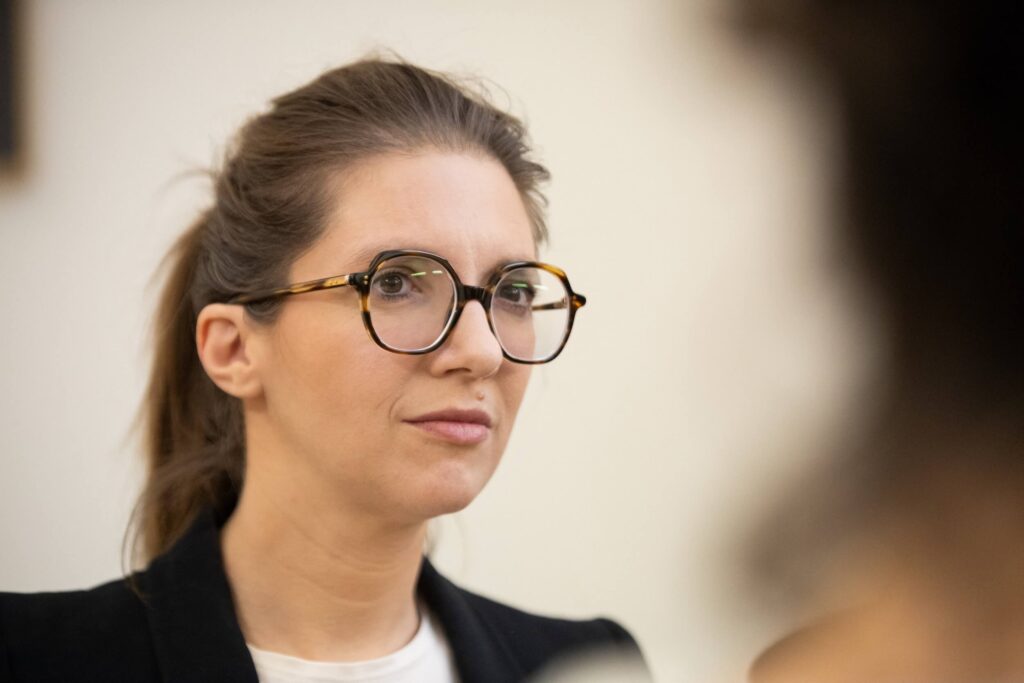
Having become aligned with a historic demand of transgender people, Aurore Bergé now promises the dejudicialization of gender-change procedures in civil status records. But the timetable of the Minister for the Fight against Discrimination pushes the reform far beyond the next electoral deadlines…
It took until the latest national plan against LGBT phobias (2026-2029) of the Macron era for Aurore Bergé to experience an epiphany. And to make it known, the Minister for the Fight against Discrimination deployed the communication apparatus of big moments: a trip to the Rural Pride in Chenevelles and an interview in the national press. The revelation appears in Libération: “We must dejudicialize the procedures for changing one’s first name and gender in the civil status.”
Thus the former deputy for the Yvelines, touched by the grace of transgender people, is moved. “As my exchanges with the people concerned progressed, I became convinced that these procedures must be dejudicialized, experienced in a painful way”, she explains. Then she promises to put an end to it, come hell or high water: “I am committed to it”, she asserts.
At the same time…
The snag is that only a few months ago, in March, the minister defended the exact opposite position in our columns. Asked about this long-standing demand from transgender associations, Aurore Bergé dodged the issue. “For now, what matters to me is that the law applies in the same way across the territory”, she replied, praising a circular from the Keeper of the Seals intended to reiterate the foundations of the existing law. Changing the procedure was not on the agenda. Even more, Aurore Bergé seemed to close the door to any evolution. “It seems to me that the law has found an balance that guarantees the autonomy of individuals”, she insisted.
Aurore Bergé has learned the art of political gymnastics on this issue. During the 2022 presidential campaign, Emmanuel Macron himself opened the door to this reform, in the pages of Têtu: “People who embark on a process of transition must be respected in their choices and their life should not be made more complex by administrative procedures if they are unnecessary”, he declared as he presented his program. Two years later, a change of tone. In the middle of the legislative campaign provoked by the dissolution of the National Assembly, the president brutally closes that door. During a trip to the Île de Sein in Brittany, he denounces the inclusion of this measure in the left’s program and, in front of the cameras, as others order a glass of red, he quips, like command a ball of rouge: “There are things completely absurd, such as, for example, going to change one’s sex at the town hall, well…”
France lagging behind
Let us nevertheless give to Aurore Bergé what is due to her: she finally resolves to support a simplification that makes sense. Noting the “absurd” aspect of her sudden conversion, the trans rights advocacy group Outrans deciding to take her at her word, “welcomes this commitment and calls for works to begin as soon as possible”.
The figures from the Ministry of Justice spell out the absurdity of the current procedure. Applications to change the sex designation on civil status are accepted in 99% of cases. In other words, appearing before a judge almost never serves to refuse a petition. By contrast, the cases themselves pile up in the courts: they rose from 426 in 2018 to 2,883 in 2024, a 577% increase.
France is moreover far from being a pioneer on this topic. Twelve European states have already taken the plunge. Denmark led the way in 2014, followed by Malta, Ireland, Norway, Belgium, Portugal, Iceland, Switzerland, Spain, Finland. More recently, Germany adopted this reform in 2024—the very year Aurore Bergé entered the government as minister in charge of Equality.
And let no one claim that Parliament lacks time. In Germany, the debate lasted… 45 minutes. The calendar argument had already been used at the end of 2021 by Aurore Bergé’s predecessor, Élisabeth Moreno, to justify caution on the ban of “conversion therapies”. “On these as essential topics, you must say things as they are: it does not take half a day to pass laws. If it were that easy, it would be known”, she insisted. The result: the text was adopted unanimously after only 6 hours and 45 minutes of debate, with one day ahead of schedule.
The 2029 ruse
Aurore Bergé does not even need to draft the reform: two proposals are already ready. The first was filed by Green Senator Mélanie Vogel in 2024; the second by La France Insoumise deputy Jean-François Coulomme in 2025. It’s simply a matter of using them, as the government did for the inclusion of voluntary termination of pregnancy (IVG) in the Constitution, where, too, several parliamentary proposals already existed.
So, should they start in September? In October? No. In the French manner, as Marie-Jo in Au Service de la France, the minister proposes a distinctly French method. “We will create a Cerfa form and a notice explicitly stating that no medical element is required for these procedures”, she announces initially. Then she adds, in a more martial tone, that “everyone will have to comply with the 2016 law”. By the way, happy birthday to this old law.
As for the dejudicialization announced in Libération, one must read the fine print. “We will get there before the end of the deadline of this plan”, promises Aurore Bergé. That is to say, by… 2029. Until then, she feigns to forget, the French will have elected a new President of the Republic, and a new National Assembly will probably decide the future of the minister. In short, she commits today to a timetable whose political outcome she does not control. Moreover, who is making this promise? The government member or the head of Renaissance, the party led by Gabriel Attal, a potential candidate for the presidential election? The question deserves to be asked, especially since Aurore Bergé has not yet announced whether she would support the former prime minister. From her appearance this weekend in Vienne, La Nouvelle République captured this appeal from Aurore Bergé: “We must be much more proactive”, she says. For once, it is hard to disagree with the minister.
