
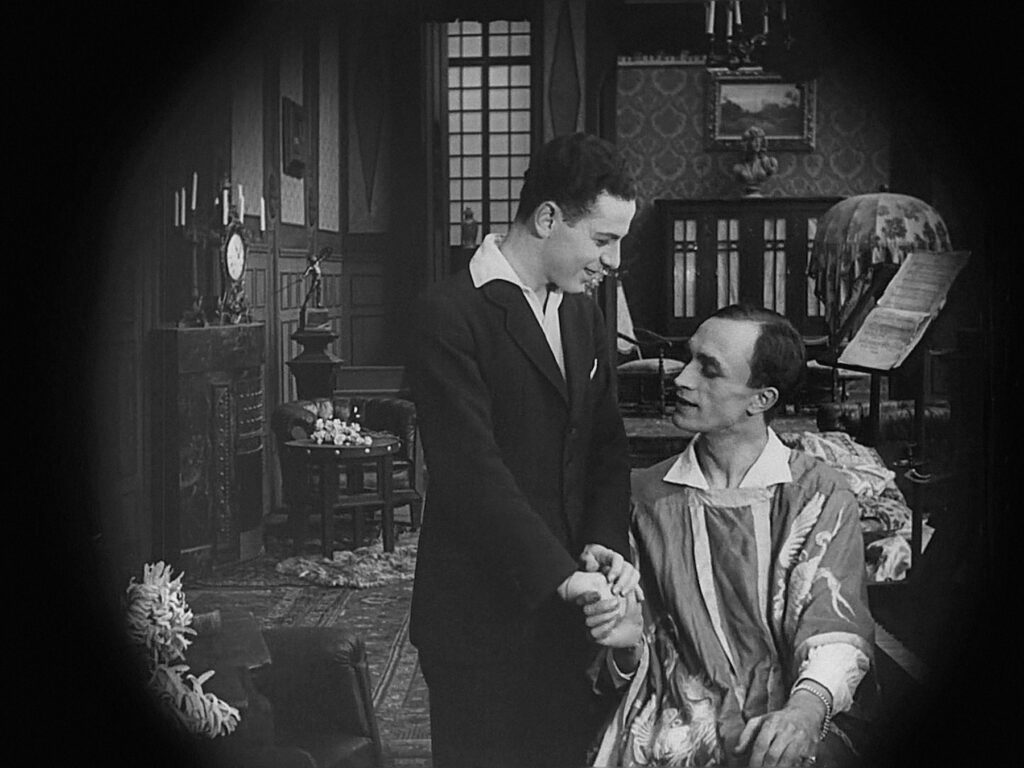
[Article to be found in the summer issue, at your newsstand or by subscription.] A treasure of German cinema released in 1919, and whose traces Nazism attempted to erase, the film Anders als die Andern does not merely depict homosexuality: it explicitly denounces its repression.
Hard to believe, but gay cinema is as old as the invention of the cinematograph. As early as 1895, the Dickson Experimental Sound Film, the first film whose sound was recorded at the same time as the images, features a pair of men dancing to the sound of a violin. In 1919, this instrument reappears in Anders als die Andern (Different from the Others), a silent film that refuses to stay silent, as it is the first to openly speak about homosexuality, as well as about homophobia.
In this production directed by Richard Oswald, the actor Conrad Veidt, an emerging star of German Expressionist cinema, plays Paul Kröner, a successful violinist who falls in love with a young man. He becomes the target of a thug who threatens to reveal his homosexuality to extort money from him. A screenplay that presents itself as a plea against the repression of homosexuality, embodied by Paragraph 175 introduced into the German Penal Code in 1871. Beyond the criminalization of relations between men, the film highlights how this makes homosexuals the prey of blackmailers, often driving their victims to despair: cornered, Paul takes his own life.
Magnus Hirschfeld associated with the film
Forgotten, but in the Weimar Republic, that is, Germany between the wars, cinema spoke about sexuality. Sexual education films were even a popular genre, and Richard Oswald was one of its prolific figures: during those years he made films about syphilis, unwanted pregnancies, or prostitution. For the screenplay of Different from the Others, he partnered with Magnus Hirschfeld, a pioneering gay physician who, in the same year in Berlin, founded his Institute of Sexology, a center that helps transgender people. Playing his own role in the film, he addresses the violinist’s parents with these words: “Your son does not suffer from his condition, but rather from the bad judgment that is passed on it. It is a social condemnation of his feelings.”
If Different from the Others is a success, it does not escape moral and religious condemnations calling for its censorship. It is banned in 1920. When Adolf Hitler comes to power in 1933, the Institute of Sexology is burned down by the Nazis. Jews, Magnus Hirschfeld and Richard Oswald flee Germany, as does Conrad Veidt, whose wife is Jewish. The last copies of the film disappear in Nazi flames.
It would take until the 1970s to recover a fragmented version, of which the Munich Film Museum produced a restored edition, which can be seen on DVD or on the Internet, and in which missing scenes are described. In the latter, the violinist’s surviving lover is discouraged from suicide by Magnus Hirschfeld, who tells him: “If you wish to honor the memory of your friend, you must not take your own life, but continue to live in order to change the prejudices that this deceased man was the victim of, among so many others.” The battle for visibility is launched, on the big screen.
