
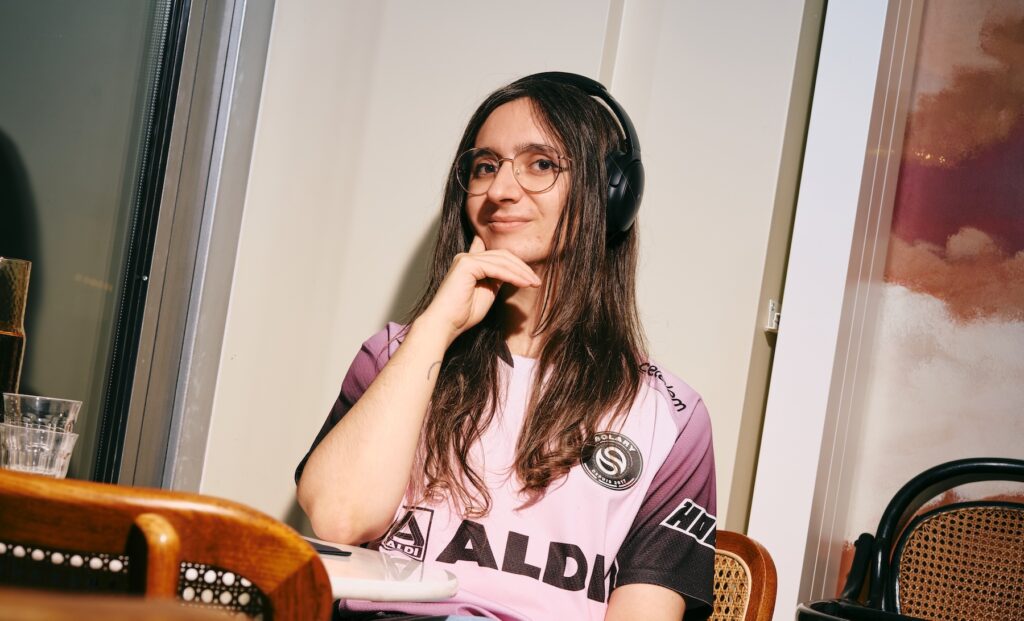
[Portrait to be found in the summer issue of the magazine, at your newsstand or by subscription.] As Esports World Cup 2026, the world championship of competitive video gaming, begins this week, meet one of the rare transgender women players on the circuit, Lilith, who has made a name for herself in League of Legends.
Photography: Guillaume Blot for têtu·
In a Paris tea room, Luna Benzerara-Arnoux arrives with a shy smile and nervous gestures. It’s hard to imagine that this quiet 28-year-old woman is already, under the pseudonym Lilith, a figure in French esports (or competitive video gaming). Her battleground is League of Legends (LoL), the behemoth of the genre, in which two teams of five players face off to destroy the opposing base. A competition still very underrepresented and where LGBT people, like Eika or Lilith, are rare.
Luna discovers the game in high school, at the moment of a breakup that makes her understand that she is gay. Very quickly, LoL becomes an escape, all the more after a trauma that leaves a lasting mark. “I was close to a boy openly gay, in a high school not far from mine. He suffered a lot of harassment”, she recalls. One evening, she sees an alarming message appear on her Facebook page. She writes to him immediately; he never replies. The next day, she learns of her friend’s suicide, a victim of homophobia. At 14, she makes a promise to herself: to commit to LGBT people. “It’s utopian, but I never wanted it to happen again“, she analyzes.
Lilith, Back from Her Hell
Her puberty arrives later, around 16, and with it questions about her gender identity. Her family tells her that “it will pass”. So, Luna buries her questions and hides in video games. But in 2019, everything changes. Having left for Paris for her studies, she sinks into a deep depression. She loses twelve kilos, hardly leaves the house, and experiences panic attacks. The situation worsens when her mother, with whom the ties were already broken, stops helping financially and withdraws the guarantee for her housing. Desperate, Luna swallows a box of pills. “At the moment I act, a friend writes to me to ask if I’m okay. I tell her what I’ve done. She found my address, called the firefighters and accompanied me to the emergency room.”
Hospitalized in psychiatry, she refuses to stay there. Then begin several months of wandering, between staying with relatives and periods on the street. It is during the first lockdown that she finally begins her transition, at 21 years old. It is also the year when she is spotted by the player Sanah, who invites her to join the semi-professional scene. “If I am still alive today, it’s thanks to video games”, she breathes. While her players are known for their toxicity, League of Legends has nonetheless been a “safe place” for Lilith. “When I play, I feel aligned with myself. I have met the most beautiful people of my life there.”
The First to Raise Her Voice
In the game as in life, Lilith has established herself as a leader. In League of Legends, she plays the position of midlaner, often considered the role that guides the team. For years, Lilith has also channeled this determination toward change. With the Riot Games studio and competition organizers, she has multiplied feedback on playing conditions, the visibility of inclusive scenes, and the support of teams. “I think I was the first to raise my voice”, she says with a smile. A reputation confirmed by several people in the scene. “She’s always ready to make her voice heard and defend her opinions”, notes Caelan, her former general manager at Solary, her most recent team. Her friend Yume, an esports commentator, speaks of “an embodiment of courage”.
During her integration into Solary in February 2025, a transphobic harassment campaign is conducted online against the player. “For several months, the attacks are continuous. […] No matter my behavior, they come again and again to insult me and undermine me”, she writes then on Elon Musk’s social network, in a plea for help published on Trans Visibility Day. While waiting to find a new team, Lilith tries to make a living from content creation on Twitch, YouTube and social networks. And she says above all that she has regained a sense of balance. “I am well surrounded. I am close to my father and my stepmother, my boyfriend supports me… I am learning to live with my traumas.” Then, she smiles. “I am ready to continue my battles.”
