
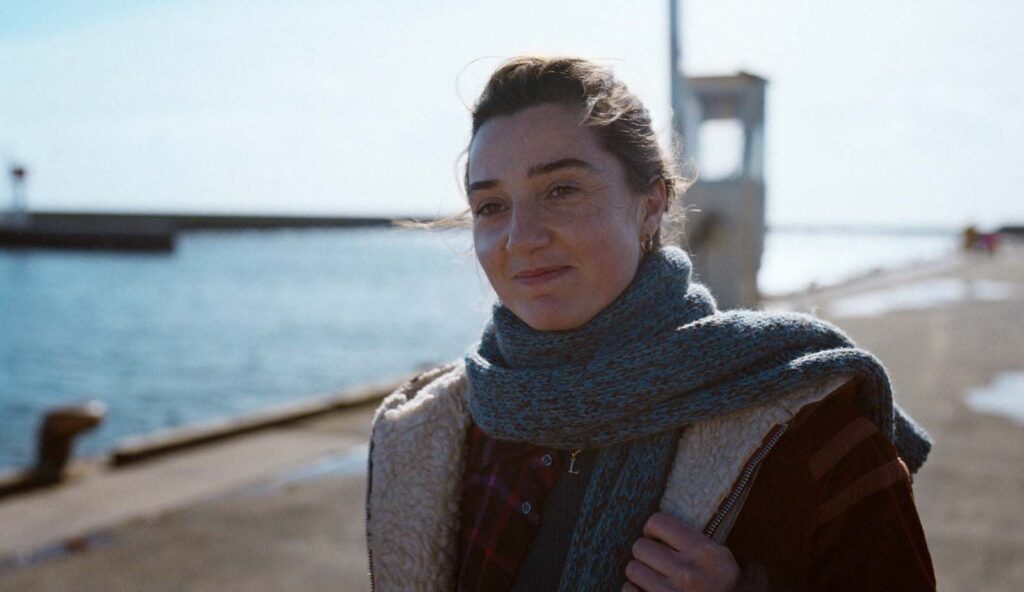
César-winning in 2025 for her role in The Story of Souleymane, Nina Meurisse is starring in Julian, a moving romantic drama released this week. The actress discusses her lesbian character in the film as well as the political dimension of cinema.
Nina Meurisse knows how to choose projects that matter, and she is finally reaping the rewards. Last year, the Normandy-born actress won the César for Best Supporting Actress for the multi-prized The Story of Souleymane, by Boris Lojkine, a director who had already helped her earn a nomination in 2020 in the César category of Most Promising Female for Camille, a biopic of Camille Lepage, the young photojournalist killed in 2014 in the Central African Republic. The actress has also worked in front of Céline Sciamma’s camera (Petite Maman, 2021), acted for Agnès Jaoui in cinema as well as on stage, and appeared in notable French series such as B.R.I. or Black Hearts. At 37, she is this week on the poster of Julian, Cato Kusters’ debut feature. In this romantic drama inspired by a true story, she plays Fleur, a woman in love who sets off with her wife on an original symbolic travel project: to unite in each of the 22 countries where same-sex marriage has been legalized.
What touched you in the screenplay of Julian?
Nina Meurisse : It’s the breadth of the love between the two characters. In cinema, we often tell the birth of a love, its construction, the obstacles to overcome… In the story of Julian, love is so strong that it is what keeps the characters upright in the major trials, and what makes life deeply alive. When I read this screenplay, I was working on the series Black Hearts, where I play a special forces soldier who fights Daesh in Iraq. So it did me good to discover this screenplay, especially since I haven’t often played love stories. And the fact that it is a true story reinforced this feeling.
Did you meet Fleur Priet, whose real-life story inspired the film?
Yes, Fleur was there from the very beginning of the project. She was very present throughout the shooting, both happy and nervous, because it isn’t the same thing to write your story and to see it on screen. She was extremely generous in how she shared her intimacy, in the details she gave us to help us understand her story. Her presence undoubtedly added a form of pressure not to disappoint her, but this pressure was beneficial.
How did you approach this lesbian role?
Not differently from any other role, although I was attentive to representation, to avoiding clichés in speech, gestures, or costumes. We spent a lot of thought on the sex scene, in particular. It was important for us to show two women facing each other, in an equal relationship, without domination. It isn’t a revolution, but it helps to deconstruct certain patterns. More generally, I pay attention to the representation of sexuality, including in heterosexual couples: avoiding automatism, also showing pleasure without necessarily reaching orgasm, missteps…
Were you sensitized to these issues in your upbringing?
I grew up in a left-wing, highly engaged family where taking part in demonstrations was part of daily life. It was a very humanist environment that sought to embrace all minorities. That helped shape my perspective. The LGBT issue might have been less central at the time, but I never made distinctions between people. On the contrary, I always looked to see how everyone expressed their freedom.
This lesbian story is universal, by the way…
I like the idea that fiction represents a world where some things are already acquired even if it isn’t yet totally true. I think showing stories where differences are no longer barriers can, gradually and gently, influence reality. For me, it’s a form of political engagement, more discreet but perhaps more effective than films that are more overtly activist.
Your previous film, The Story of Souleymane, which earned you your first César, was heavily politically charged. Do you choose your roles for their political dimension?
People often tag me with this label, and I would like to shake it off. I think I am instinctively sensitive to this political dimension, but it isn’t a will that dictates my choice of roles. Cinema is also about moving away from reality, creating poetry, offering imaginations. And even when a film isn’t meant to be activist, it always carries a form of message, if only through the emotion it provokes. I think cinema should not be dogmatic; its diversity is what makes it rich. And one should not oppose forms: popular films also help finance more engaged films. Culture must remain open, accessible.
