
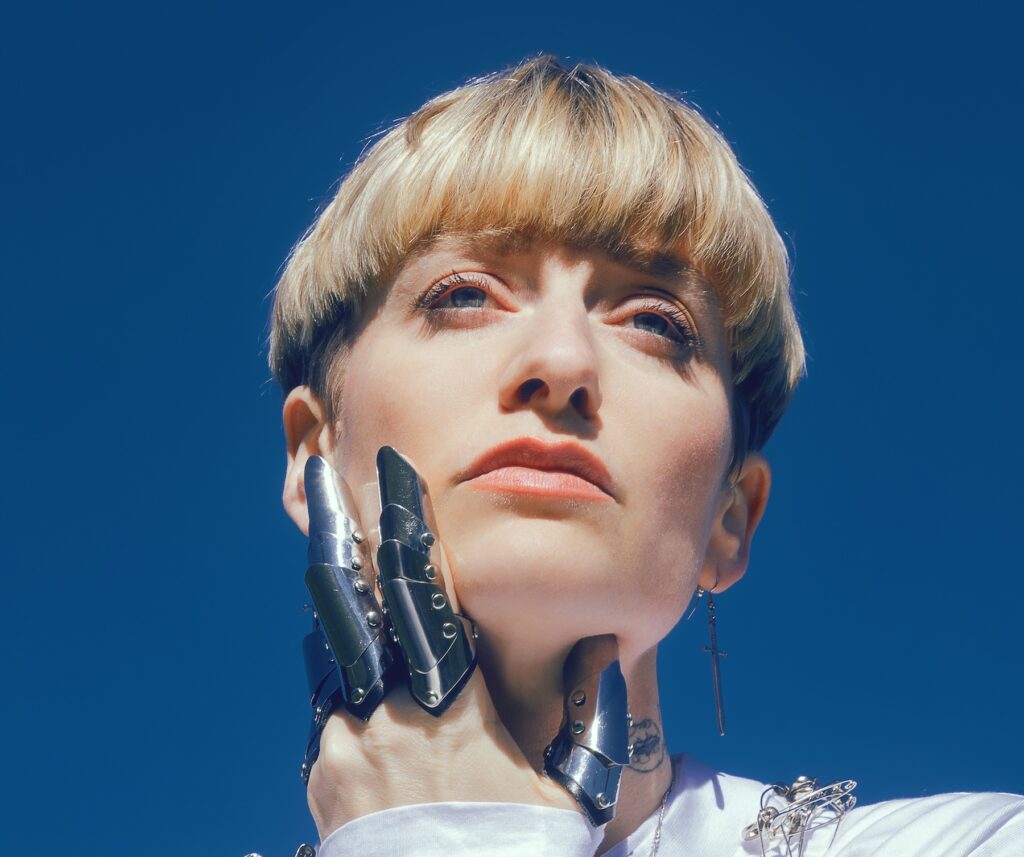
With her look of a modern Joan of Arc and lyrics that do not mince words about what she feels, Gervaise blends style with speech. The singer releases La Pudeur, her first album.
“I admit it, I don’t like being where I’m expected to be,” sings Gervaise. More a guiding principle than a pose. Behind the efficiency of her melodies, often calibrated to stay at the top, the young woman bears a refusal of the expected trajectories (relationship, children…) as well as of body norms and conventional social interactions. This tension between pop accessibility and rejection of frames is at the heart of her artistic project.
Raised by a mother who is an actress, the 35-year-old singer grew up on the stage. After studies in musicology in Dijon, Gervaise first sharpened her blunt speech by composing two EPs. In Humeur Vive (2018) and Chair Tendre (2023), she deploys incisive electro-pop to denounce patriarchal injunctions, especially those that govern women’s appearance. With “J’le féminin,” the opening track of the second, she embodies a free femininity, moving, liberated from the male gaze: “I do it in my own way, I do it even if it may displease you (…), never a fairy, more of a witch.”
Body-to-Body of a Woman
Is it a way to muster courage in the face of persistent insecurities? The relationship to the body runs through her songs as well as her podcast, also named Chair Tendre, where she questions it with the invited guests. This love-hate relationship with her own body goes back to childhood, she explains. And if we are to believe the line “Fuck my body,” the battle is far from over: “My femininity that exceeds, what do I do with it? (…) I fight, I battle with myself – does anyone know how one learns to love?”
Since her beginnings, Gervaise has moved along a tightrope between asserting power and exposing her fractures. Far from slowing her down, these fractures seem to push her to go further. Ten years ago, when she gave her first concerts, she also experimented with burlesque on stage. In Parisian cabarets, in contact with the queens and kings of the drag scene, she gradually deconstructed her view of femininity. “When I came out of my twenties, I had long hair, mini-skirts and ballet flats. The queer scene made me realize that I was fed up, that I wanted to break these codes of femininity. It was at that moment that I cut my hair”, she recalls.
From her childhood, Gervaise has kept a keen sense of staging and a taste for costume. On the poster for her first twelve-track album, La Pudeur, released this year, she sports a bob cut and a stylized armor, like a modern Joan of Arc, at once strong and fragile. “While writing, she emphasizes, I realized I had never opened up so much about my feelings and my flaws.”
Letting Go of Modesty
Her new challenge: moving from stripping to emotional unveiling. “I like portraying a badass woman, but this time I need something else”, she explains. In “Je suis née,” an excerpt from her album, she declares: “I don’t have more demons than others, I just have time to think about them.” Where do these inner monsters come from that nourish her work? Beyond her complexes, her lyrics hint at a deeper wound: her father’s alcoholism, which she briefly mentions in “Journal intime” or “Fame” – “When my father yelled at night, I sang in the dark, to better defend myself.”
She says little more. For now, lacking the right words to address him. In that place, modesty still resists, but perhaps not for long: “It will come. I am quite at peace with that, and I think it will touch many people.” When she asks herself in song: “In front of you, letting go of modesty, will I manage it?”, one wants to believe. After all, as she likes to remind, Gervaise means “ready for battle.”
