
[Article to be found in the summer issue, at your newsstand or by subscription.] In Amsterdam, the Homomonument has stood since 1987 in memory of gay victims of persecution. As World Pride unfolds in the Dutch capital, a look at this memorial that tells as much the history of past violence as our stubbornness not to disappear.
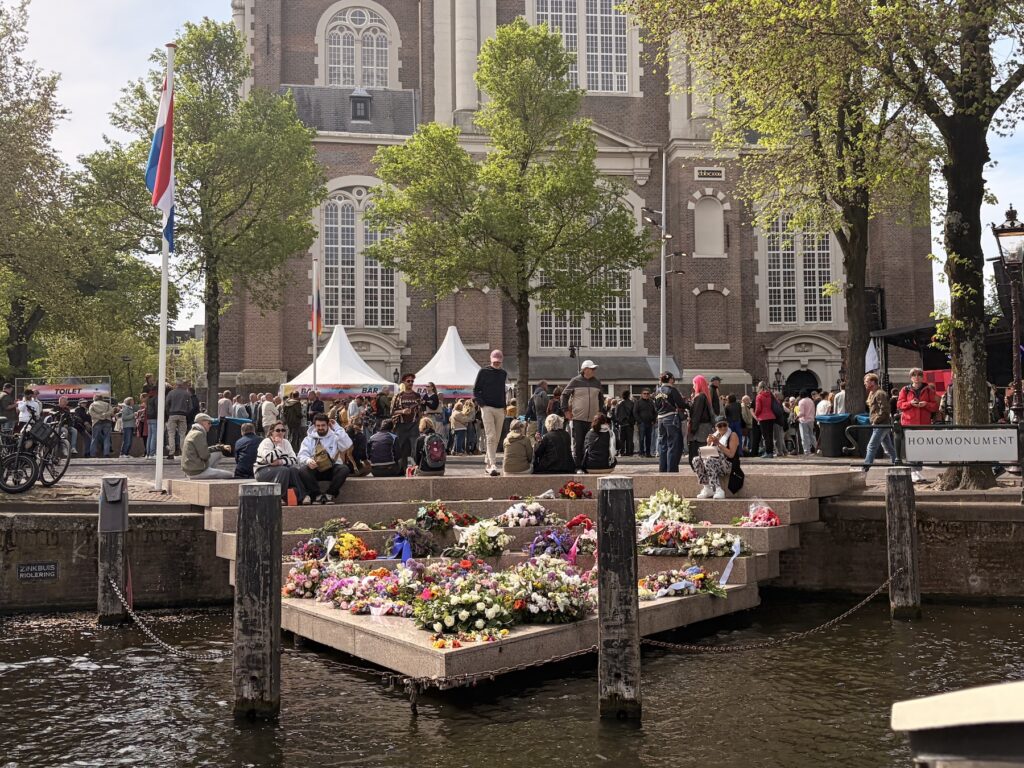
In Amsterdam harbor there are sailors who sing. And to the west of the port, squeezed between the bicycles along the Keizersgracht canal and the crowded terraces, there is the Homomonument. A memorial that does not immediately suggest a memorial. It is, however, the world’s first monument dedicated to homosexual victims of persecution. But here, there is no monumental statue raised toward the sky; one must look at the ground, in which three pink granite triangles are inlaid, forming themselves the three vertices of an equilateral triangle of 36 meters on each side. It is located in the heart of the historic Jordaan district, right next to the Westerkerk (“the Church of the West”), whose 85-meter spire dominates the capital of the Netherlands.
The Homomonument was inaugurated forty years ago, on September 5, 1987, but its history begins at the end of the 1970s. The Dutch activist Bob van Schijndel then imagined a public monument honoring the memory of gay and lesbian victims of the Nazi regime, while reminding that homophobic violence does not belong only to the past. The project triggered sharp political tensions. It would take eight years to come to fruition. The work was finally entrusted to Dutch architect Karin Daan, known for her work on public space and for thinking of the city as a place of circulation, of meeting, and of memory.
The pink triangle is the one that the Nazis sewed onto the uniforms of prisoners arrested for homosexuality and sent to concentration camps. The entire monument project hinges on this symbolic reversal: turning a sign of rejection into a rallying point.

Credits: Geert-Jan Edelenbosch
“Such an immeasurable longing for friendship”
Each of the three triangles making up the whole represents a different relationship to time. The one that sinks toward the canal, facing the Dam Square and the National Monument dedicated to the victims of World War II, embodies memory. Another faces the premises of the Cultural Recreation Center (COC), the world’s oldest LGBTQI+ organization. Emerging from the ground, it can be used as an open stage; it symbolizes the present and the collective struggle. The third, embedded in the ground, bears these words from the Jewish and homosexual poet Jacob Israël de Haan: “Naar vriendschap zulk een mateloos verlangen”, meaning “Such an immeasurable longing for friendship.” Turned toward the future, it represents the hope of a freer world.
The 4th of May each year, for Dodenherdenking, the National Remembrance Day, the atmosphere at the site changes. Amsterdam slows down, the flags are lowered to half-mast. For the 2026 edition, the ceremony gave a voice to Viktória Radványi, president of Budapest Pride, who spoke about the rollback of LGBT rights in Hungary and the threats facing queer communities in Europe. Around 8 p.m., silence falls over the city. Around the monument, political representatives, associations, residents and tourists observe two minutes of contemplation, only disturbed by the splashing of the canal and the rustling of bouquets laid along the canal’s edge.
The following day, May 5, solemnity gave way to a huge outdoor party, to celebrate Liberation Day. The square then vibrates to the rhythm of basslines, sparkling with glitter and lukewarm beer. The Liberation Day evening, organized by Sweetie Darling and Superball, attracts hundreds of people. Behind the turntables, Darling Peter, Lady Deep or PRISZ spin house and club sets while MC Tjo-kwan fires up the crowd in a ballroom atmosphere. Further on, RuPaul’s Drag Race star Kerri Colby crosses paths with more underground artists like Roseè-Sheneè Plastique or Stache. The party stretches late into the night, drag queens traverse the Westermarkt perched on their high heels and bodies press together before the monument to celebrate, together, memory, visibility, and queer joy.
