
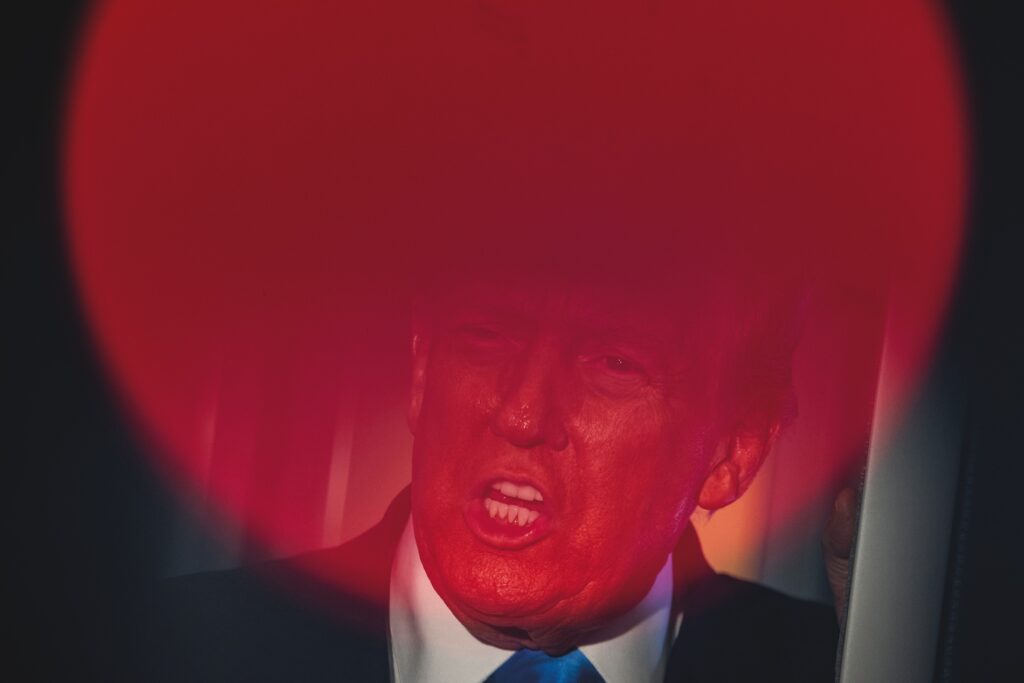
[Interview to read in the winter issue of têtu magazine, available at newsstands or by subscription.] Director of Information at France Inter, Philippe Corbé was RTL’s New York correspondent throughout the entire first Trump presidency. The journalist publishes a new book, Weapons of Mass Distraction, in bookstores on January 7, which he conceived as a discourse of the Trump method.
“Impose the story you want to tell before the facts prove you wrong, never apologize, always attack.” The advice that the young Donald Trump had received from his mentor, the flamboyantly infamous lawyer Roy Cohn, resonates strongly today, forty years later. Journalist Philippe Corbé, who was RTL’s correspondent in New York for the entire first Trump presidency, had already told, in 2020, in a biography, Roy Cohn, the Devil’s Advocate, how this closet homosexual, who died of AIDS in 1986, had become the Pygmalion of the future U.S. president.
Since the return to power of an even more Trumpist Donald Trump than the first version, Philippe Corbé has already had the opportunity to publish a selection of texts in Women Against Trumpism (Grasset) as well as an essay written with Thomas Snégaroff titled The New Oligarchs. How American Billionaires Impose Their Vision on the World (Les Arènes). On January 7, he publishes Weapons of Mass Distraction from Grasset, a new essay in which he analyzes the first year in the White House of the 47th president of the United States, this time through the prism of the power of entertainment that the billionaire uses and abuses, about whom he has understood better than anyone the electoral potential in our showbiz societies.
- What global view do you have of the first year of Donald Trump’s second term?
This year has been marked in the United States by a continuous struggle between an authoritarian drift and the defense of the institutions of American democracy. The first term of Donald Trump had been protected by the “adults in the room” at the White House, who managed to mitigate the president’s devastating decisions. For example, during the riots following George Floyd’s death, when the presidency had demanded that the army be deployed, the Secretary of Defense refused. Since the beginning of the second term, in January last year, this is no longer the case: the strategy is to push constitutional boundaries and flood the courts by multiplying decrees evidently illegal.
- Do we, in your view, witness the beginning of an authoritarian presidency, perhaps dictatorial or even fascist, as some say?
I am wary of these terms, because Donald Trump does not exercise a state of emergency. He was elected legally, and, above all, many of the lawsuits filed against his decrees succeed, which limits him in his action. Yet he stages an authoritarian power driven by an illiberal ideology. Trump is, in short, a Viktor Orbán on steroids. The two moments of truth will be the midterm elections, in April 2026, then, above all, the 2028 presidential election, in anticipation of which Trump already positions himself as a candidate, although constitutionally he cannot seek a third term.
- How can one explain that a country so attached to freedom and democracy has landed in such a situation?
If Donald Trump has returned to power, it is because he knows better than anyone how to capture and divert our attention. With him, it’s constant show, as when he summons all the admirals of the armed forces to berate them about their girth, and with moments of astonishment when, for example, he says he wants to annex Canada to the United States. By focusing on the spectacle, we lose sight of the real issues that lie within his institutional confrontation with democracy.
- Does the recent Supreme Court decision not to challenge the right to same-sex marriage mark a limit to Donald Trump’s power?
Even if the Supreme Court shows independence, it is not straightforward. And Donald Trump did not really campaign against same-sex marriage. It is rather a sign that the Republicans are divided and, for the moment, more favorable to marriage between people of the same sex. It should be remembered that if in France the argument that prevailed in opening marriage to same-sex couples was equality of rights, in the United States it was more the freedom to form a family, an argument compatible with conservative ideology. However, as with all rights now, one cannot claim that this right is a permanent attainment.
- The Democratic Party has recently won several electoral victories: in New York, Virginia, New Jersey, and California. Is this a sign of the Trumpist fatigue?
What is striking is the scale of defeats for Trump’s side. This is the through line of all these victorious Democratic candidacies, which represent the different factions of progressivism. The Democrats mobilized on an anti-Trump message as well as on the cost of living, a very unifying argument. But Zohran Mamdani’s emphatic victory in the New York City mayoral race says more about the city’s cosmopolitan identity than it does about national lessons. There were more stakes in the California gubernatorial election, Gavin Newsom, who now appears as a potential Democratic candidate for the White House.
- The United States, where political polarization seems extreme, are they at risk of a deep division?
In Donald Trump’s view, American society has, in a sense, entered into a cold civil war. Indeed, two Americas stand facing each other, no longer speaking to one another, listening to one another, or finding common ground. This is a conflict that has existed since the 1960s, but where previous presidents sought to unite, the current one deliberately widens the gap: the battle is cultural, and Donald Trump governs through this prism.
- Did the murder of the far-right influencer Charlie Kirk mark a tipping point in this battle?
What struck me is that he instantly became a martyr, a conservative Martin Luther King. Charlie Kirk represented a post-MeToo youth who feels a crisis of masculinity, a electorate that was particularly important for Donald Trump.
- Kamala Harris’s defeat marks— as some have argued—the weakness of woke ideology in the face of the lure of reactionary lobbying?
It isn’t so much an ideological defeat as a defeat of a method. Kamala Harris was mostly vague, with a desire to distance herself from her image as California’s attorney general, in a country where Black and Latino people are overrepresented in prisons, while not appearing only as the candidate of minorities. The Republican Party, for its part, sought to mobilize the male electorate, even masculinist, using, for example, transphobic arguments. In the final days of the campaign, Donald Trump’s team spent millions on advertising with this cruel slogan: “Kamala is for iel, Donald Trump is for you.” Again, an effective smoke screen from Donald Trump while Kamala Harris struggled to mobilize on defending American institutions.
