
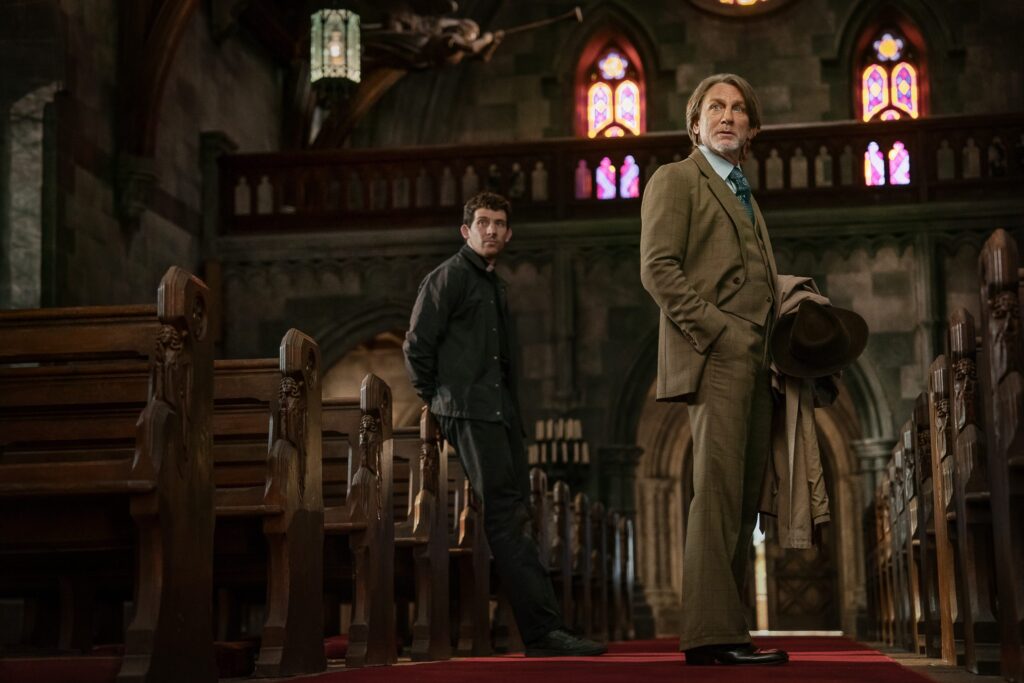
With Wake Up Dead Man: A Knife-Edge Tale, available for streaming on Netflix, the director Rian Johnson signs a sparkling investigative film with Daniel Craig, as dazzling and funny as ever in the role of a gay detective.
Wake Up Dead Man reminds us of a simple truth: Daniel Craig doesn’t need to be named Bond to turn the suit into a weapon of massive seduction. In Benoit Blanc, a dandy detective in immaculate form, he plays with the codes of masculinity as if they were an accessory—grandiose gestures, assumed theatricality, permanent irony—to lead what is surely his most peculiar investigation.
In this third installment of the Knives Out saga, available on Netflix, the investigator is summoned to a small church in a village in New York State after a murder that seems utterly impossible. Monsignor Jefferson Wicks, portrayed by Josh Brolin, a charismatic preacher and quasi demiurge, has been found stabbed in a sealed church closet, moments after leaving the scene of a sermon delivered before the eyes of the entire congregation. A classic closed-room crime pattern that Agatha Christie would not have disavowed.
An enticing cast
At the heart of this mystery, Blanc meets Reverend Jud Duplenticy (played by Josh O’Connor), a magnetic and idealistic young priest, quickly named the main suspect. Around him revolves a gallery of characters whose pious façades poorly conceal their flaws: parishioners too smooth, local elites, a doctor, a lawyer, a paranoid writer… In this village where everyone watches everyone, faith is alternately an armor and a weapon.
We savor the casting as a sly pleasure. Andrew Scott, who entered the collective imagination with his sexy and ravaging priest role in Fleabag, here plays Lee Ross, an eccentric, paranoid, best-selling author and devout believer in a system that overwhelms him. A delicious wink when one recalls the erotic and subversive charge of his previous God-fearing man. Josh O’Connor, for his part, imposes a benevolent priest, somewhat argumentative, who gives the film a troubled, almost feverish intensity. Facing them, Daniel Craig, the former heterosexual fantasy par excellence, reinvented as a southern detective with an unmistakable dandyism, embodies a clearly gay Benoit Blanc—we’ve known his homosexuality since Glass Onion, the second film in the trilogy. A scene indeed presented our hero in full lockdown, living peacefully with his partner, played by Hugh Grant.
Far from a mere detail, the detective’s sexuality colors his way of looking at others, sniffing out moral pretense, welcoming ambiguity without trembling, and not giving in to the temptation of easy judgment. Wake Up Dead Man is, indeed, less an investigation into a murder than an autopsy of faith. Two ideological visions clash. On one side, that of Monsignor Jefferson Wicks with his sermons of guilt and punitive morality. On the other, that of Jud Duplenticy, defender of forgiveness, solidarity, and understanding of the other. The director Rian Johnson does not judge; he observes how some distort beliefs to preserve their privileges, reminding us that the fear of Judgment Day is an excellent engine of domination. Because Wake Up Dead Man not only seeks to make us guess who did the deed, but to probe what drives us collectively to believe what we believe. Who lays truth on the altar? Who manipulates it? And at what price? Rian Johnson delivers a deeply humanist film, a meditation on faith, shame, redemption, and the possibility of a less corrupted future.
