
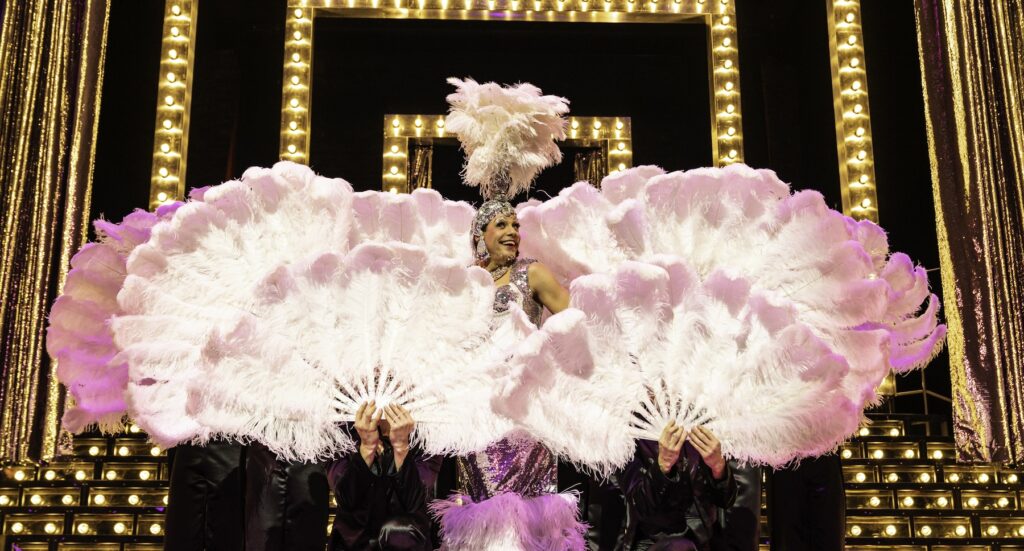
This winter at the Théâtre du Châtelet in Paris, director Olivier Py and actor Laurent Lafitte reveal their French version of Broadway’s gay classic: La Cage aux Folles, a socially conscious and festive musical comedy.
Almost fifteen minutes of standing ovation. The audience at the premiere of La Cage aux Folles, at the Théâtre du Châtelet in Paris, was not mistaken: this 2025 version is a triumph, and a show ideal to watch with family and friends during the holiday season.
If in France we mainly have in mind images — and often a mixed memory — of the play, later adapted to cinema by Jean Poiret with Michel Serrault, it is the Broadway musical version, less known here, that director Olivier Py has seized, running until January 10, 2026 in the Paris theater he runs. A version that is more musical, more anchored in the cabaret milieu, but also more sensitive and engaged, far from the clichés that the original version was widely criticized for.
“I Am What I Am”
And for good reason: when the American composer Jerry Herman, who found success in the late 1960s with Hello Dolly, discovers the Edouard Molinaro film adaptation from the 1978 play, he sees a hybrid object, at once bold and full of stereotypes. Planning to make it a more political musical, he asks the actor, screenwriter and playwright Harvey Fierstein — whom we will later see in Torch Song Trilogy — to write the book. At first doubtful, Fierstein eventually agrees and the two early gay militants mount a musical that will go around the world, deploying a message eminently modern and engaged about queer identities as well as about gay parenting. The show’s main song, “I Am What I Am,” is even taken up by Gloria Gaynor to become an undeniable anthem of queer pride.

“I have the right to be myself”, proclaims in French Laurent Lafitte, who in Olivier Py’s staging reprises the famous role of Albin, aka Zaza Napoli, a drag artist in the Saint-Tropez cabaret named “La Cage au Folles.” His partner, Georges, is played by singer Damien Bigourdan. While the two lead a life of love, feathers and sequins, Georges’s son, whom Albin raised, returns home with the plan to marry the daughter of a conservative politician. That is where everything goes off the rails: Albin is judged too exuberant, too effeminate, too “crazy” to have the union accepted by the in-laws. As he must learn to perform masculinity, as in the now-memorable toast scene, tensions in the couple appear.

“I have the right to be myself,” proclaims in French Laurent Lafitte, who in Olivier Py’s staging reprises the famous role of Albin, aka Zaza Napoli, a drag artist in the Saint-Tropez cabaret named “La Cage au Folles.” His partner, Georges, is played by the singer Damien Bigourdan. While the two lead a life of love, feathers and sequins, Georges’s son, whom Albin raised, returns home with the plan to marry the daughter of a conservative politician. That’s when everything goes off the rails: Albin is judged too exuberant, too effeminate, too “crazy” to have the union accepted by the in-laws. As he must learn to perform masculinity, as in the now-memorable toast scene, tensions in the couple appear.
Après The Imaginary Molière, the reunions of Olivier Py and Laurent Lafitte thus take place under the banner of exploring gender norms but also under that of cabaret. The principal frame of the show, the genre is dear to the director, also known for his character Miss Knife, his female on-stage double. And, if he makes no concessions on the grandeur of the show — a magnificent troupe for dance and singing, more than 155 costumes, 39 set changes and kilos of glitter — he does not forget his engaged and subversive nature. Updating the message of the American musical, the show speaks of equal rights, of homoparentality and of unconditional love that transcends gender norms, multiplying jabs at narrow-minded critics of all stripes while not omitting nods to the pioneers of our struggles. The quality of the translations and orchestrations, the enthusiasm of the “cagelles” and Laurent Lafitte’s incendiary smile are as much arguments to applaud the show as blows to those who would like to smother our pride. We laugh, we cry, and we applaud a unifying show.
