
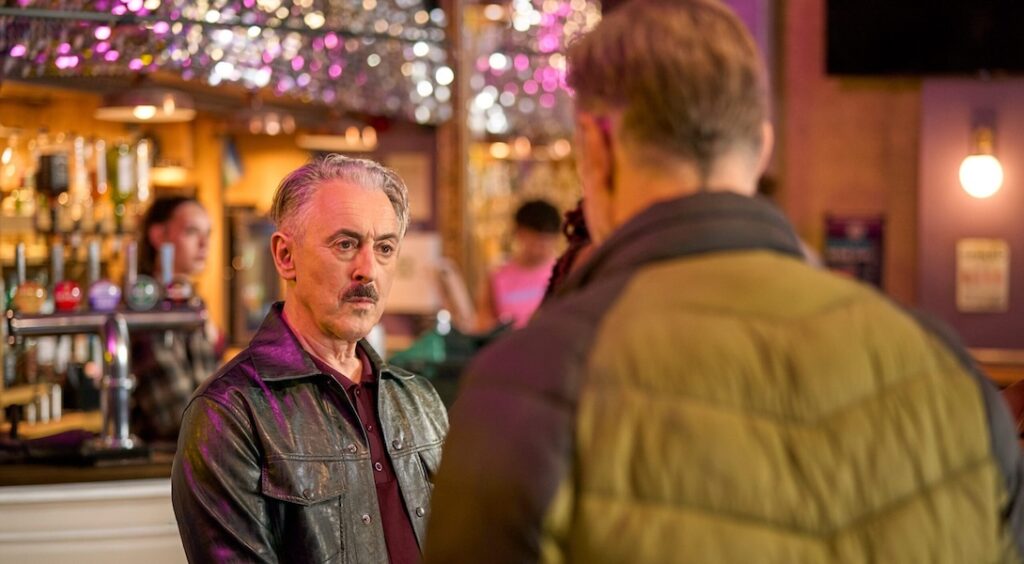
British screenwriter and pioneer of queer stories on screen, Russell T Davies delivers a more anxious-than-ever look at the resurgence of anti-LGBT hate in Tip Toe, his new miniseries released this week in France on HBO Max.
“Will we ever end hatred and insults?”, asked Hoshi in “Amour censure” in 2020. With Tip Toe, his new miniseries to be streamed on HBO Max, Russell T Davies provides a response as clear as it is chilling: not for quite some time. The creator of Queer as Folk, Years and Years, and It’s a Sin signs the darkest project of his career, a thriller that dissects the contemporary production of homophobia.
The first episode opens on a crime scene. Leo, a sixty-something owner of a gay bar in Manchester, England, is found hanged from a lamppost. How did we get there? In five episodes, Tip Toe rewinds the days leading up to the tragedy and reconstructs, piece by piece, the gear that transforms neighborhood tensions into tragedy. “I wanted to talk about the terrible things that happen in our society: the rise of homophobia, anti-Semitism, misogyny… The thriller is a Trojan horse to address these subjects”, explains Russell T Davies to têtu·.
The Gangrene of Homophobia
Face to face, Alan Cumming (X-Men) and David Morrissey (The Walking Dead) embody two visions of the world. Leo is a militant gay man, HIV-positive, a loudmouth. His neighbor Clive is a solitary electrician whose daily life gradually reduces to a marriage that is fraying, conspiracy videos, masculinist influencers and furious TikToks scrolling on his phone. Between them, a seemingly trivial incident is enough to tip a previously peaceful cohabitation into crisis…
Around this duel revolves a whole gallery of characters that paints the portrait of a fractured society: a waitress in the midst of a gender transition, a teenager discovering his homosexuality, an aging drag queen, a wife trapped in a loveless marriage, or a football team soaked in toxic masculinity. Russell T Davies returns to his talent for making characters immediately endearing, before dragging them into a machinery whose outcome the viewer already knows.
But Tip Toe not only tells the rise of hate. It also shows how it circulates. Private messages, FaceTime, dating apps, OnlyFans, social networks: screens irrigate the narrative as much as they feed the frustrations of its characters. “A text message goes wrong, a DM, a voice message, a FaceTime call… it all accumulates”, summarized the Welsh screenwriter in the spring at the Series Mania festival in Lille. Homophobia never appears there as a sudden flash but as a progressive contamination, nourished by algorithms, reactionary discourses and daily frustrations.
“The Darkest Story” by Davies
If Russell T Davies returns to his favored themes, namely queer identity, the memory of AIDS, or the critique of conservatism, he here radically changes register. The author, who had accustomed us to the chronique (Queer as Folk, It’s a Sin) or to anticipation (Years and Years), claims “The Darkest Story” as the darkest he has ever written.
This darkness finds an echo in reality. In five years, homophobic offenses recorded in the United Kingdom rose by about 20%, while transphobic crimes jumped by nearly 50%, according to Stonewall. Data that feed the writer’s pessimism. “I will always have hope in human beings, he wants to believe. But today, pessimism overtakes me. When one sees that the United States is governed by a mad despot, capable of detonating an atomic bomb at any moment, I tell myself that we are living through terrible times…”
The premise of the series is ultimately summarized by its title, which means “to walk on tiptoe.” It is thus that one of its characters, Melba, illustrates her state of mind in the face of the renewed violence against LGBT people: “Before, when I entered a room, I would shout ‘ta-daaa’, now I walk on tiptoes, you never know…” The entire project of Tip Toe hinges on this image: to tell of a time when some LGBT+ people began to keep a low profile again, out of fear of hatred. A work of fiction that unsettles precisely because it resembles less and less a dystopia.
