
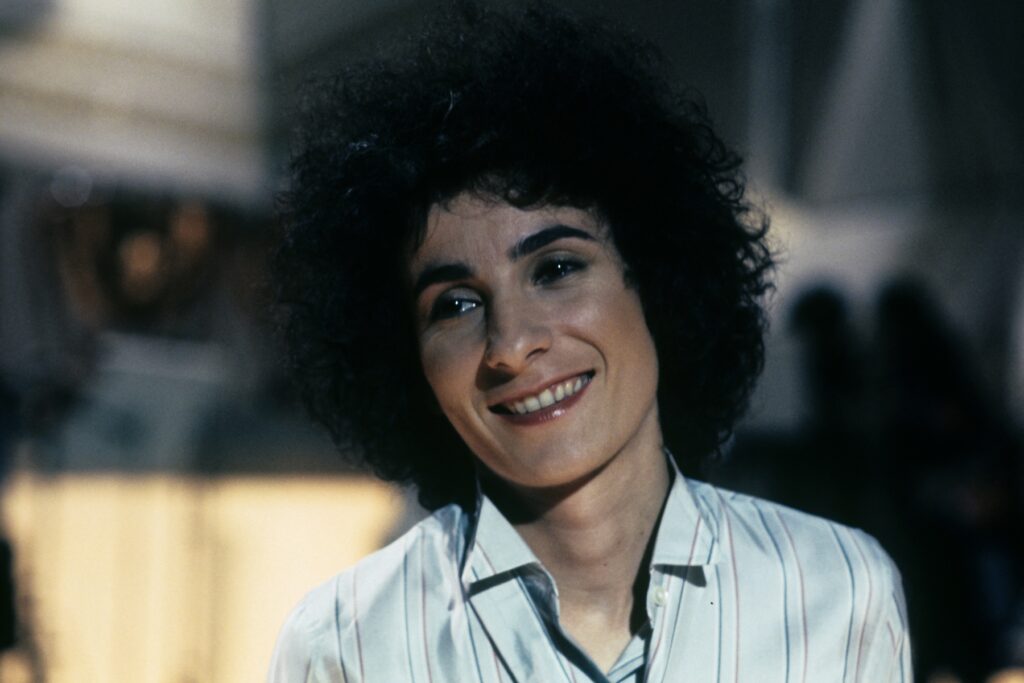
The singer and pianist Marie-Paule Belle died this Saturday, July 25, at the age of 80, after a battle with cancer. A look back at the discreet destiny of a woman free and transparent about her loves.
She wanted to “make people aware with words”. The singer, composer and pianist Marie-Paule Belle died of cancer this Saturday, July 25, at the age of 80, her press officer announced to the Agence France-Presse (AFP). Interpreter of “La Parisienne” (1976), she left a mark on French chanson with engaged lyrics, in which she notably addressed homosexuality and her lesbian relationship.
Born in 1946 in Pont-Sainte-Maxence, in the Oise, Marie-Paule Belle grew up in Nice. Her mother, a thwarted musician, put her at the piano from the age of three. A revelation of the instrument of her life: “The piano, it’s my breath”, she declared a few months before her death. After a master’s degree in psychology, she settled in Paris. In parallel with her studies, she followed in the footsteps of the singer Barbara and performed alongside her studies in the cabarets of the Left Bank in Paris, L’Échelle de Jacob and L’Écluse. In 1969, she won the Chapeau de Radio Monte-Carlo contest, which earned her the recording of a first 45 rpm single with CBS. In 1975, Serge Lama took her on tour before a first consecration in 1976 with her hit “La Parisienne”.
“Not militant at heart”
Marie-Paule Belle never sought to turn her life into a manifesto. “Not militant at heart”, the feminist singer writes in 2011, on the album Belle et rebelle, “Celles qui aiment elles,” co-written with Dominique Valls. The song was born, she explained, from an imaginary 1950s photo showing “two women holding hands”, a modest starting point for a text about lesbian love. If she never truly came out, she has always been transparent about her sexual orientation: “I never hid it, but I never made a banner out of it”, she said. Between 1970 and 1981, she shared her life with the Belgian novelist Françoise Mallet-Joris, winner of the Femina prize in 1958 for The Celestial Empire, who also became her lyricist. It is to her that we owe part of the words of “La Parisienne”. “Our friendship, which had become amorous, suddenly transformed into passion”, wrote Marie-Paule Belle several years later.
Making her songs a means of carrying messages, she co-wrote “Assez” in 2011 on violence against women, explaining that she had always supported feminist movements. In the same vein, she also took a stand for the right to die with “Un pas de plus,” released in 2004. “It’s a sister I am losing […] My heart is sad, but she joins Françoise Mallet-Joris, the great writer. They surely have a lot to say to each other,” Serge Lama saluted upon the announcement of the singer’s death.
