
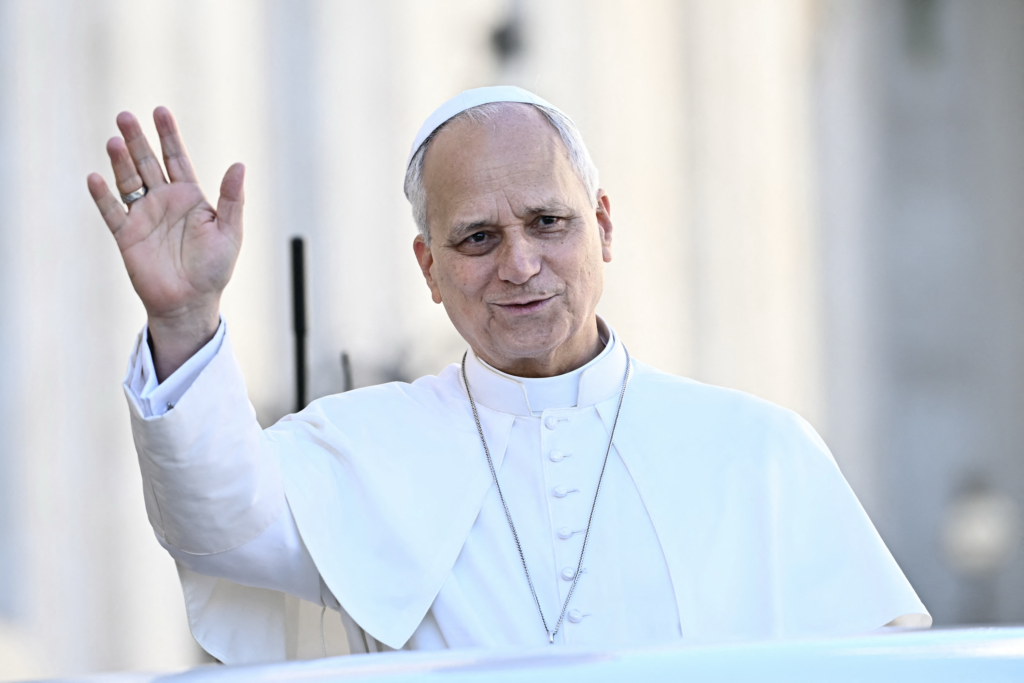
Pope Leo XIV is in France for four days, from Friday, September 25 to Monday, September 28. As his pontificate begins to take shape, LGBT Catholics scrutinize the first signals sent by the successor of Francis: maintaining pastoral openness, evolution of doctrine, recognition of transgender people… So many topics on which expectations remain strong.
For his first visit to France, the American pope must pass through Paris, Lourdes and Metz. On the program: religious celebrations, meetings with the faithful, but also several segments devoted to peace and interreligious dialogue. A predominantly pastoral journey, which should not be an occasion for major doctrinal announcements. But for LGBT Catholics, his arrival comes at a particular moment: a little over a year after his election, Leo XIV’s line on LGBT questions is beginning to take shape.
“There are very nice messages that have been carried since his election, notably on peace or ecology, but there have still not been major announcements concerning LGBT people“, notes Claire, a 36-year-old lesbian, member of D&J Arc-en-Ciel, an association working for better integration of LGBT people within the Church. She does not plan to attend the celebrations organized during the visit.
After Francis, what continuity?
For Claire, Francis’s pontificate had opened a breach. “He was a showman, a real reformer”, she recalls. As early as 2013, the Argentine pope had made an impression with his formula: “If a person is gay and seeks the Lord with goodwill, who am I to judge?” Ten years later, in front of about 500,000 young people gathered in Lisbon, he insisted: “There is a place for everyone in the Church, no one is superfluous.”
This openness also translated into several decisions. In November 2023, the Vatican specified that a transgender person could receive baptism under the same conditions as other faithful, including after hormonal treatment or surgery, provided there is no “risk of public scandal or disorientation among the faithful”. A few weeks later, on December 18, Francis approved Fiducia supplicans, which allows priests to bless spontaneously and non-liturgically same-sex couples, without equating this blessing with marriage. “I have always wanted our LGBT experiences and our faith to nourish one another”, explains Claire. Since the election of Leo XIV, she has been waiting to know how far this dynamic will continue.
Théo Moy, a journalist at the Cri média, a progressive Catholic magazine, sees in Leo XIV “a pope of social Christianity”, attached to a Church open to all. But he cautions against expecting immediate advances on LGBT issues from his visit to France: “This visit is pastoral.” It should therefore be more about dialogue and gathering than about changes on questions that continue to divide the Church.
A will to openness, without doctrinal change
Since his election, Leo XIV has spoken little directly about LGBT questions. On September 1, 2025, however, he received at the Vatican the American Jesuit James Martin, known for his work with LGBT Catholics. At the end of their meeting, he described a “warm, welcoming, friendly and relaxed” exchange and said that the pope intended to continue Francis’s openness toward LGBTQ people. The blessings of same-sex couples, however, had not been discussed.
A few months later, during the “Jubilee of the Poor,” about fifty trans women participated in the lunch organized at the Vatican with people in precarious situations. Unlike in previous years, none were seated at the pope’s table. Cardinal Konrad Krajewski, organizer of the meal, invoked a random drawing for seats and assured that there had been “no exclusion.”
But on doctrinal ground, Leo XIV has been much clearer. In a book of interviews published in 2025, he judged “very unlikely, at least in the near future” an evolution of the Church’s teaching on sexuality and marriage. This is precisely where Claire’s expectations focus. The Catechism still describes homosexual acts as “intrinsically disordered”, a formulation she would like to see disappear. “We need to evolve on this issue”, she insists. She also hopes “that the blessings of couples become doctrinally recognized, and that we move away from case-by-case”.
Alix, 33, also a member of D&J Arc-en-Ciel, is waiting for a better recognition of transgender people within the institution. “They must be recognized by the Church, because otherwise it can have concrete consequences, such as the refusal of baptism or confirmation for these people“, she says.
She does not envisage a near recognition of same-sex marriage either. “As a bisexual, even if I marry a man, I won’t do it in the Church. For now, they do not recognize the same value to LGBT people as to heterosexual people. So it is not possible.”
The fear of political co-optation
Expectations concern not only doctrine. For Bertrand, gay and father of a little boy born from a co-parenting arrangement, the pope’s visit should also be a moment of communion. “The main issue is that we must avoid political co-optation”, says this theology PhD candidate. He fears that a faction of identitarian Catholics will take advantage of the event to push their own reactionary themes. A concern shared by Théo Moy, who notes, in his view, “a strong entrenchment of the identitarian far right within the Church”. He nevertheless stresses the need to distinguish this tendency from traditional Catholic conservatism.
In this context, he mainly expects from the pope a word capable of transcending political and religious fractures, notably during the interreligious meeting scheduled in Metz. “The symbol is very strong. This meeting between Muslims, Jews and Christians is not ordinary; it can help calm,” he argues.
This worry is also accompanied by particular attention to internal resistances within the Church. Several priests or episcopal conferences have contested or refused to apply certain provisions introduced under Francis, notably the blessings provided by Fiducia supplicans. In several African countries, such as Ghana or Uganda, Christian churches also play a role in debates around laws criminalizing homosexual relations, with positions varying by country and religious authorities.
Alix also senses a return to more conservative practices in some parishes. “When I go to church, I see that women are again relegated to the second rank, they are completely subordinated, even their place around the altar”, says the Auxerre resident. Yet she continues to believe that change can come from the faithful themselves. “It’s because there will be more and more LGBT people baptized that the Vatican will evolve”, she hopes.
During Leo XIV’s visit, she will therefore attend a Mass with another ambition: “My coming, beyond appreciating this kind of event, is also a way to make visible the association and LGBT people, to show that we exist.” A presence that echoes, a few days before Paris’s Pride march, the same demand: to be visible within an institution of which LGBT people remain members, even when its doctrine continues to keep them at a distance.
